
1. How Does HUD Deliver a Clear Image to the Driver?
While driving, information such as vehicle speed, navigation instructions, and warnings can appear directly within the driver’s field of view. This is the most intuitive value of a HUD (Head-Up Display): the driver does not need to look down at the instrument cluster, allowing visual attention to remain focused on the road.
However, delivering an image directly into the driver’s field of view is far more complex than simply applying a coating to the windshield. Light emitted by the projection unit must pass through multiple optical components, such as folding mirrors and freeform mirrors, which redirect and shape the optical path before the light is ultimately reflected by the windshield into the driver’s eyes.

Whether this optical path can deliver a clear and bright image is closely related to the optical design, mirror surface accuracy, and reflectance of the optical components. Insufficient reflectance causes continuous optical losses along the light path, ultimately reducing display brightness and visibility, particularly under strong ambient-light conditions.
High reflectance is achieved by depositing optical reflective coatings on the surfaces of the mirrors inside the HUD system.
2. A Reflective Coating Is More Than Simply “Depositing a Layer of Aluminum”
When it comes to coating a mirror surface, many people may initially think that depositing a single aluminum layer is sufficient. However, the reflective coatings used on internal HUD mirrors are generally more sophisticated. They typically employ a multilayer structure combining an aluminum layer with dielectric layers. The aluminum layer provides high visible-light reflectance, while the dielectric layers protect the metallic layer and can further enhance reflectance within the target wavelength range.
For internal HUD mirrors, visible-light reflectance is generally designed to exceed 90%, while certain enhanced high-reflectance coating systems can achieve more than 95%. The actual target value depends on the wavelength range of the light source, angle of incidence, and overall optical design of the HUD system. There is therefore no single reflectance specification applicable to every HUD product.
Achieving high reflectance requires the coordinated optimization of coating materials, multilayer architecture, and deposition parameters. Substrate cleanliness, continuity of the aluminum layer, density of the dielectric layers, and the thickness of each individual layer can all influence the final optical performance.
Achieving a high reflectance value at a single measurement point on one sample is not the most difficult part. The real challenge is maintaining stable reflective performance across the entire design wavelength range, at different angles of incidence, and over the complete effective area of the workpiece, while ensuring that the performance remains compliant after environmental testing and throughout high-volume production.
This means that meeting the reflectance target is only the entry-level requirement for HUD optical coating. Once the coating enters automotive applications and mass production, film-thickness control, coating uniformity, adhesion, environmental stability, and batch-to-batch consistency become equally critical.
3. Reliability in Mass Production: From Film-Thickness Control to Batch Consistency
Achieving the required reflectance is only the foundation of HUD optical coating. Once applied in automotive environments, the coating must maintain uniformity across the entire effective area, remain firmly bonded to the substrate, withstand changes in the in-vehicle environment, and deliver stable optical performance during continuous production.
Film-Thickness Control and Uniformity
HUD high-reflectance coatings are typically composed of multiple material layers, each with a precisely designed thickness. Even relatively small deviations in individual layer thickness can cause changes in reflectance, spectral characteristics, or perceived color. Therefore, the deposition rate and thickness of each layer must be precisely controlled.
At the same time, HUD mirrors may be planar, curved, or freeform surfaces. Differences in the distance and orientation between different regions of the workpiece and the deposition source can easily result in non-uniform film thickness. A single-point measurement that meets specification does not necessarily indicate that the entire surface is qualified. Only when the coating distribution remains uniform across the effective optical area can localized differences in reflectance performance be minimized.

Adhesion and Environmental Stability
The long-term adhesion of a coating to the substrate is closely related to substrate cleanliness, surface pretreatment, and film density. Insufficient cleaning or pretreatment may reduce adhesion strength and eventually lead to cracking, peeling, or delamination. If the coating is insufficiently dense or inadequately protected, problems such as haze and oxidation may occur.
Ion-assisted cleaning and surface activation, combined with ion assistance during deposition, can help improve film density and interfacial adhesion.

HUD optical components are exposed to sunlight, heat generated by light sources, and changes in temperature and humidity during service. After specified environmental tests, including high-temperature, low-temperature, and damp-heat testing, the coating must remain firmly bonded, maintain its optical properties, and remain free from visible defects. These factors are important indicators of long-term coating reliability.
Batch-to-Batch Consistency
Ultimately, all of these performance requirements must be translated into stable mass production. Producing a qualified sample can often be achieved through repeated process adjustment, but during continuous production, variations in vacuum level, target condition, sputtering power, gas flow, and workpiece positioning can all introduce batch-to-batch deviations.
Therefore, during mass production, critical process parameters need to be incorporated into automatic monitoring and closed-loop control systems, allowing a qualified sample process to be transformed into a stable and repeatable production process.
Precise film-thickness control, coating uniformity, adhesion, environmental stability, and batch-to-batch consistency all depend on a coating system with stable performance and accurate process control.
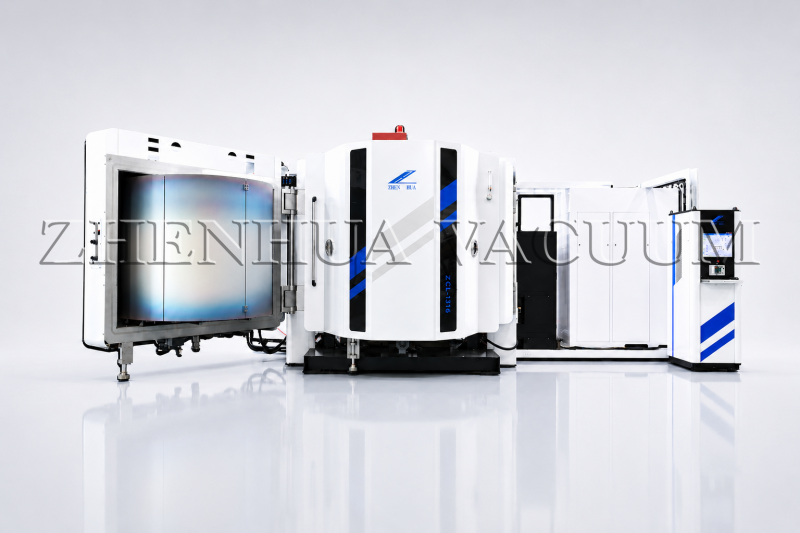
With more than 30 years of experience in the R&D and manufacturing of vacuum coating equipment, Zhenhua Vacuum has developed the GFM1916 Magnetron Sputtering Optical Coating System for the process development and mass-production requirements of HUD mirrors, freeform mirrors, glass cover components, and other optical parts, providing equipment support for high-performance optical coating and stable mass production of HUD components.
4. Zhenhua Vacuum HUD Coating Solution — GFM1916 Magnetron Sputtering Optical Coating System
Equipment Advantages
1. Fully Automatic Control
The system features a high level of automation, simple operation, and fully automatic process control, helping reduce operator dependency and improve process repeatability.
2. High Loading Capacity and High Production Throughput
The cylindrical workpiece-holder design provides a loading capacity approximately twice that of conventional electron-beam evaporation coating equipment. It supports various workpiece geometries and offers greater application flexibility for different optical components.
3. High-Performance Coating
The system integrates PVD + CVD coating technologies with an ion-source-assisted system, enabling dense coatings, stable refractive-index characteristics, and strong adhesion. Aluminum, dielectric, and AF (anti-fingerprint) layers can be deposited within a single process cycle according to the coating-system requirements.
4. Precise Coating Control
The system is equipped with a crystal-monitoring system for precise film-thickness control, providing high process stability and repeatability. The SPEEDFLO closed-loop system and fully automatic control system effectively improve the SiO₂ deposition rate, enabling visible-light reflectance above 90% and meeting the demanding requirements of HUD optical applications.
Applications: HUD optical components, glass cover components, and other optical parts.
5. Conclusion
The value of HUD optical coating is not simply achieving a high reflectance figure. The real challenge is maintaining stable coating performance across the entire effective area of the workpiece, under complex automotive environmental conditions, and throughout continuous mass production.
From film-thickness control, coating uniformity, and adhesion to environmental reliability and batch-to-batch consistency, every stage of the coating process can ultimately affect display performance and mass-production quality.
For HUD mirrors, freeform mirrors, glass cover components, and other optical products, Zhenhua Vacuum can provide corresponding equipment configurations, process development, and sample-validation services according to the substrate material, workpiece geometry, multilayer coating architecture, and production-capacity requirements, helping customers move from initial process trials to stable, high-volume production.
-This article was published by vacuum coating equipment manufacturer Zhenhua Vacuum
Post time: Aug-21-2026