
As automotive cockpits continue to evolve toward digitalization, intelligence and integrated design, center information displays, digital instrument clusters, head-up displays, electronic rearview mirrors, in-vehicle touch panels and pillar-to-pillar display modules are being adopted more widely. Display components are no longer used solely as information terminals. They are becoming essential interfaces for vehicle interaction, functional control and interior design.
Compared with conventional consumer-electronics displays, smart cockpit display components must operate reliably under demanding conditions involving high and low temperatures, direct sunlight, vibration, high humidity and frequent touch interaction. Their surface coatings are required not only to increase transmittance and reduce reflection, but also to provide electrical conductivity, anti-glare performance, fingerprint resistance, wear resistance, contamination resistance and integrated decorative effects.
Coating smart cockpit display components is therefore not simply a matter of depositing a thin film onto glass or plastic. It requires a systematic balance among optical performance, substrate compatibility, multilayer architecture, environmental reliability and high-volume manufacturing consistency.
Higher Display Performance Requires More Precise Optical Coatings
Under different driving conditions, cockpit displays may be affected by direct sunlight, reflections from vehicle windows, interior reflections and ambient stray light. If the surface reflectance of the cover panel is too high, displayed information may become difficult to read, particularly under strong ambient illumination, where image contrast can decrease significantly.
Anti-reflective coatings can reduce reflection losses from cover glass or display modules, thereby improving visible-light transmittance and display contrast. However, automotive anti-reflective coating design cannot focus only on a single wavelength or normal incidence. Drivers and passengers view displays from different positions and angles, so the optical stack must maintain stable performance across a broad visible spectrum and a wide range of incident angles.
Multilayer dielectric coatings generally use optical interference between high- and low-refractive-index materials to reduce reflection. Even small deviations in individual layer thickness can shift the reflection spectrum and cause overall color shifts, localized chromatic non-uniformity or appearance differences between production batches. For large-area display covers and integrated curved displays, film-thickness uniformity, refractive-index stability and interfacial quality are particularly important.
Some smart cockpit components also require semi-reflective, hidden-display or seamless black-panel effects. When the display is switched off, the active area may need to match the surrounding interior with a uniform dark or metallic appearance. When activated, images and illuminated symbols must remain clearly visible through the coated surface.
These functions are commonly achieved using metallic films, dielectric multilayers or non-conductive vacuum metallization, or NCVM, structures. Reflectance, transmittance, chromaticity and electromagnetic properties must be controlled simultaneously.
Multiple Surface Functions Require Coordinated Multilayer Design
Smart cockpit display components frequently combine display, touch-control, decorative and protective functions. A single coating layer is rarely sufficient, so practical applications often require multilayer structures incorporating transparent conductive films, optical coatings, protective layers and surface-functional coatings.
Transparent conductive materials such as ITO, AZO and related films must balance high visible-light transmittance with low sheet resistance. Increasing film thickness may improve conductivity, but it may also increase optical absorption and reflection. If the film is too thin, electrical continuity may become unstable, leading to higher sheet resistance or reduced touch sensitivity.
When anti-reflective coatings are combined with transparent conductive films, the overall optical performance is no longer determined by an individual layer. Material refractive indices, layer thicknesses, interfacial roughness and deposition sequence all influence final transmittance, reflectance, chromaticity and electrical performance. The complete film stack must therefore be optimized as an integrated system rather than by improving each layer independently.
The outermost surface may also require an anti-fingerprint, hydrophobic and oleophobic coating to reduce the adhesion of fingerprints, grease and water stains. Although an AF coating is extremely thin, its surface energy, uniformity, abrasion resistance and adhesion to the underlying layer directly affect its service life.
Insufficient surface activation, unstable contamination control or poor interlayer compatibility may cause localized AF failure, reduced abrasion resistance or inconsistent performance between batches. This means that smart cockpit coating processes must address interfacial compatibility, stress matching and process integration among multiple functional layers.
Large, Curved and Multi-Material Components Increase Deposition Complexity
Smart cockpit displays are moving toward larger formats, curved geometries and multi-screen integration. Compared with small flat glass substrates, large-area display covers are more susceptible to center-to-edge thickness variations, transverse color differences, non-uniform reflectance and localized sheet-resistance deviations.
For curved glass, three-dimensional cover panels and irregularly shaped components, the target-to-substrate distance and deposition incidence angle vary across the surface. These differences may cause variations in deposition rate, film density and optical constants. Cathode configuration, magnetic-field design, substrate motion and process compensation must therefore be optimized to improve coating coverage and uniformity over complex geometries.
The substrates used in smart cockpit displays are also diverse. In addition to glass, some decorative display areas use PC, PMMA or other polymer materials. Compared with glass, polymer substrates have lower thermal resistance, higher coefficients of thermal expansion and different surface hardness and chemical stability.
During vacuum deposition, excessive plasma energy, ion bombardment or substrate-temperature rise may cause deformation, internal-stress release, surface damage or reduced coating adhesion. Coating polymer display components therefore requires surface activation, nucleation and film growth to be completed under a limited thermal budget while maintaining adequate film density and coating-substrate adhesion.
A single component may also contain printed glass areas, transparent display zones, touch-sensitive regions and decorative sections. Each area may require different coating properties. Controlling functional boundaries through masking, selective deposition or localized film-stack design is another important engineering challenge in high-volume production.
Automotive Reliability Requirements Demand Long-Term Film Stability
Automotive display components are expected to remain in service for extended periods. Their coatings must meet the required optical and electrical specifications not only after production, but also after temperature cycling, damp-heat exposure, ultraviolet irradiation, vibration, cleaning-agent contact and repeated wiping.
Different materials within a multilayer structure have different coefficients of thermal expansion. As a vehicle repeatedly transitions between high-temperature solar loading and low-temperature environments, the coating stack is exposed to cyclic tensile and compressive stresses. Excessive residual stress, insufficient interfacial adhesion or incompatible material combinations may result in cracking, peeling, localized delamination or optical-property drift.
Coating design must therefore consider both the optical constants and mechanical properties of each material. Film density, residual stress, interfacial contamination and defect density must be controlled during deposition to improve long-term stability under environmental loading.
For transparent conductive coatings, damp heat and temperature cycling may lead to sheet-resistance drift. In anti-reflective coatings, moisture absorption or structural changes may shift the reflection spectrum. For AF coatings, repeated wiping and exposure to cleaning chemicals may gradually reduce hydrophobic and oleophobic performance.
Automotive-grade coating development must incorporate these reliability risks into film-stack design and process validation from the beginning rather than relying only on final product inspection.
The Transition from Samples to Mass Production Depends on Process Repeatability
Achieving high transmittance, low reflectance or an attractive metallic appearance on a laboratory sample does not mean that a coating process is ready for mass production. The real challenge lies in maintaining consistent film thickness, chromaticity, transmittance, reflectance, sheet resistance and surface performance throughout long-term production.
Vacuum level, substrate temperature, sputtering power, working-gas flow, reactive-gas ratio, target condition and chamber contamination can all affect coating properties. In reactive magnetron sputtering, even small fluctuations in reactive-gas flow can change the target-surface condition, which in turn affects deposition rate, film stoichiometry and refractive index.
To maintain process stability, coating equipment must provide a stable vacuum environment, coordinated multi-cathode control, closed-loop gas-flow regulation, precise power control and film-thickness monitoring. For multilayer optical coatings, transitions between different materials and deposition steps must remain stable to minimize target-condition variation, cross-contamination and deposition drift.
Fixture design, loading position and substrate trajectory also influence batch consistency. For large display covers, deposition flux and residence time must be controlled across the entire surface. For curved and irregularly shaped components, rotation, planetary motion or continuous transport must be optimized to achieve relatively uniform coating coverage.
Process databases and parameter traceability are also becoming increasingly important. Recording vacuum curves, gas flow, power, film thickness and equipment operating status for each batch helps identify process drift and provides a reliable data foundation for switching between different products and film-stack recipes.
Smart Cockpit Coating Requires Coordination Among Equipment, Film Design and Process Control
Coating smart cockpit display components is a typical systems-engineering task. The challenge is not simply to deposit an individual thin film, but to build a multifunctional coating stack on complex substrates that combines optical, electrical, decorative and protective properties while satisfying automotive reliability and high-volume manufacturing requirements.
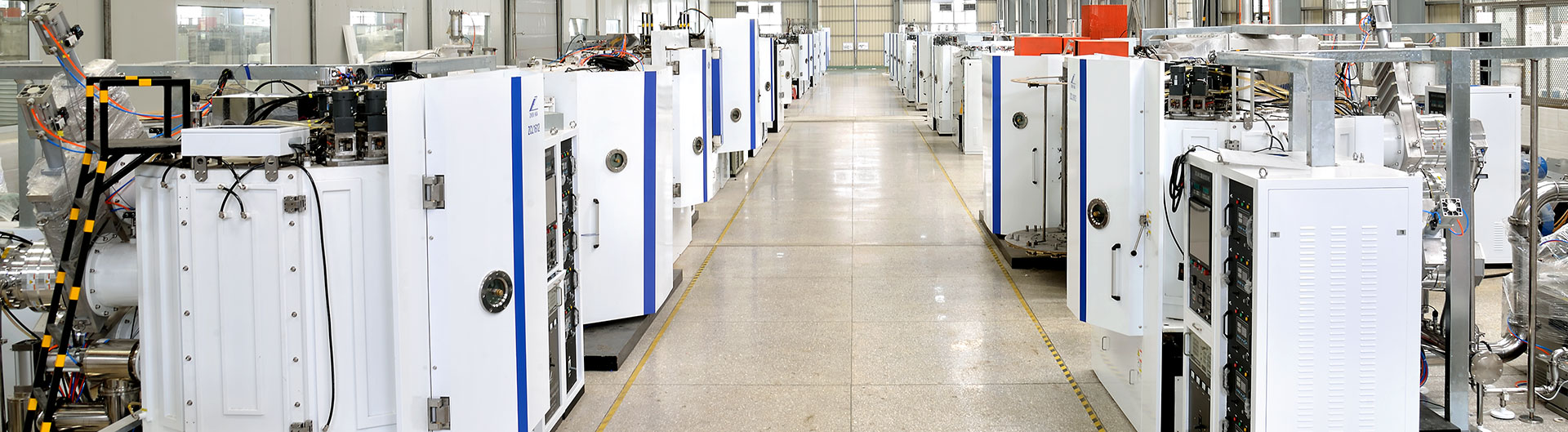
Zhenhua Vacuum provides coating solutions for smart cockpit display covers, electronic rearview mirrors, in-vehicle touch panels and related optical components. These solutions can integrate magnetron sputtering, multilayer optical coating, transparent conductive film deposition and AF anti-fingerprint processes.
Through a stable vacuum environment, coordinated multi-cathode deposition, ion-source cleaning, closed-loop gas control and automated process management, the equipment helps improve film uniformity, interfacial adhesion and batch-to-batch repeatability.
As smart cockpits continue to develop toward larger displays, curved surfaces, hidden-display designs and higher functional integration, coating equipment must also evolve from single-process deposition toward integrated processing, precision control and automated mass production.
Only through coordinated optimization of equipment, coating materials, multilayer architecture and process parameters can smart cockpit display components maintain clear, stable and reliable visual and interactive performance under complex automotive operating conditions.
-This article was published by vacuum coating equipment manufacturer Zhenhua Vacuum
Post time: Jul-25-2026