
The “color changes with a turn” effect found in color-changing eyeshadows and anti-counterfeiting labels is essentially based on the principle of thin-film interference, similar to the rainbow effect on soap bubbles or oil films. The difference is that color-changing powder is not a naturally formed liquid film, but rather a product of vacuum coating technology. Multiple nano-scale films are precisely stacked on a substrate surface, followed by demolding and powder processing to form an applicable photochromic pigment.
Stable mass production of color-changing powder hinges on the coating process. While it may seem like just a matter of “color changing,” the coating process actually demands high precision. The color effect of color-changing powder depends on the refractive index, thickness accuracy, and interlayer stability of each thin-film material. Even slight deviations in the film layers can lead to inaccurate hue, unstable color-changing angles, and batch-to-batch color inconsistencies. Especially in large-scale production, ensuring precise deposition of multi-layer film structures while balancing demolding efficiency, powder consistency, and production costs places higher demands on the stability, automation, and process control capabilities of vacuum coating equipment.
Zhenhua Vacuum GX2350 Optical Coating Equipment is Specifically Designed for Color-Changing Powders
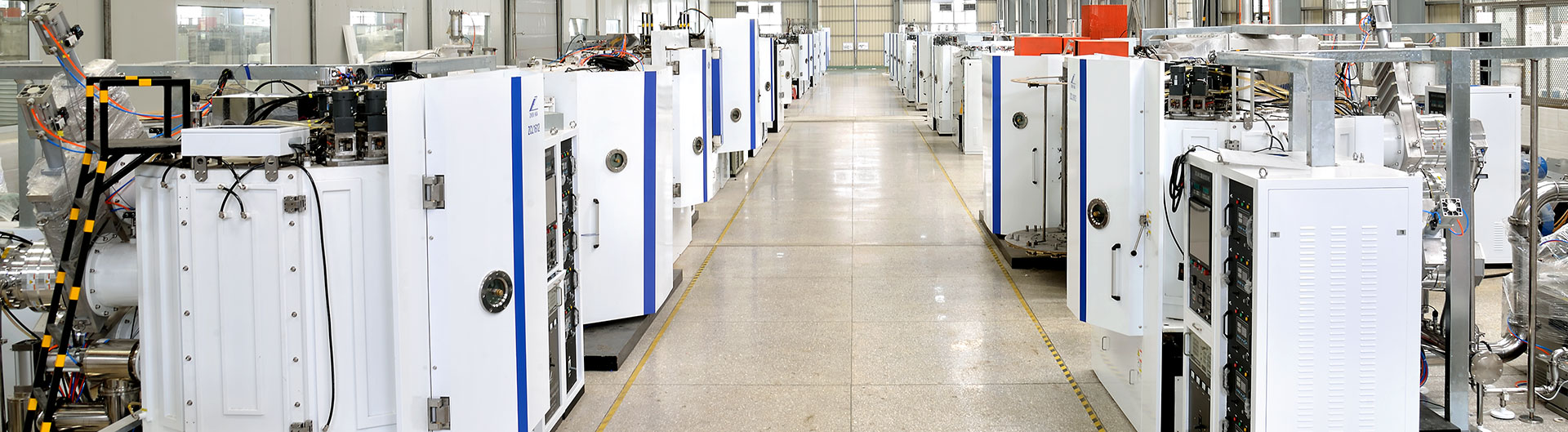
To stably produce high-quality color-changing powders in large batches, the entire multi-layer nano-coating process relies on high-precision specialized equipment. Zhenhua Vacuum GX2350 optical coating equipment is specifically designed for color-changing powders and is suitable for the mass production of photochromic products such as cosmetics, anti-counterfeiting materials, and labels. Its daily coating capacity consistently exceeds 2000 grams, far surpassing the single-batch output limit of conventional equipment, easily meeting the demands of large-scale production. Simultaneously, the equipment employs high-energy electron beam evaporation technology, enabling the evaporation of coating materials with melting points exceeding 3000 degrees Celsius, resulting in high-purity, high-thermal-efficiency optical coatings.
The GX2350 utilizes a large-arc umbrella frame, significantly increasing equipment capacity and reducing customer manufacturing costs. Combining aluminum wire resistance evaporation, multi-set release agent resistance evaporation, large-capacity ring crucibles, and multi-cavity crucibles, this system helps customers achieve multiple coating runs, reducing the number of times the equipment needs to be opened and increasing production capacity.
The equipment utilizes an industrial control computer + PLC + automatic film thickness monitoring system to construct a fully automated coating system. Even during long-term high-load continuous production, film thickness, evaporation rate, and batch powder color difference are controllable, balancing ultra-high capacity with consistent finished product quality, achieving cost reduction and efficiency improvement in mass production.
Conclusion: The iteration of light and shadow aesthetics has never been separated from the support of precision manufacturing processes. From natural iridescence to industrially mass-produced high-end color-changing powders, vacuum coating technology has opened up the path between creative colors and stable mass production. Zhenhua Vacuum Continuous Polishing Dedicated Optical Coating Equipment, with its precise and controllable nano-coating process, helps new material companies cultivate the high-end color-changing materials market, and with stable and reliable production solutions, continuously creates new possibilities for layered light and shadow in the cosmetics, anti-counterfeiting, and high-end decoration markets.
Post time: Jun-20-2026