
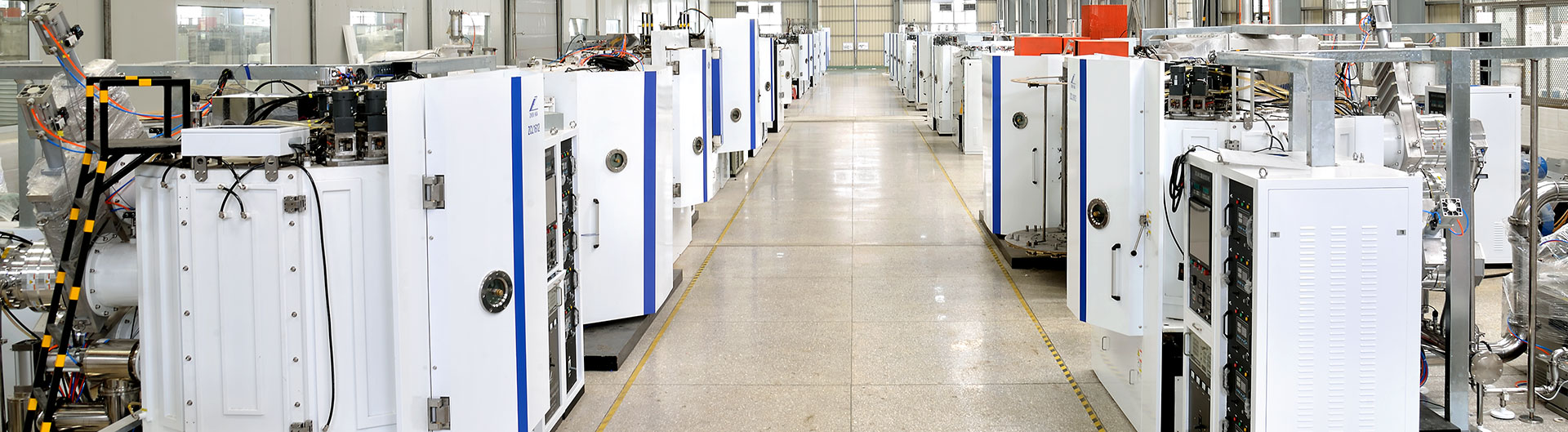
1. Application Background
With the rapid advancement of intelligent cockpits and high-end display technologies, optical components such as HUD (Head-Up Display) systems and automotive display cover glass are placing increasingly stringent demands on coating performance. Thin films must not only deliver excellent optical characteristics, but also maintain long-term stability under complex operating environments, while meeting requirements for large-area uniformity, high consistency, and mass production capability.
In HUD applications, the thickness accuracy of reflective layers and multilayer dielectric stacks, along with refractive index stability and film adhesion, directly affects image clarity and luminance efficiency. As a result, the process capability and operational stability of coating equipment have become critical factors in optical component manufacturing.
2. Challenges in Optical Thin-Film Manufacturing
① Complex multilayer film stacks require advanced process integration
HUD and high-end cover glass typically require multilayer structures consisting of metallic reflective layers, dielectric functional layers, and protective functional coatings, placing higher demands on equipment capable of multi-process integration.
② Narrow optical tolerance window demands high-precision thickness control
Minor fluctuations in dielectric layer thickness can cause variations in reflectivity and color shift, directly impacting HUD image quality. This imposes strict requirements on film thickness monitoring accuracy and process repeatability.
③ Simultaneous need for higher throughput and consistency
With the growing production volume in automotive and consumer electronics markets, optical coating processes must balance high-volume manufacturing capability with batch-to-batch consistency. Conventional low-loading systems are increasingly unable to meet cycle time requirements.
④ Film reliability directly affects product lifetime
Insufficient film density or poor adhesion may lead to failure under temperature-humidity cycling or long-term operation, ultimately impacting end-product reliability and quality.
3. Zhenhua Vacuum Solution
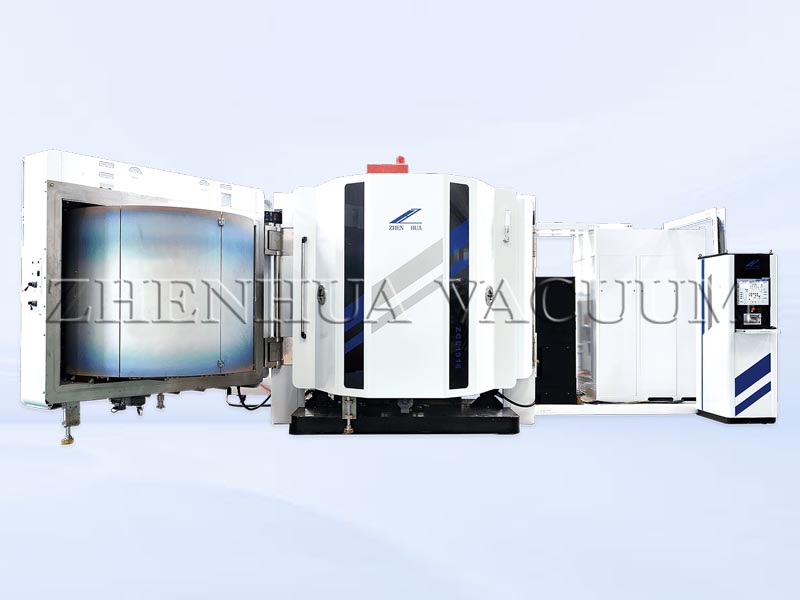
To address the demands of high-end optical thin-film applications, Zhenhua Vacuum introduces the GFM1916 Magnetron Sputtering Optical Coating System, which integrates PVD and CVD process capabilities together with an ion source assisted deposition system to enable stable, high-performance optical film production at scale.
The system is designed around high automation, large substrate loading capacity, and precision process control, balancing film performance, production efficiency, and process stability to meet the mass-production requirements of high-standard optical products such as HUD components.
GFM1916 Magnetron Sputtering Optical Coating System
1. Fully automated control
High level of automation with user-friendly operation.
2. Large loading capacity and high throughput
Cylindrical rotating substrate holder design provides a loading capacity up to twice that of electron beam evaporation systems, supporting various substrate geometries with flexible application capability.
3. Superior film performance
Integrated PVD + CVD coating system with ion source assistance produces films with high density, stable refractive index, and strong adhesion. Supports one-cycle deposition of aluminum reflective layers, dielectric films, and AF (anti-fingerprint) coatings.
4. Precise coating control
Equipped with a quartz crystal monitoring system for accurate film thickness control, ensuring high process stability and repeatability. The SPEEDFLO closed-loop control system combined with full automation effectively increases the deposition rate of SiO₂, achieving visible light reflectivity above 90%, meeting the stringent optical requirements of HUD applications.
Application Fields:
HUD (Head-Up Display), display cover glass, and other precision optical components.
-This article was published by vacuum coating equipment manufacturer Zhenhua Vacuum
Post time: Jan-29-2026