
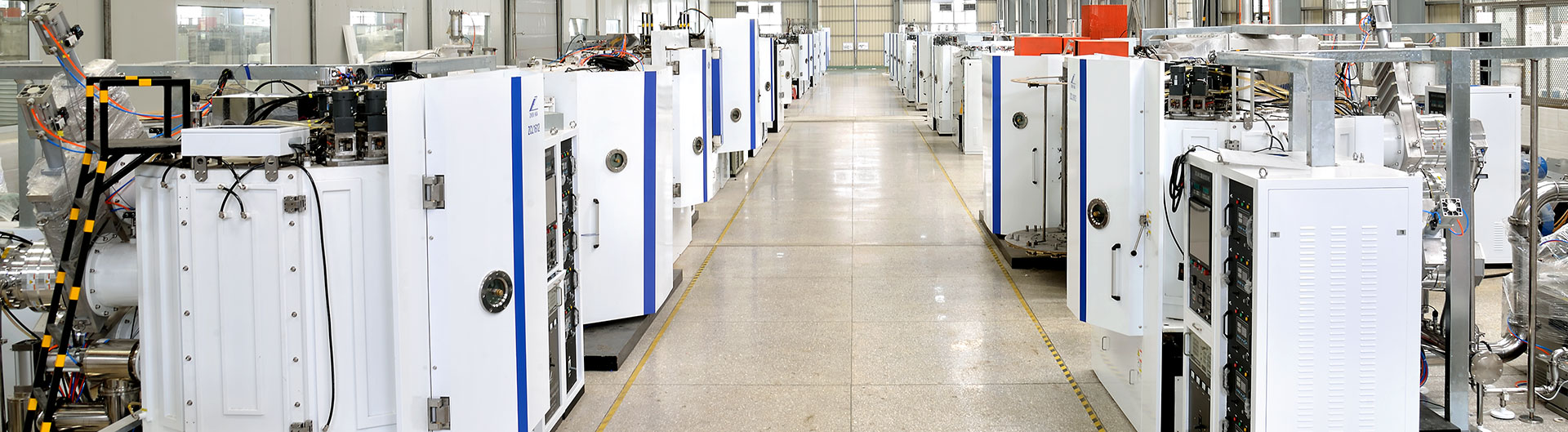
In the technological framework of vacuum coating equipment, reproducibility design is not an auxiliary metric, but a fundamental capability embedded throughout equipment development, process realization, and mass production. Particularly in applications such as automotive interior components, optical elements, and functional films—where high consistency is mandatory—the reproducibility of equipment directly defines the controllability of film properties and the upper limit of scalable manufacturing.
From a process perspective, vacuum coating is a manufacturing technology highly dependent on the coupled control of multiple parameters. Whether in physical vapor deposition (PVD) processes such as magnetron sputtering and thermal evaporation, or in hybrid deposition systems, film structure, optical performance, and adhesion are all governed by variables including vacuum level, plasma density, deposition rate, substrate temperature, and target condition. In this context, the core objective of reproducibility design is to ensure that these critical parameters remain highly consistent across different batches and time windows through systematic optimization of equipment architecture, control systems, and process pathways—thereby enabling repeatable film performance.
Reproducibility is first reflected in the stability of the vacuum system. A predictable pumping curve and a stable ultimate vacuum level form the basis of a consistent process environment. By properly integrating backing pumps, Roots pumps, and high-vacuum pumps (such as turbomolecular or diffusion pumps), along with precise closed-loop pressure control strategies, variations between cycles can be effectively minimized. In addition, symmetric chamber design and uniform gas flow distribution play a decisive role in plasma stability and film uniformity, forming the structural foundation for reproducibility.
In deposition source systems, whether in the thermal field control of evaporation sources or the magnetic field uniformity of magnetron sputtering targets, highly standardized configurations are essential to maintain a stable relationship between energy input and material output. For example, the consistency of target erosion profiles in sputtering directly affects deposition rate and thickness distribution, while in evaporation processes, the linear response between heating power and evaporation rate determines the precision of thickness control. These aspects require rigorous reproducibility validation at the design stage, rather than relying on post-process compensation.
Digitalization and modularization of control systems further support reproducibility design. With high-precision sensors, real-time data acquisition, and feedback control algorithms, key process parameters can be dynamically monitored and adjusted in closed loops, significantly reducing variability caused by manual operation. At the same time, standardized recipe management systems enable rapid product switching while ensuring full traceability and exact replication of historical process parameters, forming the backbone of scalable production.
Beyond single equipment performance, reproducibility is also the cornerstone of consistency at the production line level. In multi-chamber and multi-station continuous coating systems, parameter alignment and takt synchronization between modules directly influence throughput and yield. Therefore, reproducibility must be embedded in system-level design—from individual chambers to fully integrated production lines—to avoid imbalances caused by isolated optimization.
From the perspective of end-use applications, the value of reproducibility manifests across multiple dimensions. In automotive interior components, film color consistency and gloss uniformity directly affect perceived quality; in optical coatings, thickness deviations can lead to systematic shifts in transmittance and reflectance; in functional coatings, fluctuations in adhesion and durability impact product lifecycle reliability. All these performance indicators ultimately depend on the reproducibility of the coating equipment.
In essence, emphasizing reproducibility design is not merely about “doing the same thing every time,” but about engineering a predictable, controllable, and repeatable manufacturing platform within a complex, multi-variable process environment. This capability represents a key technological differentiator for advanced vacuum coating systems and a critical foundation for high-quality, large-scale manufacturing.
-This article was published by vacuum coating equipment manufacturer Zhenhua Vacuum
Post time: Apr-17-2026