
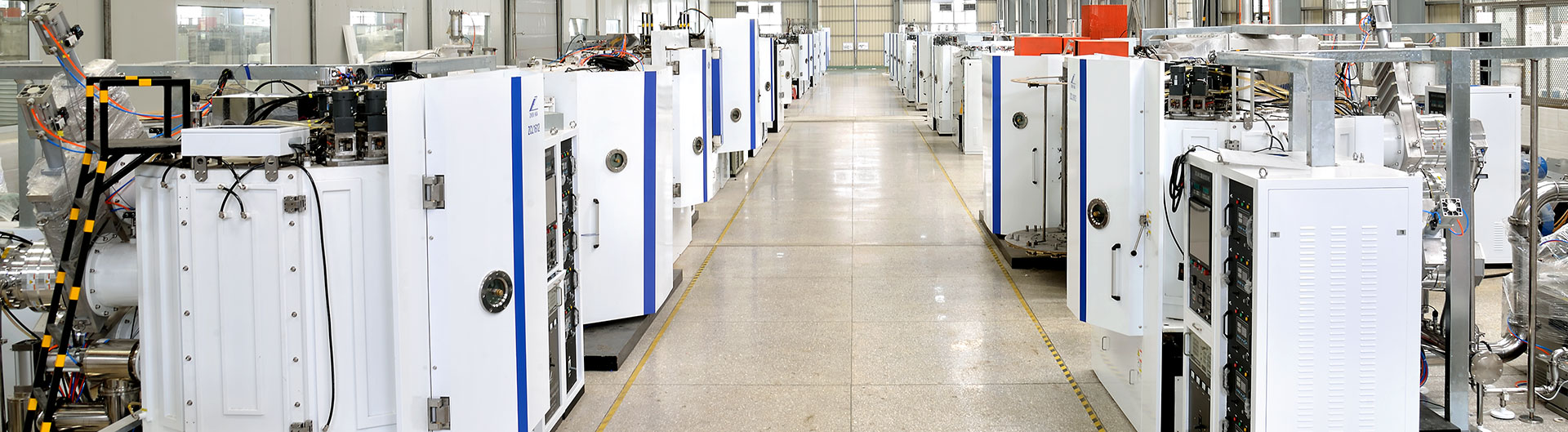
1. Industry Background: Process Diversification Drives Equipment Evolution
With the continuous segmentation of application fields such as automotive interior components, optical devices, consumer electronics, hard coatings, and functional films, vacuum coating processes are becoming increasingly diversified. From conventional thermal evaporation and magnetron sputtering to DC / MF / RF sputtering, reactive sputtering, CVD, and hybrid coating technologies, single-process equipment can no longer meet the comprehensive demands for film performance, production flexibility, and long-term scalability.
Against this backdrop, vacuum coating equipment is evolving from isolated custom-built systems toward modular, platform-based, and expandable architectures.
2. The Essence of Modular Design: Deconstructing Complex Systems into Functional Units
A vacuum coating system is a highly integrated engineering system, typically consisting of:
Vacuum chamber and sealing structure
Vacuum pumping system (mechanical pumps, Roots pumps, turbomolecular pumps, etc.)
Deposition modules (evaporation sources, magnetron sputtering cathodes, CVD modules)
Gas supply and mass flow control system
Power supplies and plasma control units
Automation and process control system
Modular design is not simple assembly. Its core lies in functional decoupling and standardized interfaces, enabling each subsystem to be independently configured, replaced, or expanded, thereby significantly enhancing system flexibility and engineering controllability.
3. Enhanced Process Compatibility for Diverse Applications
Different industries impose distinct requirements on coating performance:
Automotive interior components: adhesion strength, wear resistance, and appearance consistency
Optical and display applications: thickness uniformity, optical precision, and low defect density
Hard coatings: high hardness, low friction coefficient, and repeatable stability
Through modular design, different deposition technologies can be flexibly combined on a single platform—such as evaporation and magnetron sputtering hybrid configurations—allowing multi-process compatibility without redesigning the entire system, and effectively reducing technology upgrade costs.
4. Shortened Delivery Time and Reduced Engineering Risks
In conventional non-modular systems, process changes often require structural redesign and electrical reconfiguration, resulting in long engineering cycles and high commissioning risks.
By reusing mature modules and adopting parameterized configurations, modular design significantly shortens design, manufacturing, and commissioning timelines, while improving on-site installation efficiency and project delivery reliability.
5. Improved Reliability and Maintainability
Vacuum coating equipment typically operates under continuous production conditions, placing high demands on stability and maintenance efficiency.
Modular structures provide:
Clear functional boundaries
Independent fault diagnosis paths
Fast disassembly and replacement capabilities
When a specific module fails, targeted maintenance or module-level replacement can be performed without shutting down the entire system, effectively reducing downtime and operational costs.
6. Supporting Production Line Upgrades and Long-Term ROI
For end users, equipment investment is not a one-time purchase but a long-term capacity strategy.
Modular design reserves mechanical and control interfaces for future upgrades, enabling the integration of new processes, materials, or automation functions without replacing the main system structure, thereby extending equipment service life and maximizing return on investment (ROI).
7. Conclusion: Modular Design as an Inevitable Trend in High-End Vacuum Coating Equipment
As high-end manufacturing and precision coating requirements continue to rise, modular design has become a key indicator of engineering maturity and system capability in vacuum coating equipment.
It not only enhances technical adaptability but also provides users with a more stable, flexible, and sustainable pathway for coating production.
–This article was published by vacuum coating equipment manufacturer Zhenhua Vacuum
Post time: Jan-19-2026