
In vacuum coating processes, uniformity is almost always a persistent challenge faced by component manufacturers. For automotive decorative parts, any variation in coating thickness directly manifests as visible color deviation or inconsistent brightness. For optical functional components such as ambient light covers or touch panels, non-uniform layers can even impair light transmittance and degrade the overall visual experience.
In reality, uniform samples may be achievable in the laboratory, yet during mass production in factories, issues such as “center-thick, edge-thin” or “batch-to-batch deviation” frequently occur. Thus, uniformity has become an unavoidable difficulty across the coating industry.
I. Why is Uniformity So Difficult to Achieve?
1. Evaporation Coating: the Intrinsic Non-Uniformity of Particle Distribution
The principle of vacuum coating is based on physical or chemical processes that vaporize the source material under vacuum, enabling it to migrate directionally and condense into a thin film on the substrate surface.
Resistance evaporation is one of the most common methods used for automotive decorative parts. Its mechanism is straightforward: once the evaporation source (e.g., tungsten filament crucible containing the coating material) is electrically heated, the material rapidly vaporizes, spreading outward in a conical plume.
The characteristic of this plume is clear: the substrate area directly facing the source receives the densest particle flux, resulting in a thicker film and faster deposition rate. Conversely, substrates at the edges are reached by particles traveling at oblique angles. The longer path and potential collisions with chamber walls cause particle loss, reducing deposition on edge regions. This leads to the well-known “center-thick, edge-thin” effect—the core reason why evaporation coatings struggle with uniformity.
For example: when coating a 1-meter-long center console trim, the central region may achieve 200 nm thickness, while edge regions may only reach 130 nm—a deviation exceeding 35%, far above the ≤5% industry tolerance.
2. Complex Geometry: Physical Barriers to Particle Deposition
Automotive decorative parts are typically three-dimensional components. Unlike flat substrates such as smartphone glass or optical lenses, they feature more curvature, angles, and design details. The complexity of these geometries amplifies deposition angle variations.
A classic case is the shadowing effect: convex features on curved parts act as barriers, blocking particle flux from reaching recessed areas. For instance, on a U-shaped ambient lamp housing, the outer convex side directly receives incident particles, forming dense, thick coatings. In contrast, the inner recess relies on scattered or chamber-wall-reflected particles, which arrive in smaller numbers and lower energy, leading to porous or thinner films.
Even more challenging is micro-texture interference. Some trim panels feature brushed or embossed textures with depths of 10–20 μm—comparable to coating thickness. During deposition, “peaks” accumulate thicker layers due to particle gathering, while “valleys” receive fewer particles, resulting in thin coatings. Although such micro non-uniformity is not always visible to the eye, it can compromise tactile feel (e.g., localized roughness) and durability (thin regions prone to abrasion and peeling).
II. Multi-Step Coating: Secondary Contamination Risk
Automotive decorative coatings often require a combination of decorative layer + protective overcoat. For example, illuminated logos may first deposit a metallic reflective layer, followed by a SiO₂ protective layer for abrasion resistance.
However, conventional vacuum coaters cannot complete both steps in one cycle, necessitating two separate chamber runs. This introduces secondary contamination. After the first coating, parts must be removed and exposed to ambient air before the second run. During this transfer, surfaces can accumulate dust, moisture, or fingerprints. Even in tightly controlled environments, airborne particulates may still settle.
When the second layer is deposited, these contaminants obstruct adhesion or induce localized thickness deviations. For instance, dust on the metallic base layer may cause the subsequent protective coating to form blisters, undermining uniformity and reducing wear resistance.
III. ZHENHUA Vacuum ZCL1417: Targeted Solutions for Uniformity Challenges
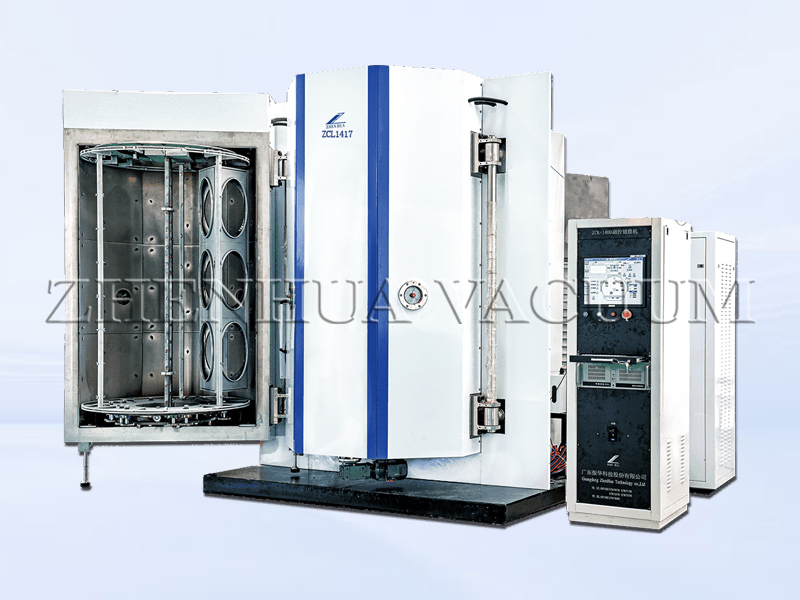
To address these fundamental pain points, the ZCL1417 Automotive Coating System from ZHENHUA Vacuum introduces innovations in process integration, structural optimization, and workflow design, and is already widely adopted by leading automotive component manufacturers.
1. Multi-Process Integration to Overcome Evaporation Limitations
The system integrates DC magnetron sputtering, mid-frequency (MF) sputtering, CVD, and resistance evaporation within a single platform. This multi-source approach enables particle flux from multiple angles, minimizing thickness deviation and surpassing industry uniformity standards. Customers can flexibly switch or combine processes to meet the demands of complex geometries and diverse decorative applications.
2. Single-Cycle Decorative + Protective Coating, Eliminating Secondary Contamination
The ZCL1417 allows decorative and protective layers to be deposited in a single vacuum cycle. Once fixtures are loaded, metallic decorative coatings and subsequent protective overcoats are sequentially deposited under vacuum conditions, eliminating exposure to ambient air and preventing dust or moisture contamination.
3. Compact Footprint and Full Automation
With a small footprint and compact layout, the system integrates intelligent automation and process monitoring. This reduces labor reliance, ensures repeatability, and stabilizes batch-to-batch consistency.
Application Scope:
Headlamp reflectors, ambient light housings, illuminated and radar-compatible logos, interior trim parts, and more. Capable of depositing metallic coatings, reactive films, and semi-transparent layers.
The coating uniformity problem in automotive decorative parts fundamentally arises from the combined effects of process limitations, geometric interference, and workflow defects. The ZHENHUA Vacuum ZCL1417 Automotive Coating System does not merely optimize a single step, but tackles the challenge systemically—through multi-source integration, single-pass process design, and real-time process control.
By transforming uniformity from a persistent pain point into a mass-production advantage, the ZCL1417 provides a robust solution for stable, high-quality production of intelligent cockpit decorative components.
—This article was published by vacuum coating equipment manufacturer Zhenhua Vacuum
Post time: Sep-10-2025