
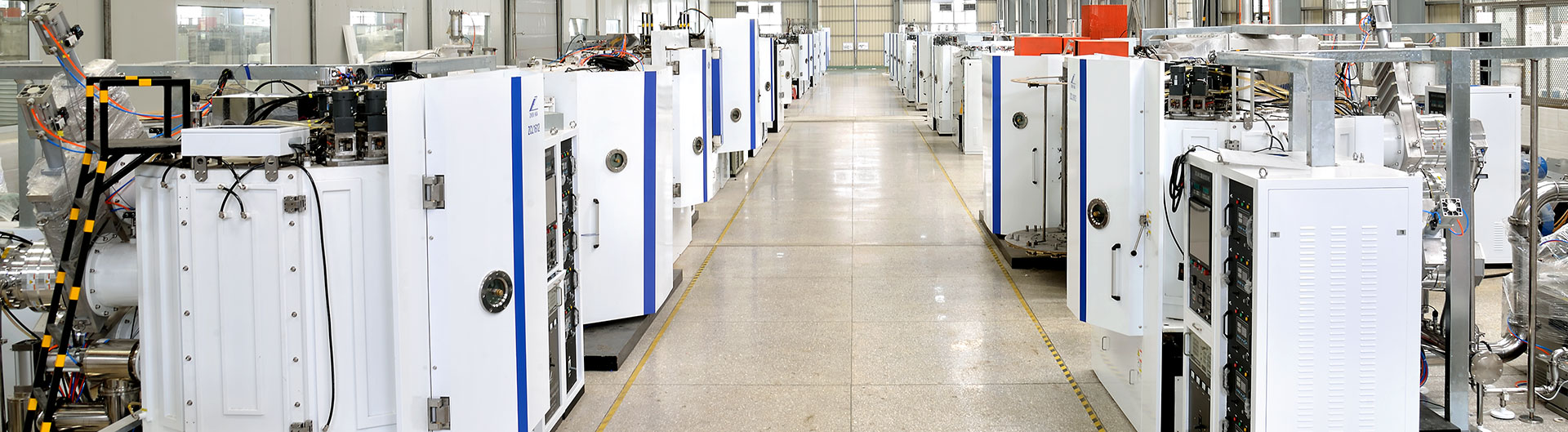
The Real Solution Lies in Surface Modification — Not in the Paint Itself
Under the dual momentum of carbon neutrality goals and stringent environmental regulations, industries such as automotive interiors, home appliances, and 3C product casings are rapidly transitioning away from solvent-based coatings. The shift toward waterborne coating systems has evolved from an option to an imperative.
However, the transformation has not been without challenges. Many component manufacturers have experienced issues such as paint peeling, scratch detachment, and poor cross-hatch adhesion test results after switching to waterborne systems. Inconsistent yield during mass production has further aggravated production instability.
For most manufacturers, the instinctive response is to “use a better paint.” Yet, even after countless adjustments to coating formulations, the adhesion issue persists. The real problem does not lie in the waterborne coating itself but in the inadequate surface condition of the plastic substrate — when the substrate fails to meet the adhesion prerequisites, even the best paint cannot achieve durable bonding.
I. The Root Cause: Plastics and Waterborne Coatings Are Naturally Incompatible
The adhesion problem between plastics and waterborne paints stems from the inherent material mismatch, primarily due to three fundamental factors:
1. Low Surface Energy — Coating Fails to Wet the Substrate
Common plastics such as ABS, PP, and PC, widely used in automotive interiors, typically exhibit surface energy in the range of 20–40 mN/m. In contrast, waterborne coatings require a substrate surface energy of at least 50 mN/m for effective wetting and spreading.
This situation is akin to water droplets rolling off a lotus leaf — low surface energy prevents tight contact, resulting in a weakly bonded “floating layer” that peels off easily under stress.
2. Polarity Mismatch — Poor Interfacial Compatibility
Waterborne coatings, being polar systems with water as a carrier, rely on electrostatic and hydrogen bonding interactions. Most plastics such as PP and PE are non-polar materials with chemically stable molecular structures and a lack of active bonding sites. The absence of chemical affinity between the two materials results in inherently weak interfacial adhesion — much like the immiscibility of oil and water.
3. Surface Contamination and Mold Release Residues
During plastic molding, mold release agents and other additives inevitably migrate to the surface. Even if the part appears clean to the naked eye, microscopic traces of silicone or oil residues create an invisible barrier that prevents direct coating-substrate contact, effectively blocking adhesion.
In essence, paint peeling in waterborne systems is not a coating defect, but a result of untreated or insufficiently activated plastic surfaces that lack the molecular compatibility required for durable bonding.
II. Limitations of Conventional Surface Treatment Methods
To improve adhesion, various pre-treatment methods have been applied — but most offer only temporary or surface-level improvement.
Flame or Corona Treatment: These methods momentarily increase surface energy but degrade rapidly within hours or days due to aging effects. Their effectiveness on complex geometries such as deep cavities or sharp corners is limited by poor uniformity.
Atmospheric Plasma Treatment: Although capable of introducing polar groups, plasma systems provide limited energy density and poor coverage on 3D surfaces. High equipment and operational costs further restrict scalability.
Chemical Etching or Primer Coatings: Chemical etching involves strong acids or alkalis, posing environmental and wastewater disposal challenges. Priming introduces additional VOC emissions and increases material and labor costs, contradicting the intent of sustainable production.
All these conventional methods remain “external remedies” — they modify the outer surface only superficially without achieving permanent molecular-level activation within the polymer structure.
III. The Technological Breakthrough: Vacuum Fluorination — A Dual Solution for Adhesion and Sustainability
Unlike external surface treatments, vacuum fluorination achieves structural-level modification of the polymer interface.
This process introduces fluorine-based reactive gases into a controlled vacuum chamber, where they undergo precise, controllable chemical reactions with the polymer’s surface molecules. The result is a stable polar interface layer with fundamentally enhanced surface energy and polarity.
This modification significantly improves the substrate’s wettability and adhesion compatibility with waterborne coatings, enabling industry-grade adhesion performance.
Equally important, vacuum fluorination is conducted in a sealed, emission-free vacuum environment, ensuring zero wastewater and solid waste discharge. It thus represents a green, high-performance surface engineering technology that aligns adhesion enhancement with sustainable manufacturing principles.
IV. From Technology to Industry: ZhenHua Vacuum’s Plastic Surface Fluorination Solution
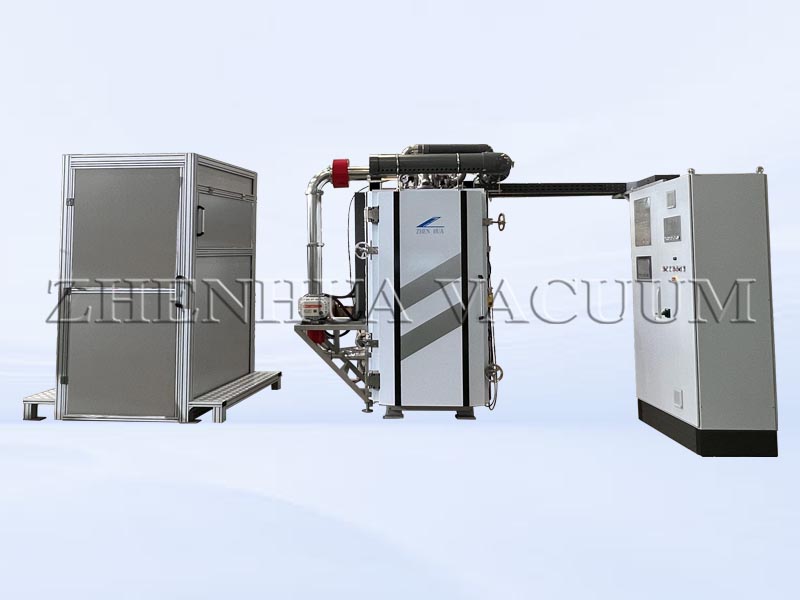
Leveraging decades of expertise in vacuum surface treatment and thin-film technology, ZhenHua Vacuum has industrialized the vacuum fluorination process into a mature, production-ready equipment platform, helping manufacturers solve waterborne coating adhesion challenges while maintaining full environmental compliance.
The solution has been successfully implemented across multiple industry leaders in automotive interiors, chemical equipment, and electronic components, demonstrating both reliability and scalability.
Key Advantages of ZhenHua Vacuum’s Plastic Surface Treatment Equipment
Enhanced Adhesion for Waterborne Coatings
Advanced fluorine-based surface modification technology dramatically increases surface polarity and hydrophilicity, effectively resolving adhesion failure in waterborne systems.
Comprehensive Performance Improvement
The treated surface exhibits superior barrier properties and durability, significantly improving the stability and lifespan of automotive interior components.
Adaptable to Complex Geometries
Process parameters can be flexibly tuned to accommodate 3D and complex-shaped parts, ensuring uniform modification and consistent coating performance.
Application Fields
Applicable to automotive, chemical, electronics, packaging, and polymer film industries.
Conclusion
As “green coating” becomes a strategic direction in manufacturing transformation, waterborne coating on plastics is no longer optional—it is essential.
Vacuum fluorination introduces a paradigm shift in surface engineering, providing a molecular-level solution to bridge the intrinsic incompatibility between plastics and waterborne coatings.
From technological innovation to industrial deployment, ZhenHua Vacuum has proven that only by addressing the problem at the material interface can manufacturers achieve stable, efficient, and sustainable waterborne coating performance on plastic substrates.
Post time: Oct-24-2025