
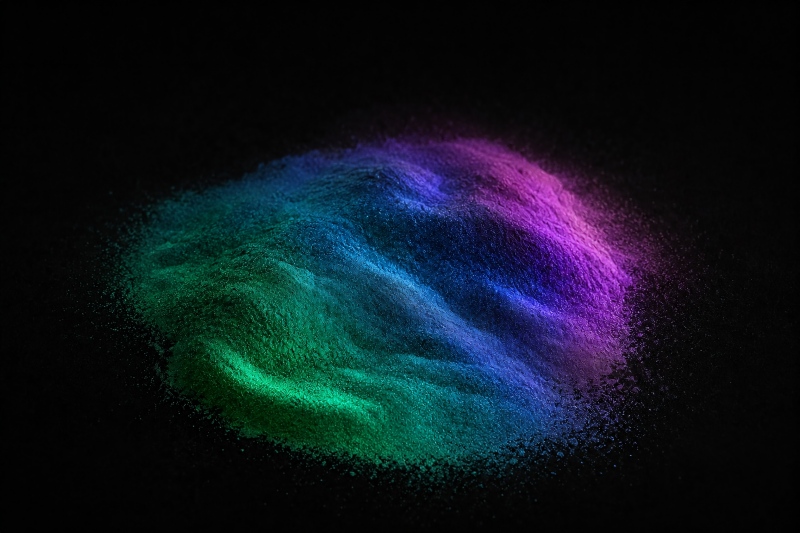
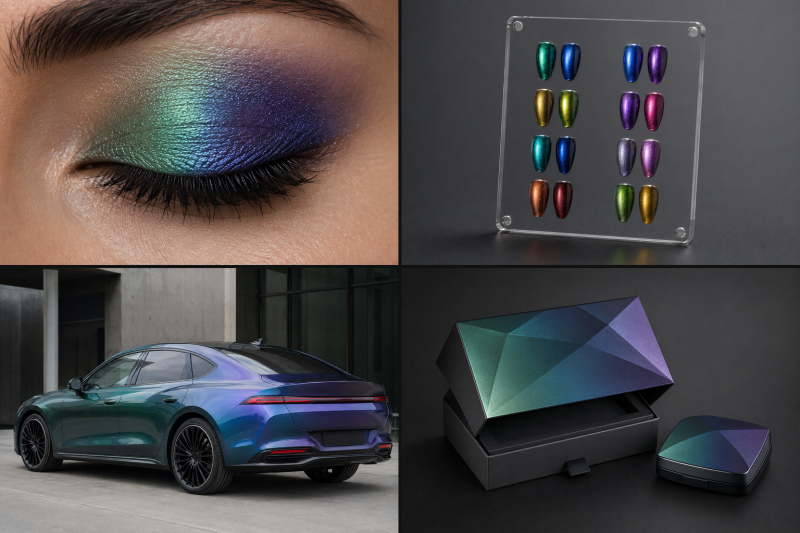
Optically variable pigments are widely used in color-shifting eyeshadows, anti-counterfeiting labels, automotive color-shifting coatings, and premium packaging. As the viewing angle changes, these pigments display different colors. For example, they may appear green when viewed from the front and gradually shift to blue or purple when viewed from the side.
This pronounced color travel gives optically variable pigments strong decorative appeal and anti-counterfeiting value. However, maintaining consistent color performance from batch to batch remains one of the key challenges in mass production.
No.1 How Is the Color of Optically Variable Pigments Produced?
Optically variable pigments are commonly used in color-shifting cosmetics, security labels, automotive coatings, and high-end packaging. When viewed from different angles, the pigments exhibit different colors. A pigment may appear green at normal incidence and shift toward blue or purple at an oblique viewing angle.
This distinctive angular color shift provides high decorative value and makes the pigment suitable for security and anti-counterfeiting applications. However, ensuring consistent color and color-travel performance across production batches is a critical requirement for industrial-scale manufacturing.
Conventional pigments produce color primarily through the selective absorption and reflection of different wavelengths of visible light. For example, a red pigment reflects more red light toward the observer while absorbing much of the remaining visible spectrum, causing it to appear red.
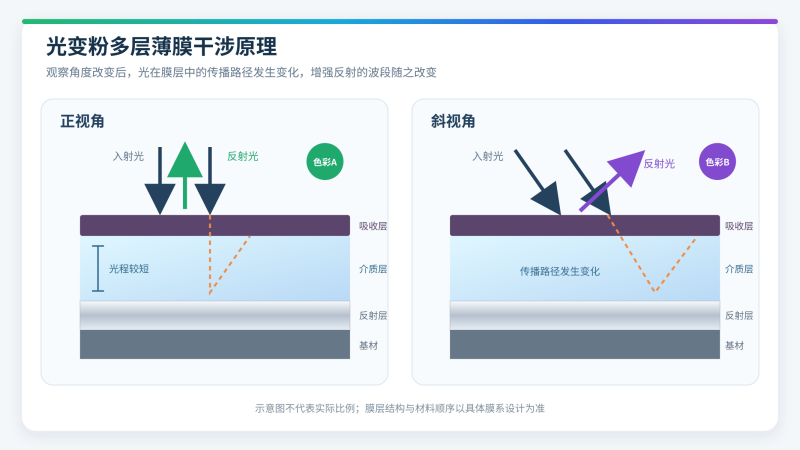
Optically variable pigments work differently. Their color is generated by the reflection and interference of light within a multilayer thin-film structure. When incident light reaches the reflective, dielectric, and absorptive layers, partial reflection occurs at the interfaces between the different films. These reflected light waves interfere with one another, enhancing certain wavelengths while suppressing others and thereby producing a specific color.
As the viewing angle changes, the optical path length of the reflected light within the multilayer stack also changes. Consequently, the wavelengths reaching the observer shift, resulting in the characteristic angle-dependent color change.
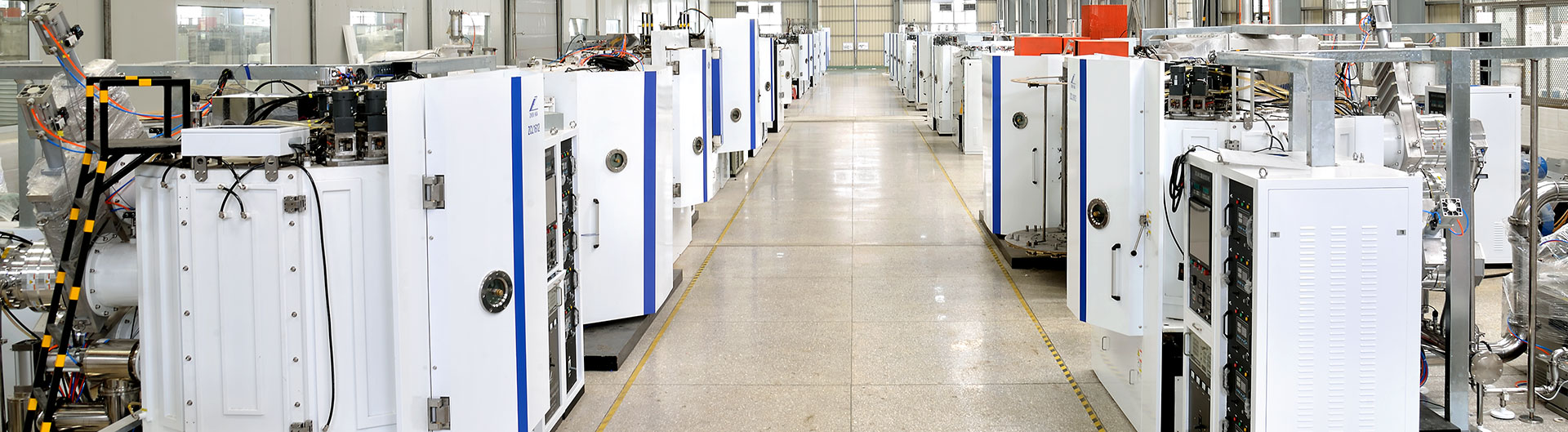
This multilayer thin-film structure is generally produced through a vacuum coating process based primarily on electron beam evaporation. Under vacuum, different coating materials are sequentially heated and evaporated according to the specified optical coating design. The vaporized materials are then deposited layer by layer onto the substrate to form reflective, dielectric, and absorptive films.
After deposition, the multilayer film is released from the substrate and subsequently processed through stripping, crushing, and classification to produce flake-shaped optically variable pigments.
Because the material composition, thickness, and deposition characteristics of each individual layer directly affect the final optical response, vacuum coating is the key upstream process for controlling color consistency. Variations in film thickness, deposition rate, or vacuum conditions may lead to noticeable color differences between production batches.
No.2 What Factors Cause Batch-to-Batch Color Variation in Optically Variable Pigments?
1. Film Thickness Deviation
The color of an optically variable pigment is highly sensitive to thin-film thickness. In an optical coating design, each layer has a specified target thickness. The dielectric layer is particularly important because it is a transparent optical film that controls the optical path length of light within the multilayer structure.
When the actual film thickness deviates from the target value, the optical path length changes accordingly. This shifts the wavelengths that undergo constructive or destructive interference, causing deviations in the apparent color and color-travel effect.
If the thickness control differs between production batches, the pigments may exhibit inconsistent hue, saturation, brightness, or angular color-shift performance.
2. Deposition Rate Stability
Even when the measured film thicknesses of different batches are similar, variations in the final color may still occur. Fluctuation in the deposition rate is one of the possible causes.
Changes in electron beam power, coating material surface condition, melt-pool behavior, or beam position may affect the evaporation characteristics and deposition rate of the material. An unstable deposition rate not only makes thickness control more difficult but may also alter the density, refractive index, microstructure, and internal stress of the deposited film.
During multilayer film deposition, the evaporation process must therefore remain stable. The deposition rate should be continuously monitored and automatically regulated to minimize the effect of rate fluctuations on thin-film properties and batch-to-batch color consistency.
3. Vacuum Conditions and Substrate Status
The color of optically variable pigments is determined not only by how thick each film is, but also by the actual physical and optical state of the deposited layer.
Variations in base pressure, residual gas composition, outgassing, or chamber cleanliness between batches may affect film composition, purity, density, and refractive index. This is particularly important for dielectric films. Even at the same physical thickness, a variation in refractive index can shift the reflected wavelength and cause a noticeable color deviation.
Substrate temperature and operating conditions must also remain stable. Differences in initial substrate temperature, coating duration, or accumulated thermal load may influence film density, stress, adhesion, and optical properties.
In addition, inconsistent substrate movement or rotation may cause different areas of the substrate to receive unequal material flux, resulting in non-uniform film thickness. A stable vacuum system, substrate motion system, and thermal management system are therefore essential for improving batch-to-batch repeatability.
4. Downstream Pigment Processing
Batch-to-batch color variation is not caused solely by the vacuum coating process. It may also be affected by downstream film stripping, crushing, classification, and application conditions.
After coating, the stripping efficiency, crushing intensity, flake integrity, aspect ratio, and particle-size distribution can all influence the brightness, hiding power, sparkle, and angular color-shift performance of the pigment.
During practical application, factors such as pigment concentration, binder or ink transparency, substrate color, coating thickness, and the orientation of the pigment flakes may also alter the final visual appearance.
Nevertheless, vacuum coating determines the fundamental multilayer optical structure of the pigment. Precise control of individual layer thickness, thickness uniformity, deposition rate, vacuum conditions, and process repeatability provides a stable optical foundation for subsequent film stripping, pigment processing, and end-use applications.
No.3 Zhenhua Vacuum Coating Solution for Optically Variable Pigments: Stable Mass Production with a Daily Output of Over 2,000g
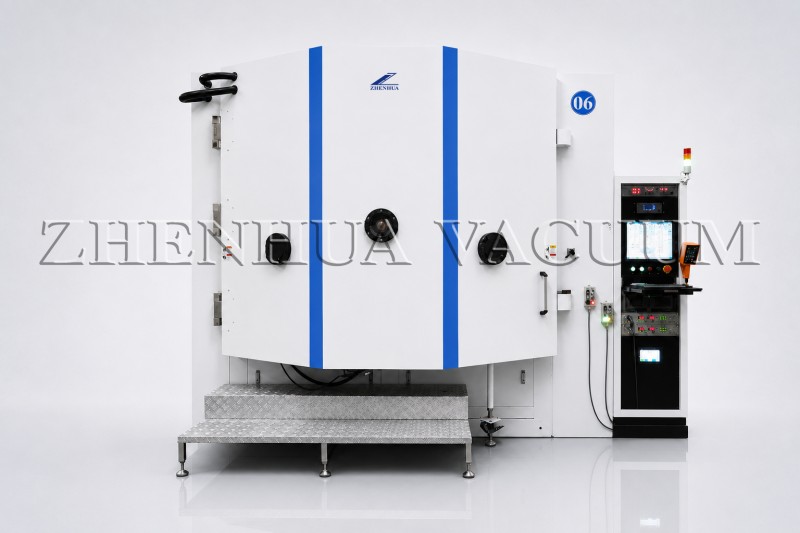
The Zhenhua Vacuum GX2350 optical coating system is specifically designed for the production of optically variable inks and pigments used in cosmetics, anti-counterfeiting labels, and other decorative or security applications.
The system is based on high-energy electron beam evaporation and is capable of evaporating coating materials with melting points of up to 3,000°C. Electron beam evaporation offers high energy density, high thermal efficiency, and high film purity, making it suitable for the deposition of precision multilayer optical coatings.
GX2350 provides large-area uniform deposition and increases single-batch loading capacity to support industrial-scale pigment production. Its high-curvature dome-shaped substrate holder expands the effective coating area and batch capacity while improving the thickness uniformity of multilayer films.
The system integrates aluminum wire-fed resistance evaporation, multiple resistance evaporation sources for release-agent deposition, a high-capacity annular crucible, and a multi-pocket electron beam crucible. This configuration supports multiple coating sequences without frequently venting and opening the chamber, helping to balance deposition uniformity, production capacity, and operational efficiency.
An industrial computer, PLC, and automatic film-thickness monitoring system form a fully automated coating control platform. This improves process stability and run-to-run repeatability, supports extended continuous operation, and reduces dependence on manual intervention.
With optimized process configurations, the GX2350 can achieve a daily production capacity of more than 2,000 grams of optically variable pigment.
No.4 Conclusion
Batch-to-batch consistency in optically variable pigment production is closely related to film thickness, deposition rate, vacuum conditions, substrate motion, thermal stability, and downstream pigment processing.
Among these factors, the vacuum coating process determines the fundamental multilayer optical structure of the pigment. Precise control of film thickness, thickness uniformity, deposition rate, vacuum environment, and process repeatability is essential for achieving stable color performance and reliable mass production.
Zhenhua Vacuum focuses on the key production requirements of optically variable pigments, including film-thickness accuracy, color consistency, and production efficiency. We provide vacuum coating equipment, customized process solutions, and technical support to help customers achieve stable, efficient, and scalable production of optically variable pigments.
-This article was published by vacuum coating equipment manufacturer Zhenhua Vacuum
Post time: Jul-16-2026