
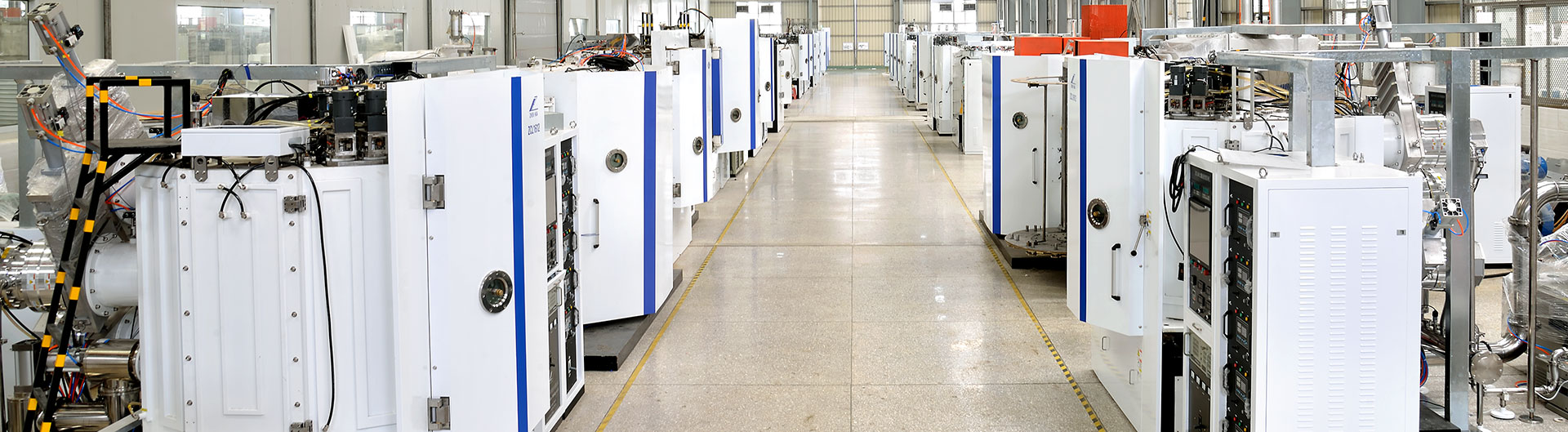
In advanced manufacturing, the value of a product is no longer determined solely by its substrate material. As industries such as consumer electronics, automotive manufacturing, semiconductors, optics, precision tooling, and medical devices continue to demand higher performance, precision, and reliability, the functional requirements placed on product surfaces are becoming increasingly sophisticated.
Wear resistance, corrosion resistance, electrical conductivity, optical performance, thermal stability, and surface appearance have all become critical indicators of product quality.
Advanced coating technologies play a vital role in achieving these performance improvements.
By depositing one or more functional thin-film layers onto a substrate, manufacturers can introduce new physical, chemical, optical, or electrical properties without fundamentally altering the substrate’s bulk structure. This not only extends product service life and enhances functionality but also expands application possibilities and strengthens market competitiveness.
1. Why Are High-Value-Added Products Increasingly Dependent on Coating Technologies?
High-value-added products typically involve higher technical barriers and more stringent requirements for material properties, dimensional accuracy, service life, and product consistency.
However, a single substrate material often cannot satisfy multiple performance requirements simultaneously.
For example, precision cutting tools must combine high hardness, excellent wear resistance, and a low coefficient of friction. Automotive lighting components require high reflectivity, weather resistance, resistance to heat and humidity, and long-term performance stability. Optical components, meanwhile, demand precise control over reflectance, transmittance, and spectral characteristics.
Relying exclusively on substrate materials to achieve these properties often results in higher material costs, increased manufacturing complexity, and limited opportunities for further performance improvements.
Surface engineering through advanced coating technologies offers a more flexible and effective solution.
Processes such as PVD (Physical Vapor Deposition), CVD (Chemical Vapor Deposition), and PECVD (Plasma-Enhanced Chemical Vapor Deposition) enable the deposition of metallic films, compound coatings, hard wear-resistant coatings, optical functional films, and protective layers onto various substrates.
By combining the inherent properties of the substrate with the functional characteristics of thin films, manufacturers can achieve more comprehensive performance improvements.
In other words, high-performance products do not necessarily require expensive bulk materials throughout their entire structure. Through precise thin-film design and controlled deposition processes, manufacturers can achieve competitive surface properties while optimizing overall material costs.
2. How Do Coating Technologies Enhance Product Value?
2.1 Improving Surface Properties and Extending Product Service Life
Under frequent use, heavy loads, or demanding operating conditions, product surfaces are often the first areas exposed to mechanical wear, corrosion, and environmental degradation.
This is particularly evident in precision machining, where cutting tools, molds, and PCB micro-drills are subjected to continuous friction and abrasive wear from challenging workpiece materials. Conventional materials and standard surface treatments may struggle to maintain the required performance over extended production cycles.
By depositing functional coatings such as TiN, TiAlN, AlTiN, CrN, and diamond-based films through PVD or CVD processes, manufacturers can significantly improve surface hardness, wear resistance, oxidation resistance, and tribological performance.
For precision tools such as PCB micro-drills, CVD diamond coatings provide enhanced resistance to abrasive wear when machining high-glass-fiber-content and highly abrasive PCB laminates. This helps reduce tool wear, extend tool life, and maintain consistent machining quality.
For high-performance molds and mechanical components, hard coatings help reduce friction and wear, improve operational stability, and minimize maintenance and replacement frequency.
2.2 Optimizing Optical Performance for High-Precision Applications
In optics, automotive lighting, display technologies, and precision optoelectronics, thin films do far more than provide surface protection. They directly determine the optical performance of the finished product.
Through processes such as magnetron sputtering, electron-beam evaporation, and ion-assisted deposition, manufacturers can produce high-reflectivity coatings, anti-reflection coatings, optical filters, and infrared functional films on glass, plastic, and other optical substrates.
By precisely controlling coating materials, film thickness, refractive indices, and multilayer optical stack designs, the reflection, transmission, and absorption characteristics of light can be tailored to meet specific optical performance requirements.
For example, automotive headlamp reflectors require high reflectance and excellent coating uniformity. Head-up display (HUD) optical components require precise control of reflection and transmission characteristics, while optical lenses rely on anti-reflection and protective coatings to improve optical performance and service reliability.
For these high-precision products, coating technology is not merely an aesthetic consideration. It is a critical factor determining overall product functionality.
2.3 Integrating Multiple Functions to Increase Product Technological Value
As end products evolve toward lightweight structures, miniaturization, and multifunctional integration, a single coating layer is increasingly insufficient to meet complex application requirements.
Multilayer coatings and integrated deposition processes are becoming important development directions in advanced surface engineering.
By combining PVD, CVD, and PECVD technologies, manufacturers can achieve multiple functions on a single product, including decorative finishing, wear resistance, corrosion protection, electrical insulation, conductivity, and optical control.
For example, automotive interior and exterior components can achieve a premium metallic appearance through vacuum metallization, while additional protective layers improve surface durability. Illuminated automotive logos and ambient lighting components require a careful balance between metallic appearance and light transmission.
In electronic components, magnetron sputtering can be used to deposit functional metallic films for conductive layers, diffusion barriers, and electrode structures.
This multifunctional approach shifts product development from competing solely on substrate material properties toward integrated surface functionality, creating greater opportunities for product differentiation and higher added value.
2.4 Improving Product Consistency for Precision Mass Production
For advanced manufacturers, achieving the required technical specifications is only part of the challenge. Maintaining consistent performance across production batches is equally important.
In automotive components, semiconductors, optical elements, and electronic devices, variations in film thickness, composition, adhesion, and coating uniformity can directly affect final product quality.
Modern vacuum coating systems achieve precise control over thin-film deposition through the coordinated operation of vacuum pumping systems, deposition sources, substrate handling mechanisms, temperature control systems, and process automation.
For example, magnetron sputtering enables manufacturers to regulate deposition rates, film composition, and microstructure by adjusting process parameters such as sputtering power, gas flow rate, working pressure, and substrate bias voltage.
Multi-arc ion plating uses parameters such as arc source configuration, substrate bias, and workpiece motion to control the deposition of hard coatings.
For complex geometries and workpieces of different specifications, optimized fixture design, planetary rotation, substrate rotation, and deposition source arrangements also help improve coating coverage and thickness uniformity.
Therefore, advanced vacuum coating equipment is not simply a tool for thin-film deposition. It is an essential foundation for consistent product quality and scalable manufacturing.
3. How Do Different Industries Create Added Value Through Coating Technologies?
Coating technologies have become deeply integrated into various advanced manufacturing sectors, supporting product performance improvements and manufacturing process optimization.
Automotive Manufacturing
Vacuum coating technologies are widely used in automotive headlamp reflectors, transparent taillight covers, interior and exterior trim components, illuminated logos, and HUD optical elements.
Through the combination of metallic reflective coatings, decorative films, protective layers, and optical functional coatings, manufacturers can improve visual appearance, optical performance, and environmental durability.
Semiconductors and Electronics
Magnetron sputtering, ion plating, and other thin-film deposition technologies are used to produce conductive films, diffusion barrier layers, electrode layers, and functional coatings.
For ceramic capacitors, resistors, and precision electronic components, vacuum metallization provides alternative processes for electrode fabrication. In suitable applications, these processes can also help optimize material utilization and manufacturing costs.
Precision Tooling
PVD hard coatings and CVD diamond coatings are widely applied to PCB micro-drills, cutting tools, molds, and precision machining tools.
These coatings help improve wear resistance, machining stability, and tool service life, particularly in demanding machining environments.
Optical Manufacturing
Anti-reflection coatings, high-reflectivity coatings, optical filters, and infrared functional films provide essential optical performance for lenses, displays, sensors, and optoelectronic products.
Although application requirements vary across industries, the underlying principle remains the same: precise thin-film design and deposition control enable products to achieve a combination of properties that may be difficult to obtain through substrate materials alone.
4. High-Value-Added Products Require High-Performance Vacuum Coating Equipment
Thin-film performance depends not only on material selection and process design but also on the technical capabilities of the coating equipment.
Vacuum level, deposition source configuration, film thickness control accuracy, temperature uniformity, substrate movement, and automation capabilities all influence final coating quality and process stability.
For different applications, vacuum coating systems must be specifically designed according to substrate materials, product dimensions, structural characteristics, target film properties, and production throughput requirements.
For optical coating applications, key considerations include precise film thickness control, multilayer optical stack design, and coating uniformity.
For hard coating applications, equipment must provide appropriate deposition rates, strong coating adhesion, high film hardness, and sufficient coverage of complex workpiece geometries.
For automotive decorative coating, particular attention must be paid to appearance consistency, production capacity, and compatibility with different coating processes.
Consequently, manufacturing high-value-added products requires more than advanced thin-film materials and deposition processes. It also depends on vacuum coating equipment that is properly matched to the application, supported by mature process engineering and reliable production technologies.
Conclusion: From Surface Treatment to Core Competitiveness — Coating Technologies Are Redefining Product Value
As advanced manufacturing continues to evolve, coating technologies have moved beyond their traditional roles in surface decoration and protection. They have become essential technologies for improving product performance, driving process innovation, and creating greater added value.
From ultra-hard wear-resistant coatings for precision tools and functional metallic films for automotive components to precision thin-film deposition for semiconductor and optical applications, advanced coating technologies are helping manufacturers overcome the performance limitations of conventional materials.
Competition in high-value-added manufacturing is no longer determined solely by substrate materials and structural design. It is increasingly driven by surface functionality and advanced thin-film technologies.
As a manufacturer of vacuum coating equipment, Zhenhua Vacuum continues to advance the development of PVD, CVD, PECVD, and other thin-film deposition technologies and equipment.
Focusing on the application requirements of the automotive, optical, electronics, semiconductor, and precision tooling industries, Zhenhua Vacuum provides customized vacuum coating equipment and process solutions to help manufacturers enhance product performance, optimize production processes, and create greater product value.
-This article was published by vacuum coating equipment manufacturer Zhenhua Vacuum
Post time: Nov-25-2026