

Driven by the rapid development of AI, the PCB industry is entering a new stage of technological upgrading. Demand for PCBs in servers, automotive electronics, and other applications continues to grow, while segments such as FPCs, HDI boards, and metal-core PCBs are also developing rapidly. As a core component for mounting electronic components and enabling electrical interconnection and signal transmission, PCBs rely on a large number of microvias to establish electrical connections between different circuit layers. Therefore, during PCB manufacturing, micro-drills with diameters of ≤0.20 mm are used to drill holes through copper-clad laminates.
In the past, conventional PCBs were mainly manufactured using FR-4 copper-clad laminates consisting primarily of epoxy resin, fiberglass cloth, and copper foil. These materials feature mature processing characteristics and relatively controllable drilling performance. Cemented-carbide micro-drills, combined with conventional hard coatings such as TiN, TiCN, and TiAlN according to specific machining requirements, were generally sufficient for conventional drilling applications.
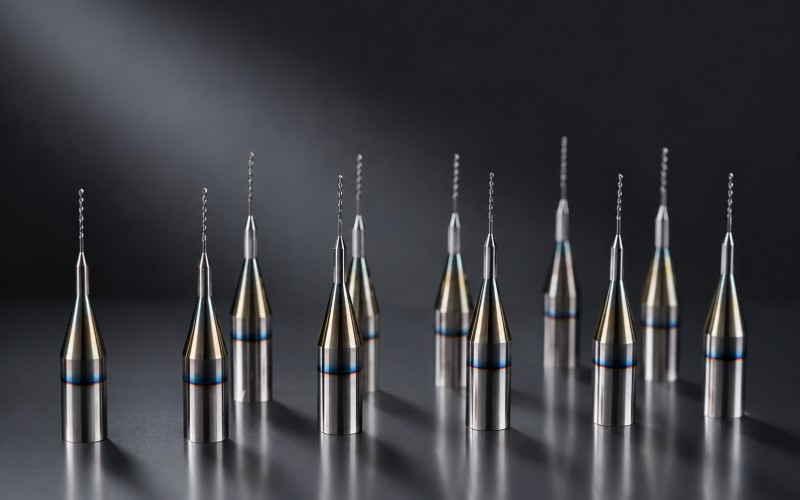
However, as PCB technology continues to advance, increasingly demanding performance requirements are driving changes in resin systems, fiberglass fabrics, and filler formulations. These changes place significantly higher demands on the wear resistance, machining accuracy, and service life of micro-drills.
On the one hand, PCB manufacturers are increasingly adopting low-loss resin systems, low-Dk fiberglass fabrics, quartz fibers, and inorganic fillers. Although these materials help improve high-speed signal transmission performance, they also tend to exhibit higher hardness and abrasiveness than conventional laminate materials. As a result, micro-drills are subjected to greater friction and abrasive wear during high-speed drilling.
On the other hand, as more high-speed signal channels and increasingly complex interconnections are required, the number of PCB layers continues to increase, resulting in greater board thickness. At the same time, high-density interconnect structures require smaller hole diameters, which means that micro-drills must become increasingly smaller in diameter. The combination of greater board thickness and smaller drill diameters leads to a higher aspect ratio, defined as the ratio of the effective drilling length to the drill diameter.
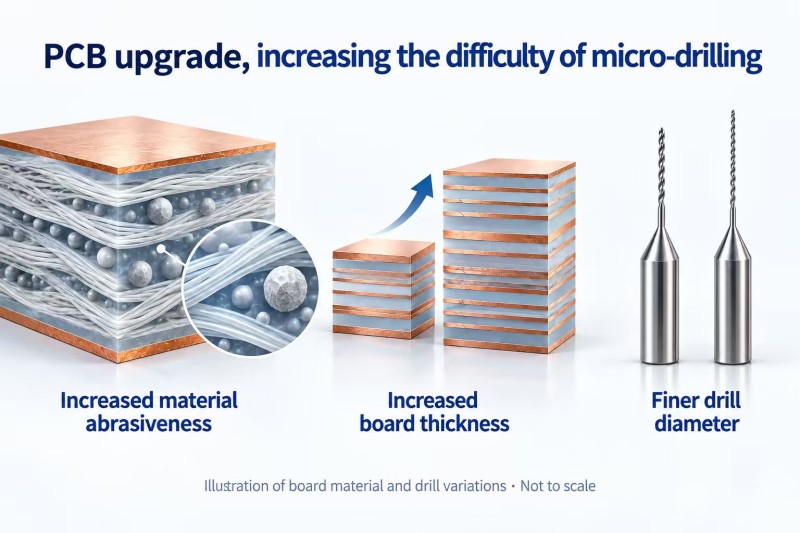
As the aspect ratio increases, the micro-drill becomes thinner and more slender, resulting in lower rigidity and reduced machining stability. Chip evacuation and heat dissipation also become more challenging, making the drill more susceptible to cutting-edge wear, runout, and drill breakage. Consequently, the number of holes that can be consistently machined by a single micro-drill is significantly reduced.
Under these increasingly demanding drilling conditions, micro-drills require enhanced wear resistance, lower friction, and improved cutting-edge retention. The application of high-performance surface coatings has therefore become an important approach to extending micro-drill service life.
2. Enhancing Micro-Drill Life: Ta-C Coatings as an Important Solution
For micro-drills used in high-layer-count, high-density server PCBs, Ta-C (tetrahedral amorphous carbon) coatings offer high hardness, low friction, and excellent surface smoothness. These properties can improve wear resistance and reduce drilling resistance, making Ta-C one of the important coating technologies for high-performance micro-drills.
However, when conventional cathodic arc evaporation is used for coating deposition, micron-scale droplets and macroparticles can be ejected from the cathode target surface and transported together with the plasma toward the substrate. For micro-drills with diameters of only 0.20 mm or even smaller, these macroparticles can easily deposit around the drill tip and cutting edges, increasing coating surface roughness and potentially altering the original cutting-edge geometry.
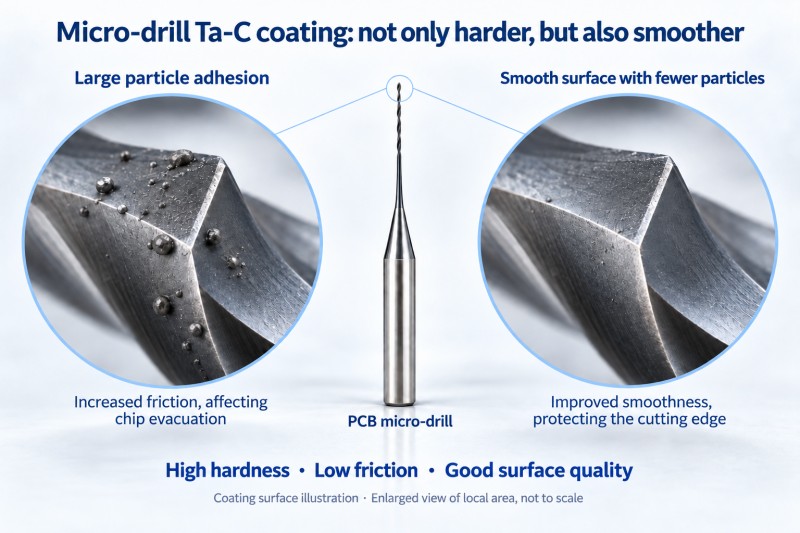
During high-speed drilling, surface particles can further increase friction and cutting resistance, adversely affecting chip evacuation. They may also act as localized stress-concentration sites, accelerating coating delamination and cutting-edge wear. In severe cases, they can increase the risk of edge chipping and drill breakage.
Therefore, Ta-C coatings for micro-drills require not only high hardness, but also an exceptionally smooth surface with minimal macroparticle contamination.
3. Zhenhua Vacuum PCB Micro-Drill Coating Equipment: In-House Developed Curved-Duct Filtration System for Effective Macroparticle Reduction
To address macroparticle deposition during micro-drill coating, Zhenhua Vacuum has independently developed a curved-duct filtration system designed to effectively filter macroparticles generated during cathodic arc deposition, thereby improving coating surface smoothness and overall deposition quality.
The equipment is capable of depositing high-performance Ta-C coatings, combining high hardness, low friction, and excellent wear resistance. The coating hardness can reach approximately 63 GPa, helping meet the demanding wear-resistance and cutting-edge protection requirements of PCB micro-drills. This helps slow cutting-edge wear and extend micro-drill service life.
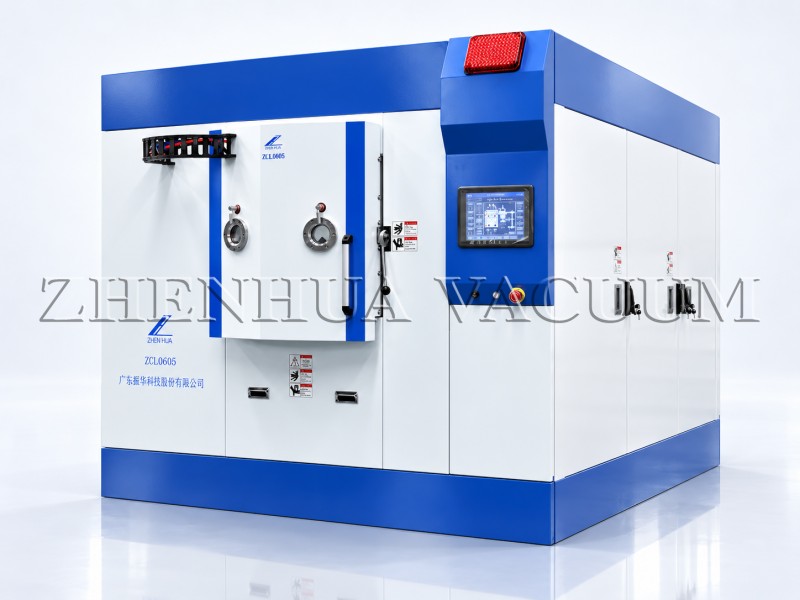
In addition, the equipment can deposit high-temperature-resistant hard coatings such as AlTiN, AlCrN, TiCrAlN, TiAlSiN, and CrN. Its applications cover PCB micro-cutting tools and can also be extended to molds, cutting tools, punches, automotive components, pistons, and other precision components.
To date, Zhenhua Vacuum has delivered 20 sets of this equipment to a well-known PCB manufacturer in China, where the systems have been put into mass-production operation. Through continuous project implementation and actual production-line operation, Zhenhua Vacuum has accumulated extensive experience in PCB micro-drill coating for mass production, enabling us to provide comprehensive support covering equipment configuration, coating process development, process commissioning, and mass-production implementation.
Conclusion
As AI continues to drive technological advancement, PCB materials, layer counts, board thicknesses, and hole diameters are all evolving, placing increasingly stringent requirements on micro-drill wear resistance, machining stability, and service life.
For PCB micro-drills, coating is no longer simply a means of increasing surface hardness. It must provide a balanced combination of high hardness, low friction, low macroparticle contamination, and effective cutting-edge protection. Zhenhua Vacuum will continue to focus on the coating requirements of PCB micro-drills and other precision cutting tools, providing stable and efficient hard-coating equipment and process solutions to help customers achieve more reliable and consistent mass production.
-This article was published by vacuum coating equipment manufacturer Zhenhua Vacuum
Post time: Oct-13-2026