
1. Environmental Pressure: Waterborne Coatings as the Irreversible Trend
With the global wave of sustainability accelerating, the automotive sector—one of the most critical branches of manufacturing—is under unprecedented environmental transformation pressure. Coatings have become a key focus of this transition.
From a regulatory perspective, China’s dual-carbon targets clearly demand lower carbon intensity across industries. Automotive coatings, as a major source of VOC (Volatile Organic Compounds) emissions, are a priority for environmental upgrading. Policies provide explicit guidance: the 14th Five-Year Plan for Green Industrial Development promotes low- or zero-VOC coatings, inks, adhesives, and cleaners to reduce emissions at the source; meanwhile, the Comprehensive VOCs Control Program for Key Industries released by the Ministry of Ecology and Environment identifies the replacement of solvent-based coatings with waterborne coatings as a core strategy in the automotive industry.
Internationally, the EU Green Deal requires significant reductions in both carbon and hazardous emissions along the automotive supply chain, compelling OEMs and Tier-1 suppliers to implement eco-friendly coating processes.
Market data reinforces the trend. According to China Industry Research Network, the domestic waterborne coating (including waterborne paints) market reached RMB 267.59 billion in 2023, up 7.9% year-on-year, with a projected CAGR of 8–10% from 2025 to 2030. Globally, the waterborne coatings market was valued at RMB 549.37 billion in 2023, with China’s share increasing to 35%.
These signals make it clear: the transition from solvent-based coatings to waterborne coatings is not optional but inevitable.
2. Core Pain Point: Waterborne Coatings Fail to Adhere to Plastic Substrates
Despite the market’s momentum, waterborne coatings bring a new challenge for interior parts manufacturing—frequent paint peeling.
Most automotive interior components are made from low-surface-energy plastics such as ABS and PP. These substrates have poor polarity and hydrophilicity, making them inherently incompatible with waterborne coatings. In actual production, even with conventional pre-treatments like primers and sanding, adhesion issues persist.
Conventional solutions are limited:
Primer coatings require the addition of numerous chemical additives, increasing costs while reintroducing VOC emissions—contradicting the intent of environmental regulations.
Mechanical abrasion may damage the surface smoothness of plastic substrates, affecting appearance, and struggles to treat complex geometries, leading to inconsistent results.
Thus, as waterborne coatings become mandatory, improving adhesion to plastic substrates has become a critical bottleneck for automakers.
3. Zhenhua Vacuum’s Solution: Vacuum Fluorination Surface Treatment System
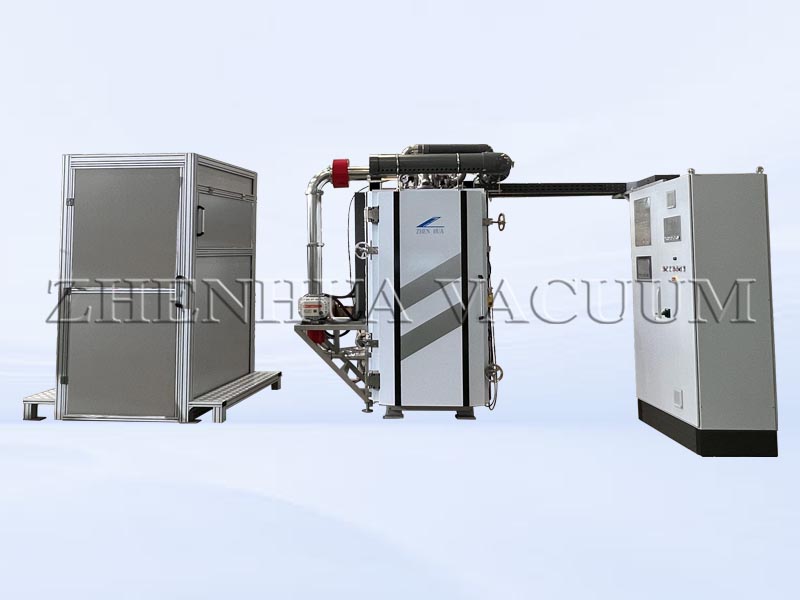
Leveraging over 30 years of expertise in vacuum surface engineering, Zhenhua Vacuum has developed China’s first Vacuum Fluorination Surface Treatment System, designed to address the adhesion issue at its root. Its key advantages include:
Direct Adhesion Enhancement – Making Waterborne Coatings “Stick”
Through innovative fluorination modification, reactive fluorine species interact with the molecular structure of plastic surfaces, enhancing polarity and hydrophilicity without damaging the substrate. This allows waterborne coatings to wet uniformly and form strong, durable adhesion.
Long-Term Performance – More Durable Interior Parts
Fluorination creates a dense modified layer that not only blocks moisture and contaminants but also improves anti-aging and scratch resistance. Independent testing confirms significantly extended service life of treated components, reducing warranty and after-sales costs for OEMs.
Flexible Adaptation – Effective for Complex Geometries
The process parameters—including fluorine gas concentration, temperature, and treatment time—can be finely tuned. Whether for ABS, PP, or PC, or for large dashboards, small precision keys, or intricate grooved structures, the treatment achieves uniform surface modification to meet diverse production needs.
Cross-Industry Value – Beyond Automotive
Automotive: Enhances coating performance for interior and exterior plastic parts, meeting stringent EU environmental standards.
Chemical Equipment: Improves corrosion resistance and durability of polymer components.
Electronics: Strengthens protective properties of plastic housings and components.
Packaging: Optimizes barrier properties and printability of films.
Functional Films & Fibers: Enables advanced performance in specialty polymer films.
As the shift to waterborne coatings deepens, paint peeling on interior parts has emerged as a critical bottleneck in the automotive industry. Zhenhua Vacuum’s Vacuum Fluorination Surface Treatment System, with its strengths in adhesion improvement, durability enhancement, and compatibility with complex geometries, provides a definitive solution—not only for automakers but also for a wide range of industries seeking surface engineering upgrades.
For companies aiming to achieve both environmental compliance and product quality improvement, adopting vacuum fluorination surface treatment is a strategic choice to overcome challenges and seize market opportunities.
Post time: Aug-28-2025