
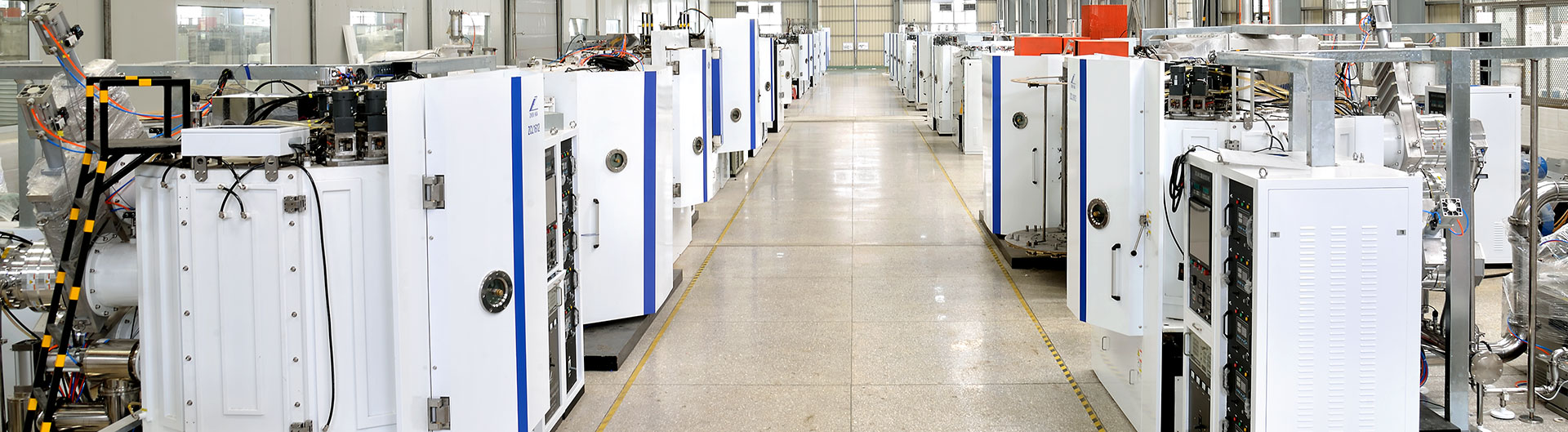
With the continued advancement of China’s “dual carbon” goals, the photovoltaic (PV) industry is experiencing unprecedented growth. As a key process for improving solar cell efficiency and enhancing device performance, vacuum coating technology is playing an increasingly vital role across multiple stages of PV manufacturing, driving industrial upgrading and innovation.
Vacuum Coating: The “Invisible Process” Behind PV Devices
Vacuum coating refers to a technique for depositing thin films onto a substrate surface under vacuum conditions, using either physical or chemical methods—primarily PVD (Physical Vapor Deposition) and CVD (Chemical Vapor Deposition). Compared to traditional wet processes, vacuum coating offers superior film uniformity, strong adhesion, precise thickness control, and minimal contamination, making it an essential step in the production of high-performance photovoltaic devices.
Key Applications of Vacuum Coating in Photovoltaics
1. Anti-Reflective (AR) Coatings for Crystalline Silicon Cells
Applying anti-reflective coatings on the surface of crystalline silicon cells is crucial to enhance light absorption. Common materials like silicon nitride (SiNx) are typically deposited using Plasma Enhanced Chemical Vapor Deposition (PECVD), which effectively reduces surface reflection losses and boosts overall cell efficiency.
2. Transparent Conductive Oxide (TCO) Films
In thin-film solar cells, TCO layers such as ITO (Indium Tin Oxide) and AZO (Aluminum-doped Zinc Oxide) serve as critical front electrodes. These are usually deposited via magnetron sputtering, a PVD process that ensures high transmittance, low resistivity, and excellent environmental durability.
3. Back Reflective and Barrier Layers
Backsheet structures often incorporate reflective layers (e.g., Ag, Al) and barrier layers (e.g., SiOx, Al2O3), which are also typically applied via vacuum coating. Reflective layers enhance internal light trapping, while barrier layers improve long-term stability and resistance to moisture and thermal stress.
4. Thin-Film Deposition in Perovskite Solar Cells
Emerging perovskite solar cells involve multiple layers—such as transport layers, interface layers, and encapsulation coatings—each requiring high-precision, low-damage deposition. Vacuum coating demonstrates strong potential in this domain, particularly for achieving uniform large-area films critical to commercial scalability.
Industry Trends and Equipment Demands
As PV technologies evolve toward heterojunction (HJT) and perovskite/silicon tandem cells, the demand for more complex film stacks and greater film stability is rapidly increasing. In response, equipment manufacturers are introducing advanced systems featuring higher throughput, automation, and energy efficiency—such as large-area inline magnetron sputtering systems and roll-to-roll vacuum coating systems—to meet the mass production needs of GW-scale PV manufacturing lines.
Coating Technology Powers the Future of Solar
Vacuum coating is not only a proven method for improving photovoltaic module performance but also a core enabler of next-generation high-efficiency cell structures. From conventional crystalline silicon to innovative perovskite solutions, from material optimization to full-process integration, coating technology is becoming deeply intertwined with the solar industry—paving the way toward a low-carbon, green, and high-efficiency energy future.
-This article is released by vacuum coating machine manufacturer Zhenhua Vacuum.
Post time: Jun-19-2025