
In the cosmetics industry, the evolution of color never ceases. From matte to shimmer, from solid tones to gradient transitions—behind each wave of makeup trends lies innovation in materials and processing. A new category of color-shifting eyeshadows, now frequently appearing in major product launches, is quietly becoming the next consumer sensation.
These eyeshadows change color depending on the angle and lighting, displaying dynamic visual effects akin to iridescent shells or butterfly wings. Rather than static blocks of pigment, they behave like “living color interfaces,” seemingly breathing with light. More than just beautiful, they are interactive—offering a layer of visual surprise. But what powers this photochromic phenomenon is not traditional pigment blending, but rather a technology more often associated with high-tech optics: vacuum coating.
A Technology Where Light, Not Pigment, Paints the Color
The principle behind these eyeshadows draws from structural color in nature—the same optical effect seen in peacock feathers or beetle shells, where vivid hues result not from dyes, but from microscopic structures that interfere with light. Vacuum deposition technology transforms this natural mechanism into a precise, scalable manufacturing process.
In these products, the surface of the base powder or substrate is coated with a nanometer-scale oxide film, with thickness precisely controlled. By adjusting the film’s material, thickness, and surface morphology, it’s possible to manipulate the way light is reflected and refracted—creating vivid, angle-dependent color effects perceptible to the human eye.
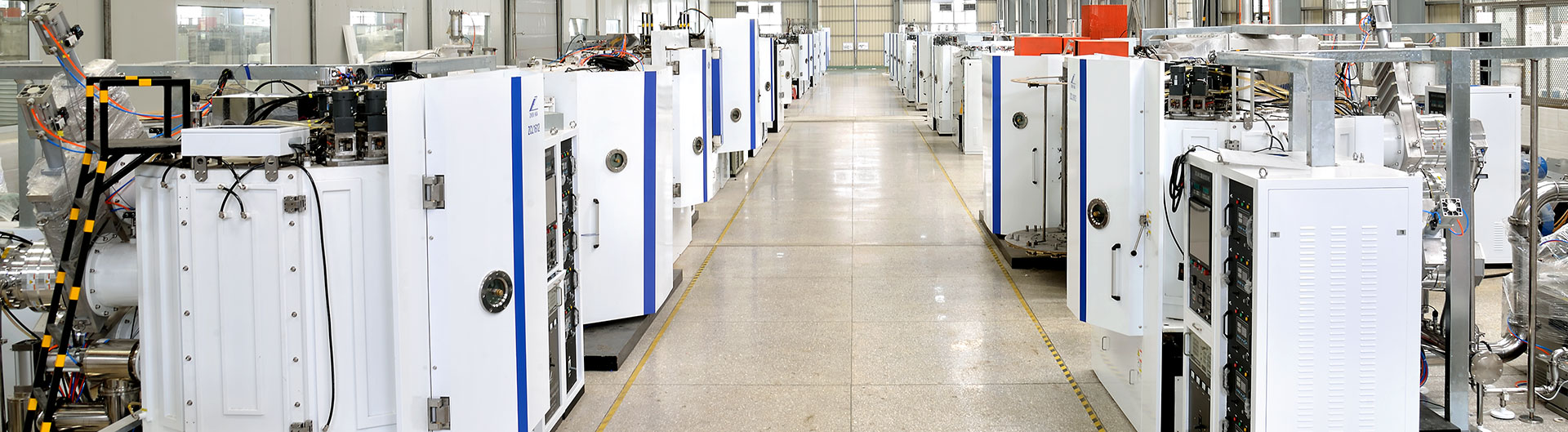
To build such sophisticated nanostructures, manufacturers rely on vacuum coating systems for their high precision and contaminant-free environments. Put simply, vacuum coating involves evaporating or sputtering functional materials under high vacuum, and depositing ultra-thin layers on powder or plastic surfaces. These layers finely interfere with visible light, creating the “color-changing” visual effect without the need for dyes.
Why Vacuum Coating Is Becoming a “High-Level” Cosmetic Technique
Compared with traditional ink printing or powder blending, vacuum coating offers several distinct advantages in cosmetic applications:
Expanded color-shift dimensions: By tuning the coating material, thickness, and layering pattern, a wide range of angular color effects across the visible spectrum can be achieved.
Superior adhesion and durability: Coated eyeshadows exhibit enhanced resistance to fallout and abrasion, ideal for long-wear formulations.
Eco-friendly manufacturing: The process occurs in a closed vacuum chamber with minimal solvent use and low VOC emissions, supporting the cosmetic industry’s sustainability goals.
Scalable and customizable: Suitable for mass production lines with programmable parameters, enabling brand-level customization for color expression and finish.
As the beauty industry shifts from pure color aesthetics to sensory-driven tech expression, vacuum coating is no longer exclusive to lenses, smartphones, or optical components. It is quietly making its way into compacts, onto vanity tables—redefining what color can do.
Beyond Eyeshadow: Where Is Color-Shifting Beauty Headed Next?
In addition to color-shifting eyeshadows, vacuum deposition enables photochromic and visual effect finishes across a variety of beauty applications:
Lipstick tubes and powder compacts: Iridescent or gradient finishes that boost shelf appeal
Brand labels and tamper-evident seals: Optical variable coatings (OVC) for angle-dependent security features
Brush handles and cosmetic accessories: Unique chromatic effects to distinguish product lines
Seasonal or limited-edition collections: Premium finishes that enhance artistic or co-branded product narratives
Put simply, as long as color remains core to brand identity, vacuum coating will have a role to play.
Zhenhua Vacuum’s GX2350 Optical Variable Ink Coating Machine
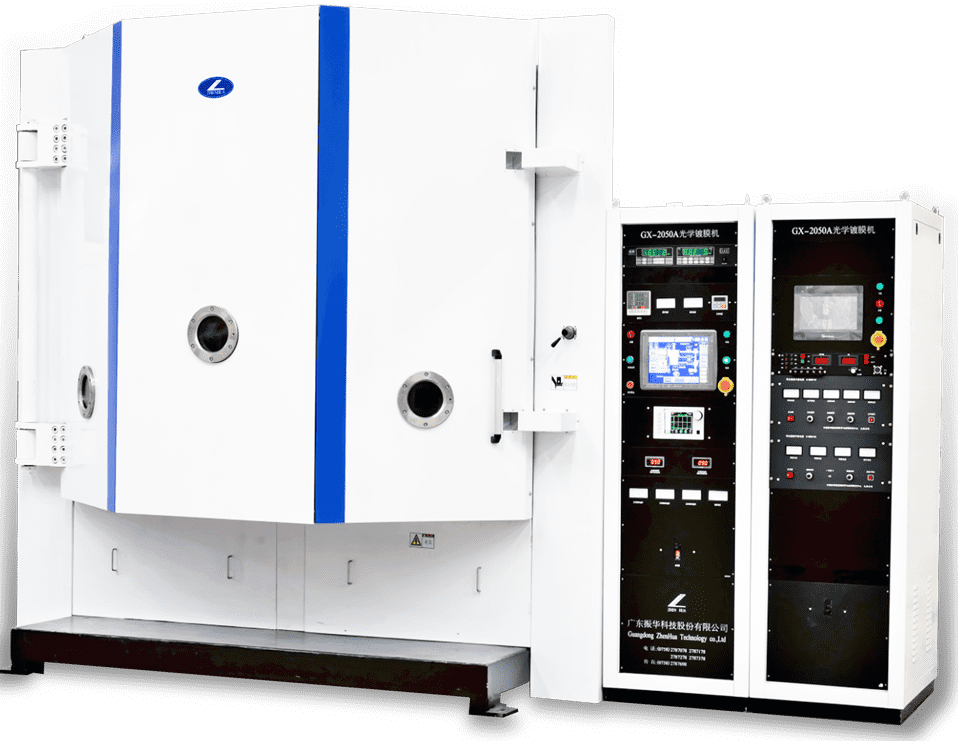
The GX2350 Optical Coating System by Zhenhua Vacuum is specifically designed for photochromic inks and effect pigments, enabling large-scale production for cosmetics, anti-counterfeit products, and specialty labels. With a daily throughput of up to 2000 grams, it meets high-volume and high-efficiency requirements for industrial color-shifting applications.
Equipped with high-energy electron beam evaporation, GX2350 can vaporize coating materials with melting points exceeding 3000°C, delivering high-purity and high-optical-efficiency thin films.
The system features a large-arc dome fixture to maximize batch capacity and minimize unit cost. It integrates multiple resistance evaporation sources (aluminum wire, release agents), a high-capacity ring crucible, and a multi-pocket setup, enabling multi-cycle deposition with fewer door openings and higher uptime.
A fully automated control system built on industrial PC + PLC + in-situ film thickness monitoring ensures stable, repeatable results with long-term continuous operation—no manual intervention needed, helping customers achieve cost-down and performance-up manufacturing.
-This article is released by vacuum coating machine manufacturer Zhenhua Vacuum.
Post time: Jun-18-2025