
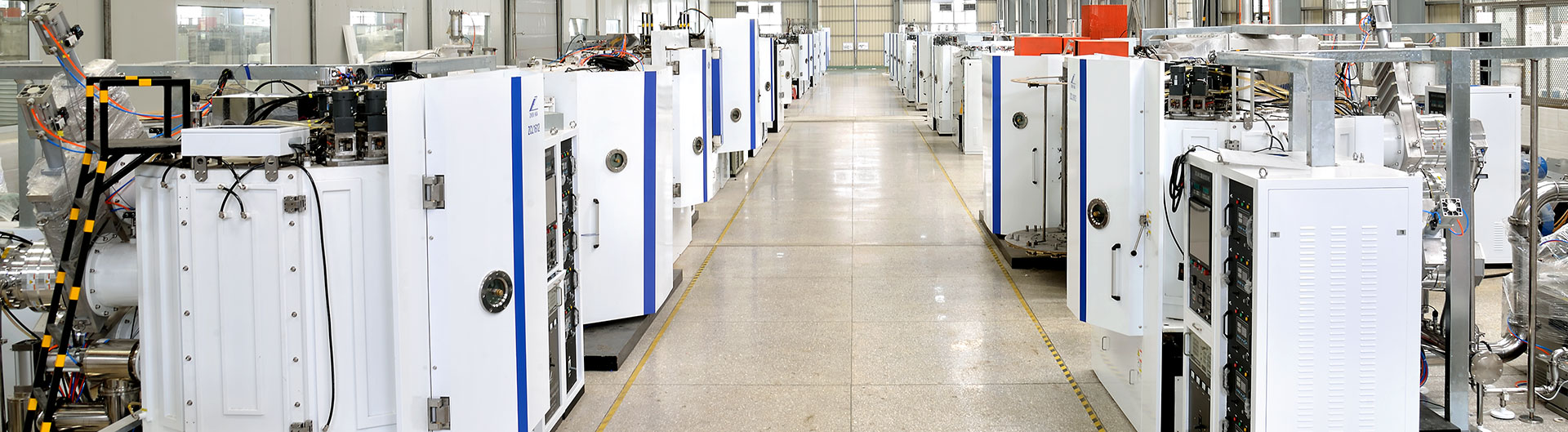
In vacuum coating systems, vacuum pumps play a critical role. They are essential components for achieving the high-vacuum environment required for coating processes, directly impacting coating efficiency, film quality, and production yield. Different coating processes have varying vacuum level requirements, making proper pump selection crucial. As a leading vacuum coating equipment manufacturer, Zhenhua Vacuum provides a comprehensive analysis of major vacuum pump types and their specific applications in coating technologies.
No.1 Classification of Vacuum Pumps
Based on operating principles, vacuum pumps can be categorized as follows:
1. Mechanical Pumps (Fore Pumps)
Primarily used to evacuate systems from atmospheric pressure to low vacuum (10⁻¹ ~ 10⁻³ Pa), typically serving as backing pumps for high-vacuum pumps.
Rotary Vane Pumps: Compact design, easy maintenance, suitable for small-scale coating systems.
Dry Screw Pumps: Oil-free operation, ideal for clean vacuum systems with high purity requirements.
2. Turbomolecular Pumps (High-Vacuum Pumps)
Capable of achieving ultra-high vacuum (≤10⁻⁶ Pa), often paired with mechanical pumps for PVD (Physical Vapor Deposition) and CVD (Chemical Vapor Deposition) processes. They provide clean, stable high-vacuum conditions, making them a core component in high-precision coating systems.
3. Diffusion Pumps
While capable of reaching 10⁻⁶ Pa, their oil vapor contamination limits their use in optical coatings and other high-purity applications. Increasingly replaced by turbomolecular pumps in industrial coating systems.
4. Roots Pumps (Booster Pumps)
Commonly used with rotary vane pumps during the medium-vacuum stage to enhance pumping speed and reduce pump-down time before coating.
5. Turbo Molecular Pumps
Known for high pumping speeds and stable operation, they are widely used in semiconductor, optical, and medical coating applications requiring continuous production.
No.2 Application Scenarios in Vacuum Coating
Different vacuum pump configurations are employed at various coating stages:
Initial Pumping Stage: Mechanical pumps (e.g., rotary vane, dry pumps) rapidly reduce chamber pressure.
Medium-Vacuum Stage: Roots pumps improve evacuation efficiency.
High-Vacuum Stage: Turbomolecular/Turbo pumps establish the required high-vacuum environment.
Special Coating Processes: Magnetron sputtering and E-beam evaporation demand oil-free systems or high-performance dry pumps to ensure film purity.
Pump selection must consider material type, process temperature, film thickness, and system volume to meet specific vacuum level and cleanliness requirements.
No.3 Selecting an Optimal Vacuum Pump System
An ideal vacuum pumping system should feature:
Pumping speed matched to chamber volume
Achievement of target ultimate vacuum
Stable operation with low maintenance
Oil-free and particle-free performance
Compliance with environmental and energy standards
For precision optical, semiconductor, or decorative coating applications, a three-stage combination (Dry Pump + Roots Pump + Turbomolecular Pump) is recommended.
Though compact, vacuum pumps are vital to vacuum coating systems. Proper pump selection and configuration enhance film quality, system efficiency, equipment lifespan, and cost-effectiveness. Contact Zhenhua Vacuum for customized vacuum solutions tailored to your coating needs.
-This article is released by vacuum coating machine manufacturer Zhenhua Vacuum.
Post time: Jun-14-2025