
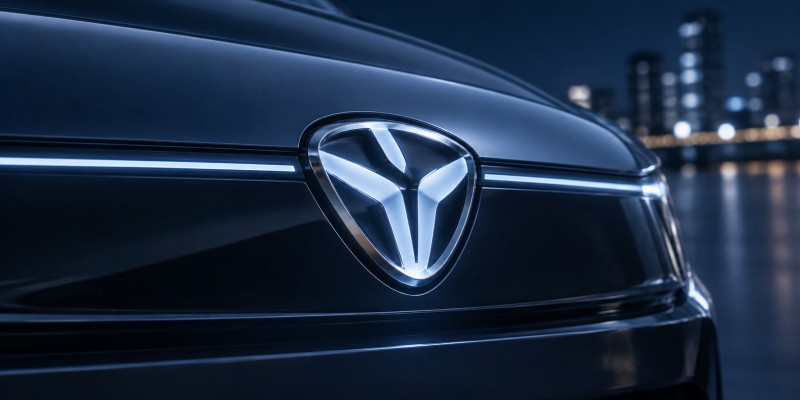
Illuminated automotive emblems need to present a uniform and attractive reflective appearance when the lighting is off, while allowing the internal LED light to transmit evenly when illuminated, creating a clear and well-defined lighting pattern. How can the same surface achieve both functions? A semi-transparent reflective coating deposited by a vacuum coating process is a key optical solution for achieving this effect.
This type of coating partially reflects incident light while allowing a certain amount of light to pass through. In actual production, however, it is not enough for the emblem to simply “transmit light.” Uniform reflectivity and light transmission must be maintained across the entire part, including areas with bends and corners. This is particularly challenging for large-sized emblems with curved surfaces and complex geometries, where higher requirements are placed on coating uniformity and production consistency.

1. Working Principle and Material Selection of Semi-Transparent Reflective Coatings
In the unlit state, the coating reflects ambient light to create the desired metallic appearance. When the emblem is illuminated, light emitted by the internal LEDs is homogenized through the light-guide and diffuser structures before transmitting through the coating. The coating itself does not “switch” between the two states; it continuously reflects and transmits light. What changes is the activation of the internal light source and the relative intensity of the internal and external light.
The coating system used to achieve this effect is mainly based on a thin metallic layer.
Coating system: Thin metallic film
Common materials: Aluminum, chromium
Key characteristics: Transmittance and reflectance are controlled through material selection and film thickness, while appearance, absorption loss, and durability vary depending on the material and coating structure.
Typical applications: Applications requiring a metallic appearance while maintaining a certain level of light transmission.
2. Key Challenges in Coating Semi-Transparent Reflective Layers for Illuminated Automotive Emblems
1. Coating Uniformity on Complex Geometries
The outer covers of illuminated automotive emblems typically feature curved surfaces, bends, edges, recesses, and other complex geometries. The distance, orientation, and line-of-sight relationship between different areas of the workpiece and the coating source can vary significantly, resulting in differences in deposition rate and film thickness. For semi-transparent reflective coatings, variations in film thickness or microstructure may lead to changes in light transmittance, reflectance, and color.
Uniformity evaluation should cover critical areas such as the center, edges, and bends rather than relying solely on measurements from the central area. Local brightness variations after illumination may also be related to LED arrangement, light-guide structures, and diffuser design. Therefore, troubleshooting and process optimization should take the coating system and the overall optical structure into consideration.
2. Balancing Light Transmission and Metallic Appearance
The same coating system needs to satisfy two requirements: providing a uniform metallic appearance when the emblem is not illuminated while allowing sufficient internal light to transmit when the LEDs are switched on. This requires coordinated control of optical transmittance and reflectance to achieve the required illumination brightness while maintaining the desired metallic appearance and masking effect in the unlit state.
During coating system development, the target ranges for transmittance and reflectance should be clearly defined, together with the corresponding wavelength ranges and measurement conditions. During deposition, the material composition, individual layer thickness, and coating structure must be consistently controlled. Final validation should combine optical measurements with visual evaluation of the complete part to verify illumination brightness, color, and light uniformity in the lit state, as well as metallic appearance and masking performance in the unlit state.

3. From Prototype Qualification to Mass-Production Consistency
Achieving qualification on a single sample is only the starting point for mass production. During continuous production, variations in coating source condition, workpiece loading configuration, and vacuum conditions can all affect coating consistency.
Mass-production control therefore needs to address both within-part uniformity and part-to-part and batch-to-batch consistency. Within the qualified process window, stable production parameters must be established according to the loading configuration and production cycle time. Batch inspection and process monitoring should also be implemented to identify deviations at an early stage, reducing repeated process adjustments, rework, and associated production costs and lead times.
4. Balancing Initial Optical Performance with Long-Term Reliability
As an automotive exterior component, an illuminated emblem needs to withstand environmental conditions such as thermal cycling, damp heat aging, and UV exposure. Coating adhesion and weather resistance depend not only on the coating system itself, but also on substrate cleanliness, surface preparation quality, film stress, and the overall protective structure.
Meeting the initial optical specifications does not necessarily mean that long-term reliability has been fully validated. Appropriate environmental and reliability tests should be conducted according to the product specifications to verify whether coating adhesion, appearance, and optical performance remain within the required specifications after testing.
3. Zhenhua Vacuum Solution for Illuminated Automotive Emblem Coating
ZCL1417 Automotive Coating System
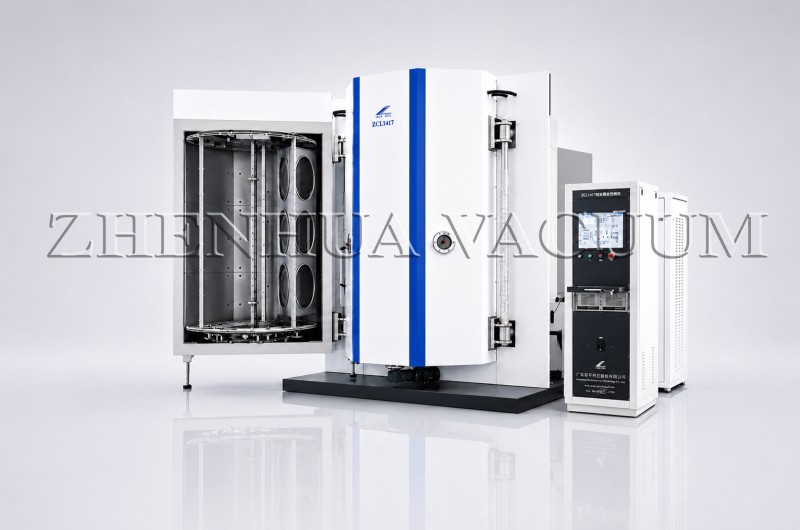
The ZCL1417 is a compact, multifunctional vacuum coating system designed for automotive applications. It can be configured with different coating technologies according to specific process requirements, while supporting automated operation for simple and efficient production.
The system integrates magnetron sputtering, CVD, and resistance evaporation technologies, allowing flexible switching between different coating processes and accommodating a wide range of automotive components with complex coating requirements.
The ZCL1417 can complete the deposition of both metallic films and protective coatings in a single vacuum cycle, helping avoid secondary-process contamination while achieving high coating uniformity and high-gloss surface finishes.
The system is suitable for a variety of automotive components, including headlamp reflectors, interior ambient-light components, illuminated emblems, illuminated radar emblems, and automotive interior trim parts. It can be used to deposit metallic coatings, reactive coatings, semi-transparent coatings, and other functional or decorative film systems.
-This article was published by vacuum coating equipment manufacturer Zhenhua Vacuum
Post time: Sep-09-2026