
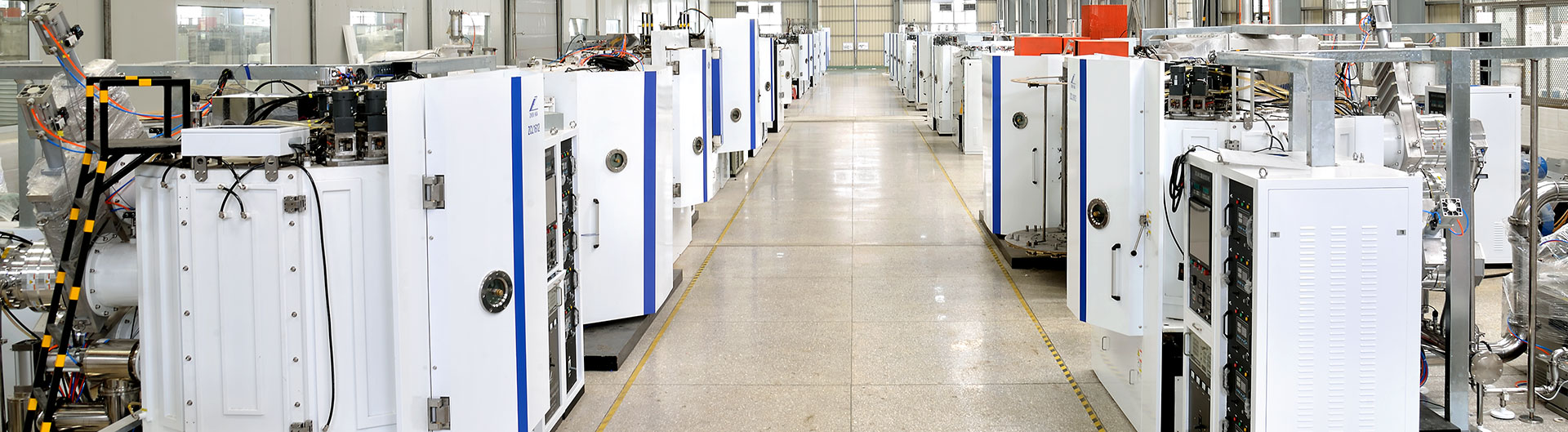
In vacuum coating processes, vacuum level is not merely a background condition, but a fundamental parameter that directly determines process stability, film quality, and production repeatability.
In industrial-scale PVD and evaporation coating systems, insufficient or unstable vacuum conditions often become the root cause of coating defects, yield fluctuation, and long-term reliability issues.
This article analyzes the real, application-level impact of different vacuum ranges on coating stability from an equipment and process engineering perspective.
1. Vacuum Level as the Foundation of Stable Thin-Film Deposition
In vacuum coating, the vacuum environment primarily controls:
Residual gas composition; Mean free path of evaporated or sputtered particles; Plasma stability; Surface contamination during film growth
As vacuum level decreases (pressure increases), the probability of gas-phase collisions rises sharply, directly affecting film density, uniformity, and adhesion.
Therefore, vacuum level is not an isolated parameter—it defines the physical boundary conditions of the entire deposition process.
2. Low Vacuum Range: Instability at the Source
In the low vacuum range (typically >10⁻² mbar), the coating process faces inherent instability risks:
Short mean free path of coating species
Evaporated atoms or sputtered particles undergo frequent collisions with residual gas molecules, leading to:
Reduced directional transport
Lower deposition efficiency
Poor thickness control
High impurity incorporation
Water vapor, oxygen, and hydrocarbons remain active, resulting in:
Oxidized or contaminated films
Degraded electrical, optical, or mechanical properties
Unstable plasma conditions (for PVD processes)
Increased gas scattering disrupts plasma density and uniformity, making it difficult to maintain consistent discharge behavior.
In this vacuum range, coating results are highly sensitive to minor fluctuations, making process repeatability extremely difficult to achieve.
3. Medium Vacuum Range: Basic Process Feasibility, Limited Stability
The medium vacuum range (approximately 10⁻³ to 10⁻⁴ mbar) is often considered the minimum threshold for industrial vacuum coating.
At this level:
Particle transport becomes more directional
Plasma ignition and maintenance are achievable
Basic film formation is possible
However, from a production perspective, process stability remains constrained:
Residual gases still significantly influence film composition
Coating properties show noticeable batch-to-batch variation
Long production runs are prone to gradual drift
This vacuum range may be acceptable for decorative coatings or low-demand applications, but it is insufficient for high-performance or high-consistency requirements.
4. High Vacuum Range: Enabling True Process Stability
When the base pressure reaches the high vacuum range (typically ≤10⁻⁵ mbar), coating stability improves fundamentally.
Key advantages include:
Extended mean free path
Coating particles travel ballistically from source to substrate, ensuring:
Predictable deposition rates
Improved thickness uniformity
Stable angular distribution
Minimal contamination during film growth
Reduced oxygen and moisture levels result in:
Dense, high-purity films
Strong interfacial bonding
Improved mechanical and functional performance
Stable plasma behavior
In PVD systems, controlled gas introduction occurs on a clean vacuum background, allowing:
Precise plasma density control
Repeatable discharge conditions
Reliable process windows
At this level, coating stability becomes controllable rather than empirical, enabling long-term, repeatable production.
5. Ultra-High Vacuum and Its Role in Advanced Applications
For certain high-end applications—such as optical multilayers, precision functional coatings, and advanced electronics—ultra-high vacuum conditions further reduce variability sources.
While not always required for standard industrial production, ultra-high vacuum:
Minimizes interfacial contamination
Enhances film interface sharpness
Improves long-term reliability and consistency
The value of ultra-high vacuum lies not in speed, but in process precision and predictability.
6. Vacuum Stability vs. Absolute Vacuum Level
In practical manufacturing, vacuum stability is as critical as absolute vacuum level.
Even a system capable of reaching high vacuum can suffer from:
Pumping instability; Outgassing from chamber materials; Thermal-induced pressure fluctuations;
These factors lead to:Plasma drift; Deposition rate fluctuation; Film property inconsistency
Therefore, coating stability depends on a well-designed vacuum system, including:Proper pump configuration; Effective chamber conditioning; Controlled process sequencing
7. Conclusion: Vacuum Level Defines the Upper Limit of Coating Stability
In vacuum coating, process stability is ultimately constrained by vacuum conditions.
Higher vacuum levels: Reduce uncontrollable variables; Expand stable process windows; Enable reproducible, high-quality coatings
For manufacturers aiming at high yield, long-term consistency, and scalable production, vacuum level should be treated as a core engineering parameter, not merely a system specification.
A stable vacuum environment is not an option—it is the foundation of reliable vacuum coating technology.
–This article was published by vacuum coating equipment manufacturer Zhenhua Vacuum
Post time: Jan-08-2026