
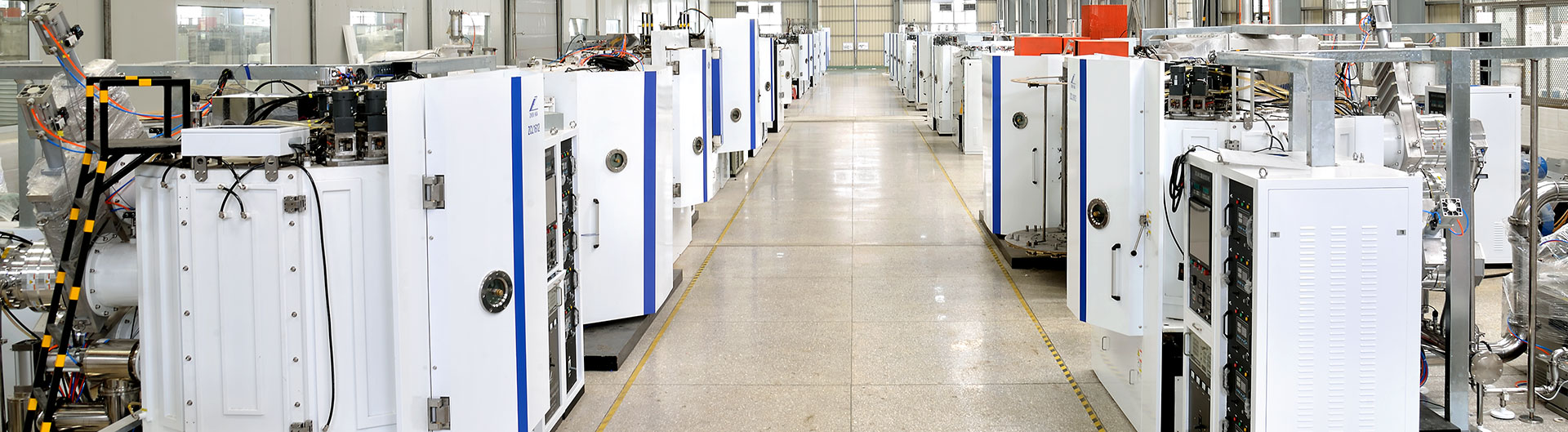
As modern manufacturing continues to demand higher precision and performance from products, vacuum coating technology has become widely used across various fields due to its efficiency in surface treatment. However, the coating process itself is often constrained by the cleanliness of the substrate surface and the adhesion of the coating. In this context, plasma cleaning technology, as an effective surface treatment process, has gradually emerged as an important method to combine with vacuum coating. The synergistic effect of these two processes can significantly improve the coating result, ensuring a higher quality surface layer.
What is Vacuum Coating?
Vacuum coating is a process in which metal, ceramics, or other functional materials are deposited onto a substrate surface under a high vacuum environment through methods such as evaporation or sputtering to form a thin film. Common vacuum coating technologies include Physical Vapor Deposition (PVD) and Chemical Vapor Deposition (CVD). This process is widely used in industries such as electronics, optics, automotive, and home appliances to enhance the surface properties of materials, such as improving conductivity, corrosion resistance, wear resistance, and aesthetic appeal.
Introduction to Plasma Cleaning Technology
Plasma cleaning is a technique that utilizes the high-energy characteristics of plasma to clean the surface of objects. By exciting gas molecules to generate plasma, organic substances, oxides, or contaminants on the surface are decomposed and removed. Plasma cleaning is highly efficient, environmentally friendly, and precise, making it widely applicable in the surface treatment of electronic components, automotive parts, medical devices, and more. In a vacuum environment, plasma cleaning provides a cleaner and more uniform substrate surface for subsequent vacuum coating processes, thereby improving the adhesion and quality of the coating layer.
The Combination of Vacuum Coating and Plasma Cleaning
Enhancing Substrate Surface Adhesion
In the vacuum coating process, the adhesion of the film layer is one of the key factors that determine coating quality. Contaminants such as oxidation layers, grease, and dust on the substrate surface can directly affect the adhesion of the film layer, even causing delamination. Traditional cleaning methods, such as solvent cleaning and ultrasonic cleaning, often fail to completely remove fine contaminants, resulting in weak adhesion. Plasma cleaning, through the action of high-energy plasma, effectively removes fine impurities and contaminants from the substrate surface, thereby improving the adhesion and uniformity of the coating layer.
Optimizing Film Uniformity and Density
Plasma cleaning not only removes contaminants but also micro-modifies the substrate surface. For example, plasma treatment can create active groups on the surface, increasing surface energy and promoting better bonding between the film and the substrate. This ensures more uniform film deposition during the vacuum coating process, improving the density and stability of the film layer, especially in high-demand applications such as optical films or hard coatings. Plasma cleaning plays a particularly significant role in these applications.
Improving Production Efficiency and Product Quality
In large-scale production, the combination of vacuum coating and plasma cleaning can significantly improve production efficiency and product quality. Plasma cleaning completes surface cleaning quickly, providing ideal surface conditions for the subsequent vacuum coating. Compared to traditional cleaning methods, plasma cleaning is faster and capable of handling more complex and precise components, such as complex curves and micro-sized parts. This reduces quality fluctuations and rework rates during production.
Environmental and Cost Advantages
Plasma cleaning does not require the use of chemical solvents or large quantities of water resources, avoiding pollutants and waste liquids that may be generated by traditional cleaning methods. Since it does not involve harmful chemicals, plasma cleaning is more environmentally friendly. Additionally, the cleanliness of the substrate surface directly impacts the quality of the film layer in vacuum coating. Plasma cleaning effectively reduces film defects, decreasing rework and waste rates due to non-conforming film layers, thereby saving costs for companies.
Application Examples
Electronics Industry: In the manufacturing of semiconductors and optoelectronic components, vacuum coating and plasma cleaning are often used together. Plasma cleaning removes tiny organic contaminants, ensuring a high-purity surface for electronic components, providing ideal adhesion for subsequent metallization and coating processes.
Automotive Industry: In the coating of automotive parts, such as mirrors, logos, and interior components, plasma cleaning enhances coating consistency and durability while reducing scratches and bubbles after the coating process.
Optics Industry: In high-precision optical lens coating, the combination of plasma cleaning and vacuum coating effectively prevents defects such as bubbles and peeling, ensuring the stability of optical performance.
Conclusion
The combination of vacuum coating and plasma cleaning provides a new solution for modern surface treatment technologies. Through the efficient surface pre-treatment offered by plasma cleaning, the adhesion, uniformity, and density of the coating layer can be significantly improved, thereby enhancing the quality of coatings and the overall performance of products. In the future, with continuous technological advancements, the combination of vacuum coating and plasma cleaning will see wider applications across more fields, becoming a key technology to improve product quality, reduce production costs, and enhance market competitiveness.
—This article was published by vacuum coating equipment manufacturer Zhenhua Vacuum
Post time: Jul-08-2025