
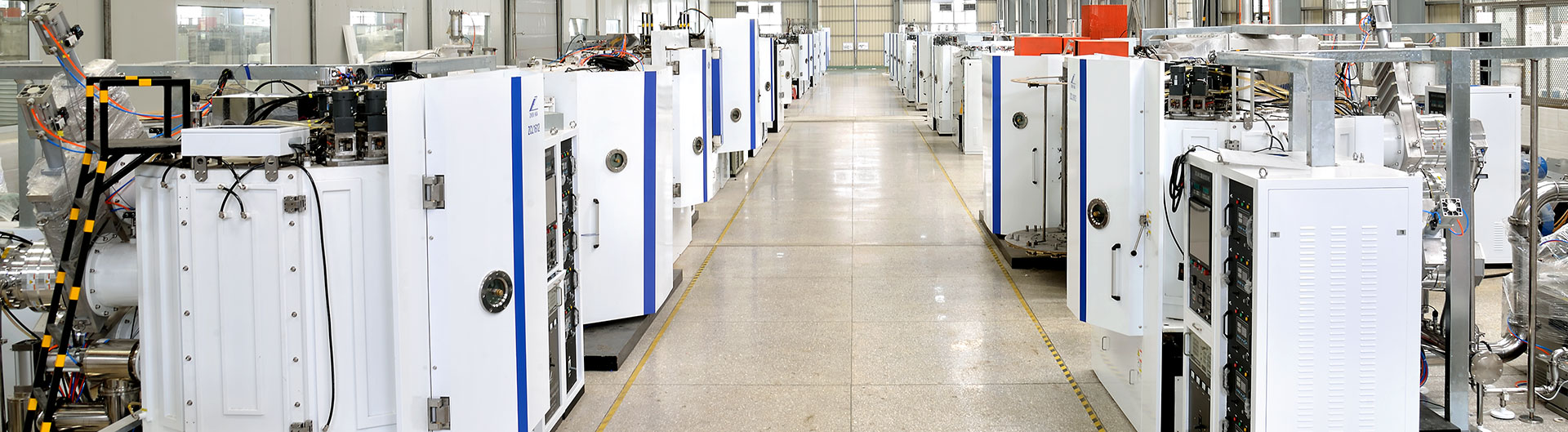
Continuous production in vacuum coating environments presents unique challenges that directly affect equipment stability, process repeatability, and thin film quality. In high-throughput PVD, magnetron sputtering, ALD, or PECVD lines, maintaining consistent deposition parameters over extended operational periods is critical, as even minor fluctuations in vacuum conditions, plasma stability, or target performance can lead to cumulative deviations in film thickness, refractive index, and optical or mechanical properties.
One of the primary challenges in continuous operation is sustaining ultra-high vacuum levels despite dynamic gas loads from substrate introduction, reactive gases, and outgassing from chamber walls or previously coated substrates. Fluctuations in residual gas composition, including water vapor, oxygen, or hydrocarbons, can induce unintended chemical reactions, alter film stoichiometry, and create defects or absorption centers that compromise optical or functional performance. Advanced vacuum pumping systems, such as turbomolecular and cryogenic pumps, combined with residual gas analyzers (RGA), are essential for real-time monitoring and control of the chamber atmosphere to ensure process stability.
Plasma stability is equally critical for continuous production. High-power magnetron sputtering or ion-assisted deposition processes must maintain consistent power density, target erosion rates, and ion energy distribution to prevent variations in deposition rate, film density, and microstructure. Equipment must integrate arc detection, pulsed DC or RF power modulation, and closed-loop control systems to mitigate instabilities that can arise from long-term operation, target contamination, or load changes.
Thermal management is another key factor affecting stability. Continuous coating of large substrates or multilayer stacks generates substantial heat, which can induce stress, warping, or micro-cracks in the deposited films. Active cooling of targets, substrate holders, and chamber walls, combined with precise temperature monitoring, ensures uniform energy distribution and reduces cumulative thermal effects over long production cycles.
Mechanical reliability and substrate handling also play a pivotal role in maintaining stability. Robotic load/unload systems, precise substrate rotation, and automated conveyor controls reduce human intervention, minimize misalignment, and ensure uniform deposition across all substrates. Proper handling prevents scratches, contamination, and variability in film thickness that can compromise optical performance or functional uniformity.
In summary, sustaining stable operation of vacuum coating equipment in continuous production requires an integrated approach, combining ultra-high vacuum control, plasma stability, thermal management, and precise substrate handling. By leveraging advanced process monitoring, feedback control, and automated material handling, high-throughput coating systems can deliver reproducible, high-quality thin films while minimizing downtime, defects, and variations over extended production cycles. This comprehensive strategy ensures consistent performance in critical applications, including optical coatings, photonics, energy devices, and large-area functional films.
-This article was published by vacuum coating equipment manufacturer Zhenhua Vacuum
Post time: Mar-19-2026