
Varistors, thermistors, and ceramic capacitors are widely used in household appliances, consumer electronics, power equipment, new energy vehicles, communications equipment, and industrial control systems, where they primarily perform functions such as circuit protection, temperature sensing, energy storage, and filtering.
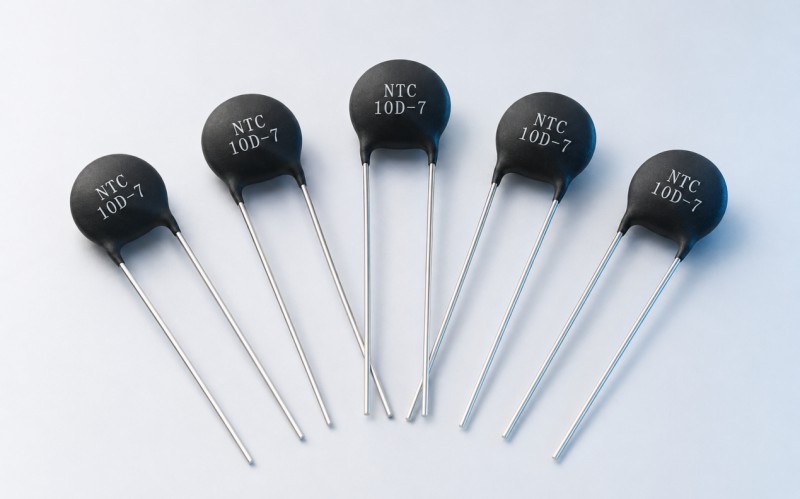
The functional properties of electronic ceramics are mainly determined by their material formulations, doping systems, and sintering processes. Zinc oxide (ZnO) ceramics exhibit varistor characteristics and are therefore used in the manufacture of varistors, where they divert surge current when transient overvoltage occurs. Certain oxide ceramics and barium titanate-based materials can be used to manufacture thermistors, while dielectric ceramics such as barium titanate and calcium titanate are widely used in ceramic capacitors.
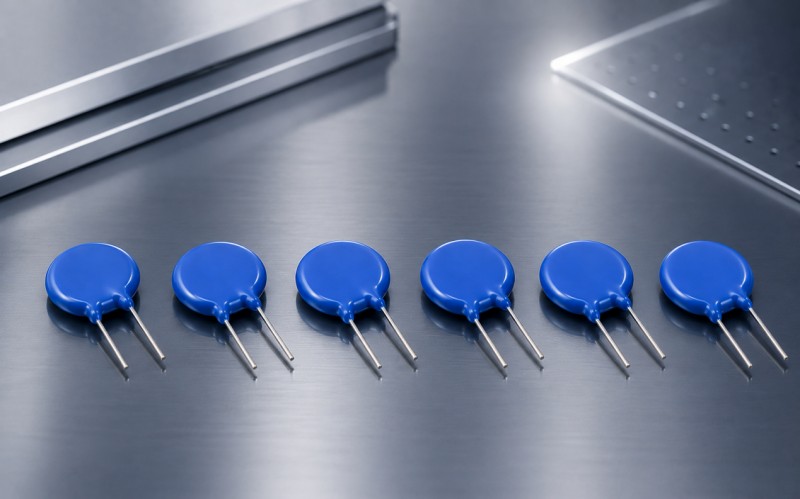
Although these materials acquire their corresponding varistor, thermistor, or dielectric properties after forming and sintering, they remain functional ceramic bodies and cannot yet be directly integrated into electrical circuits. To become electronic components that can be mounted on printed circuit boards, silver electrodes need to be formed on their upper and lower surfaces. Therefore, silver electrode formation is a critical process in the manufacturing of electronic ceramic components.
1. Why Do Electronic Ceramics Require Silver Electrode Coating?
Silver electrode coating for electronic ceramics involves forming conductive electrodes on the upper and lower surfaces of the ceramic substrate, providing a stable metallic interface for voltage application, current conduction, and lead attachment. After electrode formation, the ceramic bodies typically undergo lead bonding, encapsulation, and electrical testing before being assembled into finished varistors, thermistors, or ceramic capacitors.
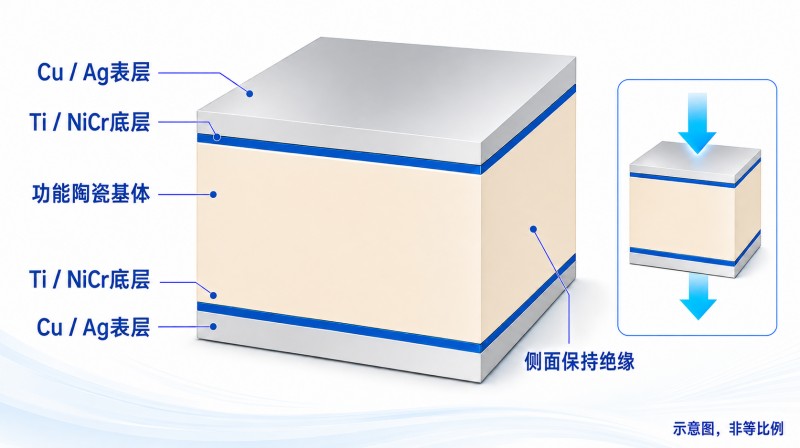
Electronic ceramic electrodes typically adopt a multilayer metallization structure. Ti or NiCr can be used as an adhesion layer to enhance the interfacial bonding between the coating and ceramic substrate, while Cu or Ag can be deposited as the top conductive layer to meet electrical conductivity and solderability requirements.
In most applications, only the upper and lower surfaces of the electronic ceramic are metallized, while the side surfaces must remain electrically insulated. Non-uniform film thickness, pinholes, or localized coating omissions may result in unstable contact resistance, poor solderability, and electrical performance deviations. Coating on the side surfaces may also electrically bridge the upper and lower electrodes, while insufficient adhesion strength may lead to film delamination. Therefore, silver electrode coating for electronic ceramics must achieve a balance among film-thickness uniformity, film density, adhesion strength, and precise control of the deposition area.
2. Material and Process Cost Challenges of Conventional Silver Metallization
Some electronic ceramic products use silver paste screen printing followed by firing, or wet chemical silver plating, to form silver electrodes. A typical silver-layer thickness is approximately 20 μm, although the actual thickness is determined by the specific product and process requirements. Silver paste screen printing and firing generally involve surface cleaning, screen printing, leveling and drying, firing, and inspection. Wet chemical silver plating typically includes pretreatment, sensitization and activation, chemical silver plating, rinsing, drying, and inspection.
Since 2026, silver prices have risen significantly and remained at elevated levels, further increasing the impact of silver material costs on electronic ceramic electrode manufacturing. The relatively thick silver layers produced by conventional silver paste printing and firing or wet silver-plating processes can result in substantial silver consumption. In high-volume production, this directly increases the material cost per component.
In addition, the drying and high-temperature firing stages required for silver paste printing, as well as the pretreatment, sensitization and activation, rinsing, and drying stages involved in wet silver plating, further increase energy consumption, production lead time, and process-control costs.
3. Vacuum Magnetron Sputtering for Balancing Film Performance and Cost Control
Vacuum magnetron sputtering is a PVD process in which high-energy particles bombard a metallic target under vacuum, causing target atoms to be sputtered and deposited onto the ceramic surface to form a uniform and dense metallic film.
According to the specific product requirements, the electrode can adopt a multilayer structure consisting of a Ti or NiCr adhesion layer combined with a Cu or Ag conductive layer, with the total film thickness controlled at approximately 6–7 μm. Compared with a conventional silver-layer thickness of approximately 20 μm, this approach can reduce unnecessary silver thickness and precious-metal consumption, thereby lowering material costs in high-volume production.
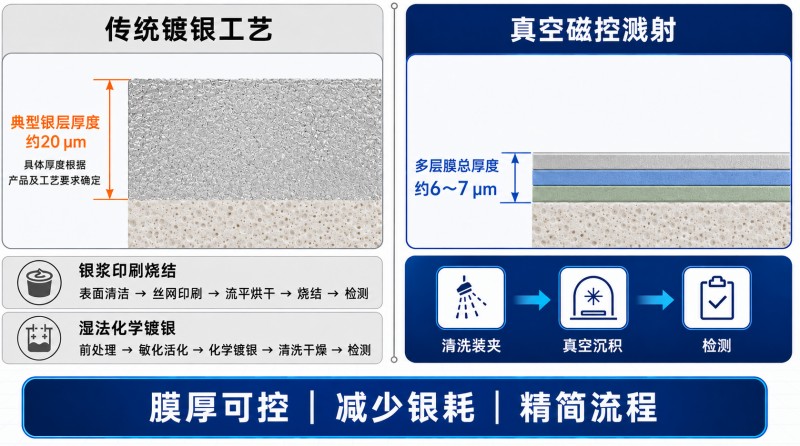
The vacuum coating process can be streamlined into cleaning and loading, vacuum deposition, and inspection, reducing process stages such as binder burnout, high-temperature firing, and multiple wet-chemical treatments. Combined with precise film-thickness control and dedicated masking fixtures, the process can improve the consistency of the deposited films on the upper and lower surfaces while keeping the side surfaces electrically insulated.
4. Zhenhua Vacuum’s Silver Metallization Solution for Electronic Ceramics
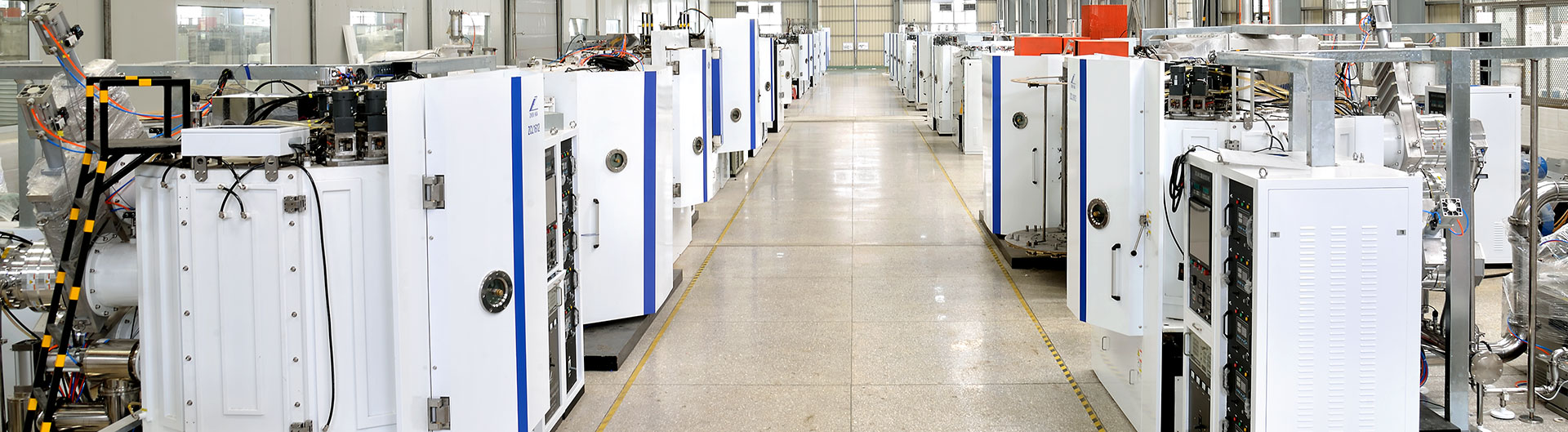
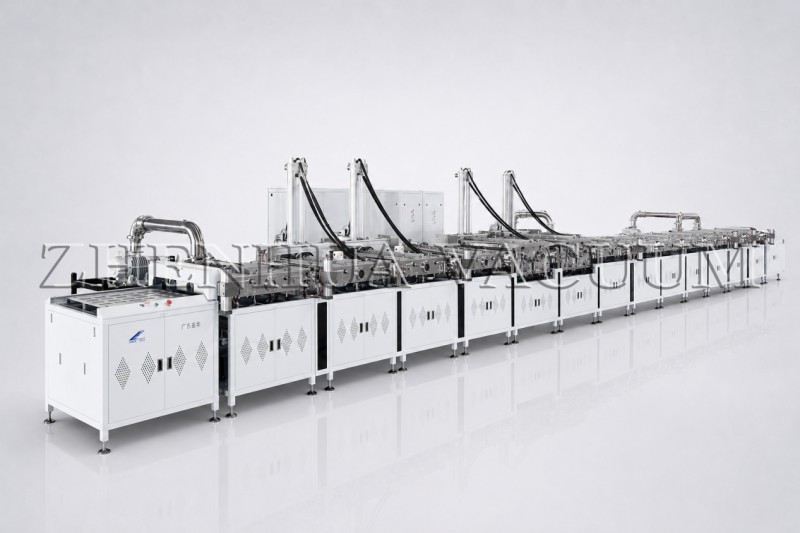
Zhenhua Vacuum’s electronic ceramic silver metallization production line can be configured with Ti, NiCr, Cu, Ag, and other coating materials according to the customer’s process requirements. Multiple metallic layers can be deposited on the upper and lower surfaces of ceramic components within the same vacuum cycle, providing a high-throughput vacuum coating solution for the electrode metallization of varistors, thermistors, ceramic capacitors, and other electronic ceramic components.
Equipment Advantages
1. Advanced Process Technology
The system adopts vacuum magnetron sputtering technology for electronic ceramic electrode metallization. Related technologies are protected by proprietary invention patents, enabling precise electrode deposition and improved batch-to-batch consistency.
2. Performance and Cost Advantages
Through multilayer film architecture and precise film-thickness control, the process can meet the requirements for adhesion strength, electrical conductivity, and solderability while reducing silver consumption and simplifying production steps, thereby lowering manufacturing costs in high-volume production.
3. Extensive Engineering Experience
With more than 30 years of experience in the vacuum coating industry, Zhenhua Vacuum has established professional process laboratories and engineering teams capable of providing technical support throughout the entire process, from process development and sample validation to pilot production and mass production.
4. Customized Solutions and Confidentiality
Equipment and process solutions can be customized according to the customer’s product specifications, production capacity, and multilayer coating requirements. Zhenhua Vacuum also maintains strict protection of customer intellectual property and technical documentation.
Applications
The equipment can deposit Ti, NiCr, Cu, Ag, and other metallic films, making it suitable for electrode metallization of electronic ceramic components such as varistors, thermistors, and ceramic capacitors. The technology can also be extended to applications including ceramic substrates and ceramic LED packages.
5. Conclusion
Against the backdrop of persistently high silver prices and increasingly stringent requirements for consistency and reliability in electronic component manufacturing, vacuum magnetron sputtering provides an effective metallization solution for electronic ceramics. With its advantages in reduced film thickness, uniform deposition, and precise thickness control, the process offers a practical approach to balancing coating performance, production efficiency, and material cost.
Zhenhua Vacuum will continue to optimize equipment, coating processes, and automation systems around the requirements of electronic ceramic silver metallization, providing customers with technical support throughout the entire production cycle, from R&D validation and pilot production to large-scale manufacturing.
-This article was published by vacuum coating equipment manufacturer Zhenhua Vacuum
Post time: Aug-14-2026