
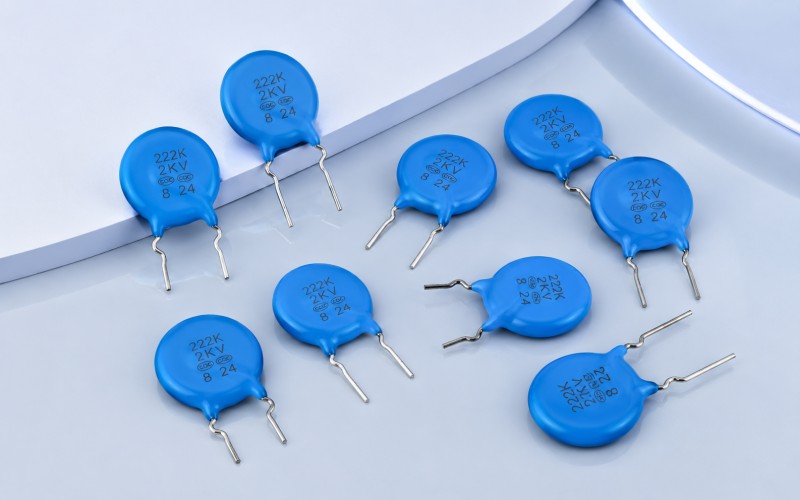
Ceramic capacitors are electronic components that use ceramic materials as the dielectric and metallic electrodes to store electrical charge. They are widely used in consumer electronics, communications, automotive electronics, and industrial control applications, where they perform essential functions such as decoupling, filtering, coupling, resonance, and energy storage.
To enable charge storage and establish electrical connections with external circuits, electrodes are an indispensable part of the capacitor structure. The metal electrodes are distributed on both sides of the ceramic dielectric or alternately embedded with the dielectric layers in multilayer structures, together forming the basic capacitor architecture. When a voltage is applied, electrical charges accumulate on the two electrodes and are connected to the external circuit through the electrode structure.
1. Why Is the Cost of Conventional Silver-Paste Electrodes for Ceramic Capacitors Continuing to Rise?
The conventional electrode fabrication process for ceramic capacitors typically uses a silver paste printing and firing process. The process generally consists of ceramic substrate preparation, silver paste printing, drying, high-temperature firing, electrode inspection, and subsequent processing. This technology has been widely used for many years, with mature silver-paste formulations, screen-printing technologies, printing processes, and firing systems. Its production equipment and supporting infrastructure are well established, with a relatively low barrier to production-line implementation and good adaptability to products with different specifications.
At the same time, silver paste uses silver powder as its primary conductive component and forms the electrode through a relatively thick-film process. As a result, the silver layer is comparatively thick, leading to relatively high silver consumption per unit product.
When silver prices were relatively low, the cost impact associated with high silver consumption was less significant. However, as silver prices have continued to rise over the long term, this cost structure has become increasingly apparent. Based on annual average silver prices converted into RMB, the price of silver was approximately RMB 1.9/g in 2005, compared with approximately RMB 9.2/g in 2025, representing an increase of around 4.8 times over 20 years.
For high-volume ceramic capacitor manufacturers, the impact of rising silver prices becomes increasingly significant as production volumes grow. The relatively high silver consumption per unit, multiplied by annual production volumes of millions, tens of millions, or even more components, can translate into substantial overall material costs. When silver prices remain at elevated levels, the conventional and well-established silver-paste electrode process faces increasingly significant pressure from precious-metal costs.
Against this backdrop, reducing silver consumption and lowering dependence on precious metals and their price fluctuations have become important considerations for ceramic capacitor manufacturers.
2. Zhenhua Vacuum’s Cost-Reduction Approach: From “Copper Replacing Silver” to Continuous Mass Production
In response to the high precious-metal consumption, multiple process steps, and exposure to silver-price fluctuations associated with conventional silver-paste electrodes, Zhenhua Vacuum has been exploring the magnetron sputtering-based “copper replacing silver” technology route for ceramic capacitor electrodes and has pursued cost reduction through both process optimization and material substitution.
Rather than relying on conventional silver-paste electrode fabrication, Zhenhua Vacuum applies magnetron sputtering technology. As a physical vapor deposition (PVD) process, magnetron sputtering deposits metallic material directly onto the surface of the ceramic substrate in a vacuum environment to form the electrode film.
Compared with conventional silver-paste screen printing, this process eliminates several conventional steps, including silver-paste preparation, printing, drying, and high-temperature firing, thereby shortening the overall process chain and reducing intermediate handling and manual operations. Since silver paste and its associated organic binders and carriers are not required, the process can also reduce organic emissions and process waste associated with paste-based electrode fabrication, providing greater potential for cleaner and more automated production.
From a materials perspective, copper is used as the primary conductive material to replace silver. Copper offers excellent electrical conductivity while its material cost is significantly lower than that of silver. This enables a substantial reduction in precious-metal consumption at the material level. For high-volume production, such material substitution can reduce electrode material costs while lowering the impact of silver-price fluctuations on overall manufacturing costs.
However, replacing silver with copper is not simply a matter of changing one electrode material to another. Copper is susceptible to oxidation at elevated temperatures, and conventional copper-paste printing and firing processes require stringent control of the paste formulation, firing atmosphere, and process window. Magnetron sputtering, by contrast, enables copper films to be deposited directly in a vacuum environment. Through the design of adhesion layers, conductive layers, and other functional film stacks, the process can improve film adhesion, density, and electrical performance, providing an alternative process route for the industrial implementation of “copper replacing silver.”
2.1 From Process Development to Mass Production: Zhenhua Vacuum’s Double-Sided Continuous Magnetron Sputtering Production Line
Magnetron sputtering can provide a technical route for “copper replacing silver,” but for high-volume ceramic capacitor manufacturing, producing coated samples alone is not sufficient. The key challenge is achieving long-term, stable, and continuous mass production.
To address this requirement, Zhenhua Vacuum has developed a double-sided continuous magnetron sputtering production line for ceramic capacitor electrodes, integrating vacuum coating technology with automated production. After entering the production line, the products are continuously transferred between different process chambers, while electrode films are deposited on both sides in the same production system. This reduces the need for manual flipping, repeated loading and unloading, and intermediate handling between processes.
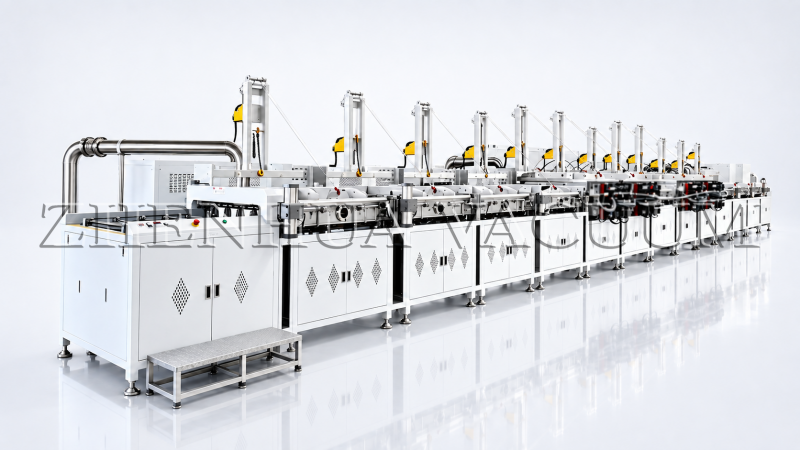
The equipment adopts a continuous production-line configuration, enabling different film layers, including adhesion or transition layers and conductive layers, to be deposited within the same integrated system. Through automated material transfer, precise process-parameter control, and production takt management, the system improves film-thickness uniformity and process stability during high-volume production.
This process route has also undergone long-term verification in mass production. In 2012, Zhenhua Vacuum delivered a double-sided continuous magnetron sputtering production line for ceramic capacitor electrodes to a customer. As of 2026, the production line has remained in stable mass production for 14 years, providing long-term verification of equipment reliability, double-sided coating consistency, and the mass-production feasibility of the magnetron sputtering-based “copper replacing silver” process.
The transition from conventional silver-paste electrodes to magnetron sputtering-based “copper replacing silver” is not simply a material substitution. It represents a coordinated optimization of materials, deposition processes, and production methods. Through magnetron sputtering technology and a double-sided continuous production line, Zhenhua Vacuum has taken the “copper replacing silver” concept beyond a technical solution and into stable, continuous mass production.
For high-volume ceramic capacitor manufacturing, the economic value of “copper replacing silver” can only be fully realized when material costs are reduced, the manufacturing process is streamlined, and long-term production stability are achieved simultaneously.
-This article was published by vacuum coating equipment manufacturer Zhenhua Vacuum
Post time: Sep-23-2026