
With the rapid development of advanced packaging technologies, TGV (Through Glass Via) is gradually becoming a key interconnect solution for glass substrates. Leveraging its advantages of low dielectric loss, excellent thermal stability, high machining precision, and strong insulation properties, TGV has shown outstanding performance in optical communications, MEMS, sensors, and high-speed interconnects, and is now expanding into more high-end application scenarios.
However, the evolution of TGV structures also brings new manufacturing challenges: smaller via diameters, more complex geometries, and continuously increasing aspect ratios. In particular, under conditions of 30 μm via diameter and aspect ratios exceeding 10:1, achieving uniform seed layer deposition inside the through-via has long been recognized as one of the most critical bottlenecks. Though less visible in the process chain, this step directly determines device electrical performance and long-term reliability.
No.1 Current Challenges in Micro-Via Coating
In TGV and TSV processes, typical via diameters can be as small as 30 μm, with aspect ratio requirements of more than 10:1. Under these conditions, conventional coating methods face several limitations:
Deposition dead zones: Strong shadowing effects along via sidewalls often lead to discontinuous films, undermining conductivity and hermeticity.
Film thickness non-uniformity: Significant deposition rate differences between via openings and bottoms result in local resistivity issues.
Insufficient multi-material compatibility: When depositing multiple materials such as Cu, Ti, W, Ni, and Pt on glass or silicon substrates, it is difficult to ensure both adhesion and uniformity across all layers.
These problems directly impact yield, increase rework risk and process cost, and restrict high-volume manufacturing efficiency.
No2. ZHENHUA Vacuum Deep-Via Coating Solution
Equipment Advantages:
Optimized Deep-Via Coating
With ZHENHUA’s proprietary deep-via coating technology, uniform seed layer deposition can be achieved even in vias as small as 30 μm in diameter, with aspect ratios exceeding 10:1—overcoming long-standing challenges in complex deep-via coating.
On-Demand Customization, Multi-Size Substrate Support
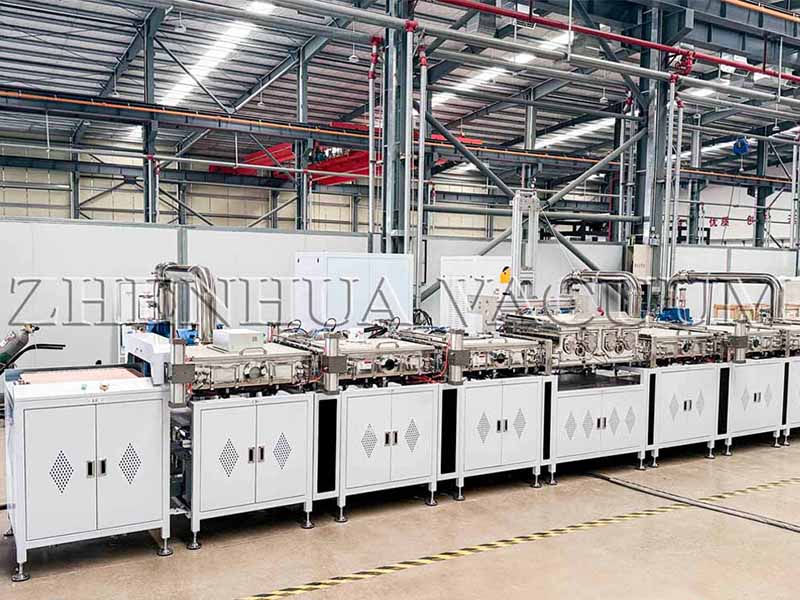
Capable of processing different sizes of glass substrates, including 600×600 mm, 510×515 mm, and larger formats.
Process Flexibility with Multi-Material Compatibility
The system supports conductive and functional thin films such as Cu, Ti, W, Ni, and Pt, enabling tailored solutions for both electrical conductivity and corrosion resistance requirements.
Stable Equipment Performance and Easy Maintenance
Equipped with an intelligent control system, the equipment enables automatic parameter adjustment and real-time monitoring of film thickness uniformity. Modular design ensures ease of maintenance and reduces downtime.
Application Scope:
Applicable to TGV/TSV/TMV advanced packaging processes, enabling seed layer coating in deep-via structures with aspect ratios up to 10:1.
As the advanced packaging market continues to expand, the demand for micro-vias and high aspect ratio structures will further increase. ZHENHUA Vacuum’s deep-via coating technology provides a scalable, mass-production-ready solution to the critical coating challenges in TGV and other next-generation packaging processes, enhancing packaging efficiency and product consistency.
—This article was published by vacuum coating equipment manufacturer Zhenhua Vacuum
Post time: Aug-18-2025