
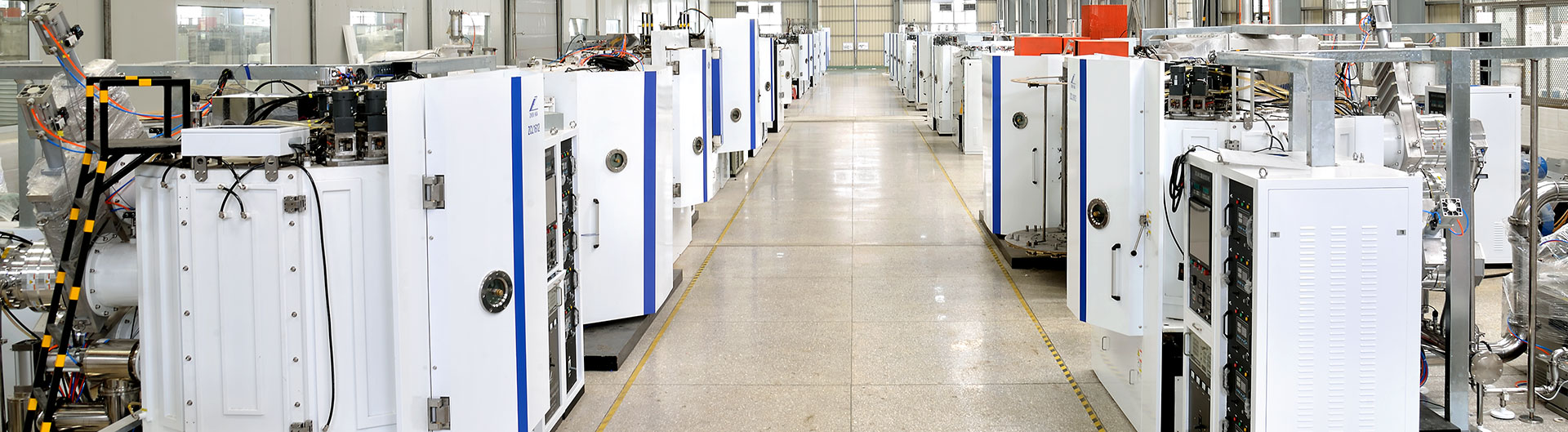
Amid the wave of electrification and intelligence, automotive cabins are rapidly transitioning from function-driven to experience-driven designs. Interior trim components have evolved from supporting roles to key elements of vehicle design language. Metallic finishes, semi-transparent luminous effects, and multi-functional integration are pushing manufacturing technologies to new heights. Meanwhile, facing challenges in yield management and process consistency during mass production, an increasing number of component manufacturers are reevaluating the adaptability and scalability of their coating equipment.
The ability to stably deposit multi-functional film stacks is becoming a new benchmark in equipment selection.
1. Evolving Interior Trim Design is Reshaping Coating Processes
From headlight reflectors to illuminated logos and ambient light guides, the proportion of automotive interior components requiring coating processes continues to rise. Manufacturers no longer merely demand “coating presence” but rather precise control over brightness, reflectivity, transmittance, high repeatability, substrate compatibility, and reliability validation.
This shift is phasing out traditional single-layer metal coating + spraying methods, replacing them with multi-layer film stacks. In terms of deposition processes, controlling interlayer adhesion matching and deposition rate stability has become the most critical challenge in mass production.
Common pain points from customer feedback include “non-uniform coating thickness,” “significant thickness variation between center and edges,” and “inconsistent batch uniformity.” These issues reflect real gaps in equipment design, such as chamber structure, target arrangement, temperature control, and process switching efficiency.
2. From “Capable” to “Consistent”: Equipment Performance Becomes a Priority
As automated production lines become mainstream, the industry demands more from coating systems—not just “deposition capability” but also “batch controllability,” ensuring film uniformity, process repeatability, and equipment stability across every production run.
Under this trend, structural design, process integration, and changeover efficiency are now decisive factors. Customers increasingly prefer solutions that “complete metal + protective layers in a single run” and “eliminate post-coating cleaning” to minimize contamination and improve yield.
A truly future-proof system is not just a deposition tool but a stable, efficient, and flexible hybrid solution.
3. Zhenhua Vacuum: Three Decades of Expertise, Setting the Standard for Interior Coating Systems
Founded in 1992, Zhenhua Vacuum specializes in vacuum coating equipment R&D and manufacturing, with extensive engineering expertise in automotive interior applications. Today, its R&D team accounts for over 30% of the workforce, offering full-cycle capabilities in equipment design, process development, automation integration, and after-sales support. Its product portfolio spans magnetron sputtering, evaporation, CVD, and other deposition technologies.
In the automotive interior segment, Zhenhua’s solutions are widely adopted for headlight reflectors, ambient light guides, illuminated emblems, and transparent trim components, making it a long-term partner for leading Tier 1 suppliers.
The company also provides comprehensive technical support, assisting customers with post-installation debugging, training, and process optimization to maximize production line utilization and stability.
4. Zhenhua Vacuum ZCL1417 Automotive Industry Vacuum Coating Equipment
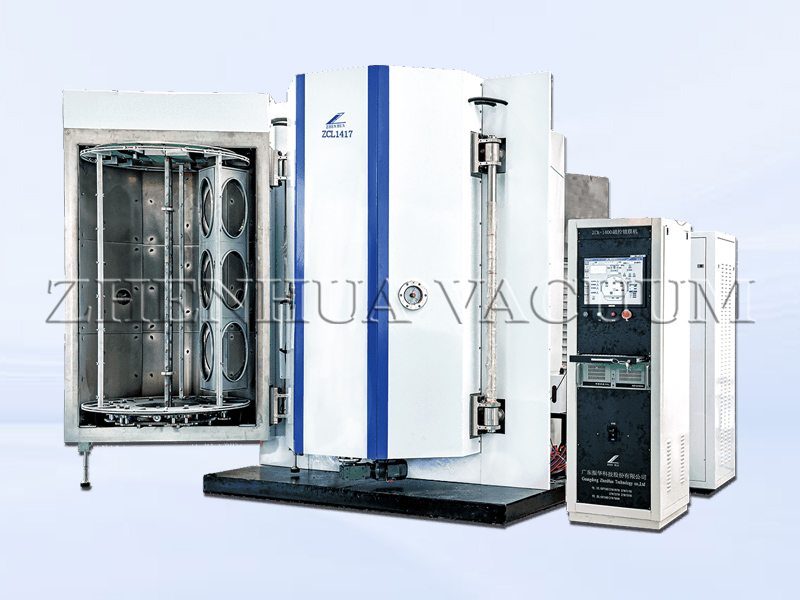
Designed to address diverse coating requirements, the ZCL1417 automotive vacuum coating system is engineered for multi-layer stacks, single-pass deposition, full functional coverage, and stable production, tackling today’s challenges in uniformity and yield.
Key features include:
Compact vertical dual-chamber design for easy production line integration.
Modular process options: DC magnetron sputtering, thermal evaporation, CVD, and MF ion cleaning, configurable for metal films, reactive films, semi-transparent layers, and protective coatings.
The ZCL1417 has been deployed in mass production for headlights, ambient lighting, and luminous trim, delivering consistent film quality and high automation performance.
5. Conclusion: Stability is the True Value Proposition
As interior trim evolves rapidly, stable deposition capability has become the cornerstone of on-time delivery, yield control, and process consistency.
The ZCL1417 addresses critical challenges such as interlayer adhesion, contamination control, and quick changeovers, while its automation and proven engineering provide customers with a low-risk, high-stability mass production pathway.
Choosing the right equipment is not just about productivity—it’s about building the foundational capability to adapt and earn customer trust.
—This article was published by vacuum coating equipment manufacturer Zhenhua Vacuum
Post time: Jul-30-2025