
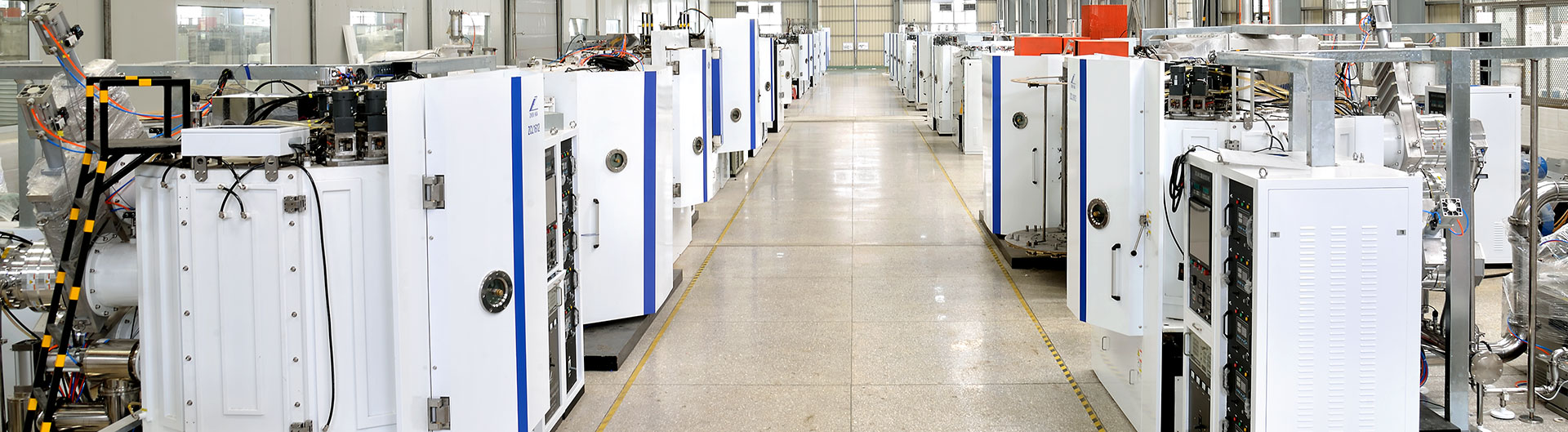
In modern vacuum coating production, high-load operational conditions present significant challenges to the stability and consistency of thin film deposition. As demands for high throughput, large substrate sizes, and multi-layer complex coatings increase, vacuum coating systems—whether PVD, magnetron sputtering, ALD, or PECVD—must maintain precise control over process parameters to ensure film uniformity, reproducibility, and overall equipment reliability.
High-load conditions place considerable stress on vacuum pumps, power supplies, and deposition sources. Maintaining an ultra-high vacuum environment is critical, as any variation in base pressure can directly affect sputter rates, plasma stability, and gas-phase interactions, ultimately impacting film density, refractive index, and adhesion. Advanced vacuum pumping systems, including turbomolecular and cryogenic pumps, are therefore integrated with real-time monitoring and feedback control to compensate for gas load fluctuations caused by large substrate volumes or reactive gas introduction during high-throughput processes.
Power delivery stability is equally vital under high-load operation. Magnetron sputtering and electron beam PVD processes require consistent power density to sustain uniform plasma and stable target erosion rates. Voltage or current fluctuations can lead to non-uniform deposition, arcing, and target poisoning, which compromise film optical and mechanical properties. To mitigate these risks, high-load coating lines employ digitally controlled power supplies with arc detection and suppression, pulsed DC or RF modulation, and real-time monitoring of target and substrate parameters.
Thermal management is another critical factor. Large-scale or high-density coating runs generate significant heat on both targets and substrates, which can induce film stress, substrate warping, and microstructural defects. Active cooling of targets, substrate holders, and chamber walls, combined with precise temperature profiling and monitoring, ensures uniform energy distribution, reduces residual stress, and maintains reproducible film microstructure across multiple runs.
Process automation and in-situ diagnostic systems are central to sustaining stable operation. Real-time monitoring of plasma characteristics, deposition rates, and thickness uniformity allows the system to dynamically adjust parameters, including gas flow, power modulation, and substrate rotation, to compensate for variations induced by high-load conditions. Such closed-loop control prevents cumulative errors over long production cycles and ensures high-quality, repeatable coatings.
Material handling also plays a pivotal role. Large substrate batches or heavy targets increase mechanical load on manipulators and conveyors, necessitating robust motion control and precise alignment to avoid deposition non-uniformity. Integration of automated load/unload systems and high-precision robotic arms reduces human intervention, minimizes contamination risk, and maintains process consistency under demanding operational conditions.
In conclusion, maintaining stable operation of vacuum coating equipment under high-load conditions requires an integrated approach, combining advanced vacuum technology, precision power control, active thermal management, real-time process diagnostics, and automated material handling. By optimizing these factors, coating systems can deliver uniform, high-quality thin films even in challenging production environments, supporting high-throughput manufacturing while ensuring reliability, reproducibility, and process efficiency.
-This article was published by vacuum coating equipment manufacturer Zhenhua Vacuum
Post time: Mar-06-2026