
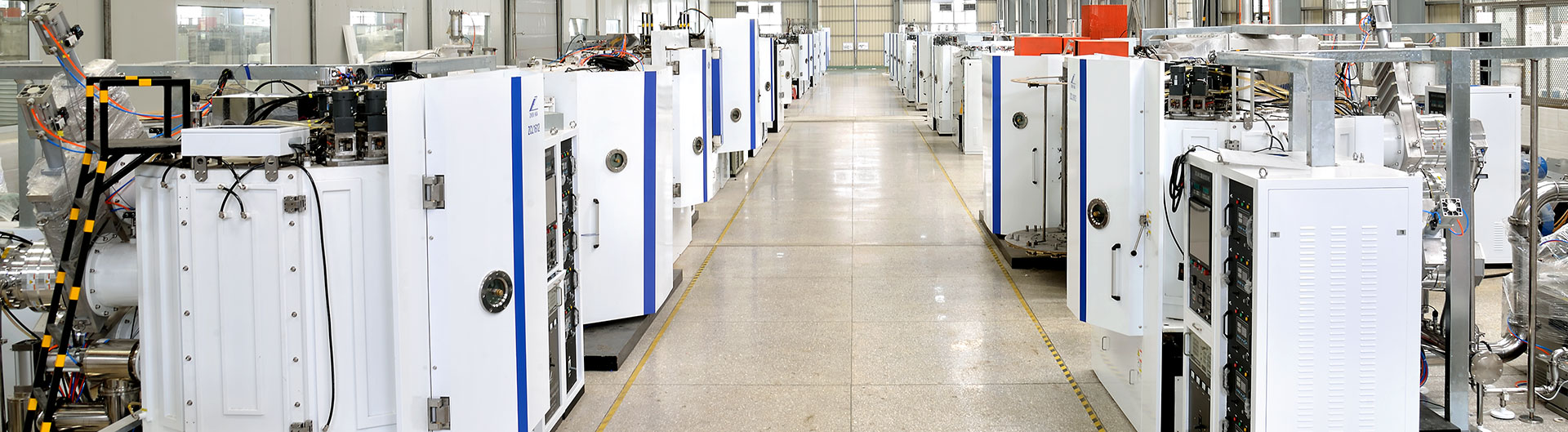
Plastic metallization is widely used in automotive components, consumer electronics, lighting products, cosmetic packaging, household hardware, and other industries. Through vacuum coating technology, a plastic substrate can be given a metallic appearance and, depending on the coating system, enhanced optical, decorative, barrier, or functional properties.
However, plastic metallization is not simply a matter of placing plastic parts into a vacuum chamber and depositing a metal film. Compared with metal substrates, plastics generally have lower thermal resistance, different outgassing characteristics, lower surface energy, and more complex geometric deformation behavior. Therefore, equipment configuration and process adaptation must be considered together with the material, geometry, production capacity, and final coating requirements of the plastic component.
For a stable industrial process, the vacuum coating system needs to be matched to the characteristics of the plastic substrate and the required coating architecture.
1. Substrate Material Determines the Basic Equipment and Process Requirements
Different plastics exhibit significantly different thermal, mechanical, and surface properties, which directly affect vacuum metallization.
Common engineering and optical plastics used for vacuum metallization include ABS, PC, PC+ABS, PMMA, PP, PA, and other polymer substrates. Their heat resistance, moisture absorption, thermal expansion, outgassing behavior, and surface characteristics are not identical.
For example, PC and PC+ABS components are widely used in automotive lighting, interior trim, and decorative applications. Under suitable conditions, they can be metallized by PVD processes to achieve a metallic appearance. Other polymer materials may require additional surface treatment, primer, or base-coat processes to obtain sufficient surface smoothness and coating adhesion.
Therefore, equipment selection should not begin with chamber dimensions alone. The first step is to determine the plastic material, injection-molding condition, surface quality, and required coating system. These factors provide the basis for determining the appropriate vacuum process and equipment configuration.
2. Part Geometry Directly Affects Chamber Size and Coating Uniformity
The dimensions and geometry of the plastic component are among the most important factors in equipment adaptation.
For flat or relatively simple parts, the coating geometry is comparatively easy to control. However, automotive components, lighting housings, decorative trim, and other plastic parts may contain curved surfaces, deep recesses, sharp edges, ribs, bosses, and other complex three-dimensional features.
During vacuum deposition, the coating flux has a directional distribution. Differences in the distance and angle between the coating source and different areas of the workpiece can therefore result in variations in film thickness, color, reflectance, and other coating properties.
For this reason, the effective coating dimensions of the chamber should not be determined solely by the maximum external dimensions of the product. The workpiece envelope, fixture dimensions, source-to-substrate distance, rotation path, and usable coating zone all need to be considered.
For complex three-dimensional plastic components, appropriate workpiece rotation and fixture design can improve coating uniformity by continuously changing the orientation of the surfaces relative to the coating source.
3. Vacuum System Performance Is Particularly Important for Plastic Substrates
Compared with many metal components, polymer materials can contain absorbed moisture, residual volatiles, and other substances that may be released under vacuum. This outgassing can affect the vacuum level and process stability.
If the vacuum system cannot effectively remove these gases, the deposition environment may become unstable, potentially resulting in defects such as poor adhesion, discoloration, pinholes, particles, or unstable film properties.
Therefore, equipment used for plastic metallization should have an appropriately configured vacuum pumping system, vacuum chamber, pumping lines, valves, and vacuum measurement system. The pumping speed and ultimate pressure should be selected according to the chamber volume, workpiece loading, substrate characteristics, and production cycle.
At the same time, substrate pretreatment and appropriate pre-baking or vacuum drying processes may be required for certain plastic materials and applications to reduce moisture and volatile release.
A stable vacuum environment is not only important for achieving the required film quality; it is also essential for maintaining repeatability during continuous production.
4. Deposition Technology Should Match the Required Coating Performance
Different plastic metallization applications may require different deposition technologies.
Resistance evaporation is widely used for decorative metallization because of its relatively simple process and high deposition efficiency. Aluminum evaporation, for example, is commonly used to create a bright metallic appearance on plastic components.
Magnetron sputtering provides greater flexibility in terms of material selection and coating structure and can be used for metallic films, alloy films, and reactive coatings. It is particularly suitable for applications requiring controlled optical properties, color, reflectance, or functional multilayer structures.
For certain applications, PECVD or other plasma-assisted processes can be integrated with PVD to deposit protective or functional layers. This is particularly useful when the metallized surface needs improved resistance to abrasion, chemicals, humidity, corrosion, or environmental aging.
Therefore, equipment selection should be based on the complete coating architecture, rather than simply choosing a single deposition technology.
5. Substrate Temperature Control Cannot Be Ignored
Temperature management is one of the key differences between plastic metallization and coating metal substrates.
Most plastic components have a relatively limited thermal tolerance. Excessive substrate temperature may cause dimensional deformation, surface defects, gloss variation, or even permanent changes to the molded component.
At the same time, some deposition processes generate significant heat through plasma bombardment or radiation from the evaporation source. Consequently, the coating system needs to control the thermal load imposed on the workpieces.
Depending on the application, the equipment may require water-cooled fixtures, controlled substrate temperature, optimized source-to-substrate distance, appropriate deposition rates, or process sequencing to prevent excessive heating.
For precision automotive and optical components, temperature control should be evaluated together with the dimensional tolerances and optical requirements of the finished product.
6. Surface Pretreatment and Coating Architecture Must Be Considered Together with the Equipment
Vacuum metallization performance depends not only on the deposition equipment but also on the condition of the plastic surface.
For many applications, the molded plastic surface may require cleaning, plasma treatment, base coating, primer, or other surface preparation before entering the vacuum chamber. The purpose is to improve surface cleanliness, reduce contamination, provide a suitable surface for deposition, and enhance coating adhesion.
The coating architecture may also include a metallic layer followed by a protective topcoat or plasma-polymerized protective layer, depending on the required durability.
For example, decorative plastic components may require a smooth and high-gloss base surface before aluminum deposition. Automotive exterior components may require additional protection against humidity, chemicals, UV exposure, and mechanical wear.
Therefore, equipment planning should consider the entire coating line, including pretreatment, vacuum deposition, cooling, and subsequent protective coating processes, rather than evaluating the vacuum chamber as an isolated piece of equipment.
7. Fixture Design Is Critical for Complex Plastic Components
For plastic components with complex geometries, fixture design directly affects coating coverage and production efficiency.
The fixture needs to provide stable positioning while minimizing the areas that are masked from the coating flux. At the same time, the fixture should allow efficient loading and unloading and provide sufficient electrical or mechanical connection where required by the process.
For three-dimensional components, planetary rotation, multi-axis rotation, or optimized workpiece orientation may be used to improve coating coverage and uniformity.
The fixture must also consider the thermal characteristics of the plastic component. Excessive contact pressure or poor mechanical support can lead to deformation, while inadequate positioning can cause inconsistent coating results between different batches.
For mass production, fixture design should therefore be developed together with the chamber layout and deposition source configuration.
8. Production Capacity Determines the Appropriate Equipment Configuration
A coating system suitable for laboratory samples may not be suitable for mass production.
Equipment capacity needs to be evaluated based on part dimensions, number of parts per batch, loading density, coating cycle time, deposition rate, and required daily output.
Increasing the number of parts loaded into a chamber can improve theoretical production efficiency, but excessive loading may affect coating uniformity and vacuum recovery time. Therefore, the optimal loading quantity is not necessarily the maximum possible quantity.
For industrial production, equipment selection should balance chamber utilization, coating uniformity, cycle time, pumping capacity, source configuration, and operator efficiency.
This is particularly important for automotive and consumer-product applications, where stable batch-to-batch consistency is often as important as the nominal coating performance.
9. Equipment Adaptation Should Be Based on the Complete Production Requirement
There is no universal vacuum coating machine that is equally suitable for every plastic metallization application.
A suitable system should be developed according to the specific requirements of the product, including plastic material, component dimensions, geometry, coating material, required appearance, optical performance, durability requirements, daily production capacity, and automation level.
For simple decorative plastic parts, a relatively straightforward evaporation system may be sufficient. For complex automotive components or products requiring multiple functional layers, a multifunctional system integrating magnetron sputtering, evaporation, plasma treatment, and protective coating technologies may provide greater process flexibility.
The equipment should also provide sufficient process monitoring and control to maintain stable parameters during continuous production.
Plastic metallization is a combination of material science, vacuum technology, plasma physics, coating process engineering, and production system design. The selection of vacuum coating equipment cannot be based solely on chamber size or nominal pumping capacity.
The substrate material determines the basic thermal and surface requirements; part geometry determines the effective coating zone and fixture configuration; vacuum performance affects outgassing control and process stability; deposition technology determines the available coating materials and film structures; while production capacity determines the required chamber utilization and automation level.
For manufacturers moving from sample development to mass production, the most important objective is to establish a stable and repeatable process window in which coating uniformity, adhesion, appearance, productivity, and long-term reliability can be maintained simultaneously.
By matching the vacuum coating equipment to the actual characteristics and production requirements of the plastic components, manufacturers can achieve more consistent metallization quality while reducing process adjustments, material waste, and production costs.
-This article was published by vacuum coating equipment manufacturer Zhenhua Vacuum
Post time: Sep-05-2026