
Preface: From Interconnects to Micron-Level Challenges
With the rapid advancement of 5G communication, AI servers, and advanced packaging technologies, PCB (Printed Circuit Board) manufacturing has evolved into a high-density, microvia-driven platform. The adoption of HDI boards, multilayer PCBs, and IC Substrates signals the transition into the micron-scale manufacturing era, where via drilling plays a decisive role in forming reliable interlayer electrical interconnections (Via Interconnects). However, as drilling diameters shrink below 0.2 mm and even 0.1 mm, conventional machining approaches are increasingly unable to meet the demands of high-frequency materials and ultra-precision production, making tool wear, micro drill breakage, and unstable hole wall quality critical challenges impacting PCB yield and manufacturing consistency.
Processing Challenges in Microvia Drilling
In high-density PCB fabrication, micro drilling is a highly sensitive process governed by tool condition, material behavior, and cutting dynamics. At ultra-high spindle speeds, often reaching tens of thousands to hundreds of thousands RPM, the extremely limited cutting edge of micro drills makes them highly susceptible to thermal effects, which accelerate tool wear, increase the coefficient of friction, and lead to unstable cutting conditions. As the cutting edge degrades, material removal transitions into deformation and tearing, resulting in hole wall roughness, burr formation, and resin adhesion, all of which accumulate across dense microvia arrays and significantly reduce process stability.
This issue becomes even more pronounced when machining advanced high-frequency substrates such as PTFE, BT resin, and ABF materials, where low modulus and high adhesion characteristics promote resin smear (Smear) and wicking effects (Wicking) along the via walls. These defects distort via geometry, compromise dimensional accuracy, and negatively affect downstream processes including metallization and electroplating reliability, posing serious risks for high-end applications like IC Substrates, where defect tolerance is extremely low.
Surface Engineering and Coating Technology Selection
To improve micro drill performance, surface engineering through advanced coating technologies is essential. While electroless plating and CVD (Chemical Vapor Deposition) can enhance surface hardness to some extent, they present limitations in micro-scale applications, including poor coating thickness uniformity, high deposition temperature, potential substrate damage, and elevated residual stress leading to coating delamination under high-speed machining conditions.
In contrast, PVD (Physical Vapor Deposition) Vacuum Coating Technology offers a more suitable solution for micro drilling applications, as it enables low-temperature deposition of dense, uniform thin films with excellent adhesion, reduced friction coefficient, and enhanced wear resistance, effectively stabilizing the cutting process while minimizing resin smear and improving hole wall integrity.
Zhenhua Vacuum Micro Drill Coating Solution
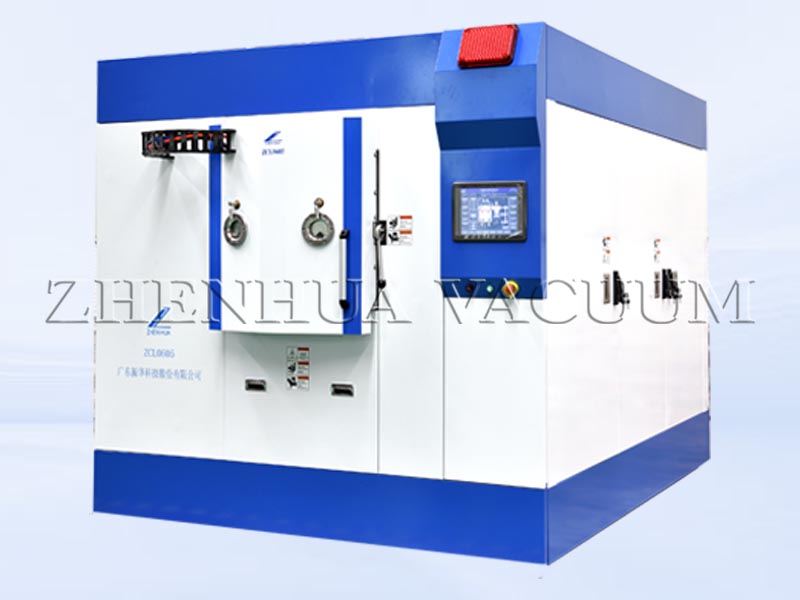
The MFA0605 PVD Coating System is specifically engineered for high-performance tool coating applications in the PCB industry. Equipped with a self-developed arc ion plating filtering system, it effectively eliminates macro-particles generated during deposition, ensuring superior film quality and coating uniformity. The system supports advanced Ta-C (tetrahedral amorphous carbon) coatings, delivering ultra-high hardness up to 63 GPa, along with low friction coefficient, excellent corrosion resistance, and significantly extended tool life. At the same time, it is capable of depositing a wide range of high-performance coatings such as AlTiN, AlCrN, TiCrAlN, TiAlSiN, and CrN, making it highly adaptable for PCB micro drills, cutting tools, precision molds, and automotive components, while maintaining stable coating adhesion, excellent batch consistency, and high-efficiency thin film deposition performance in mass production environments.
Conclusion
As PCB manufacturing continues advancing toward higher density, smaller vias, and more complex structures, micro drilling capability has become a defining factor in production quality and competitiveness. In this context, tool coating is no longer a supplementary enhancement but a critical enabling technology that directly determines tool lifespan, hole quality, and overall process stability. Leveraging PVD Vacuum Coating Technology, Zhenhua Vacuum continuously improves coating uniformity, film stability, and production consistency, enabling reliable performance in high-frequency materials and ultra-fine microvia drilling.
— Published by Zhenhua Vacuum, one of the top ten manufacturers of vacuum coating equipment
Post time: Mar-16-2026