
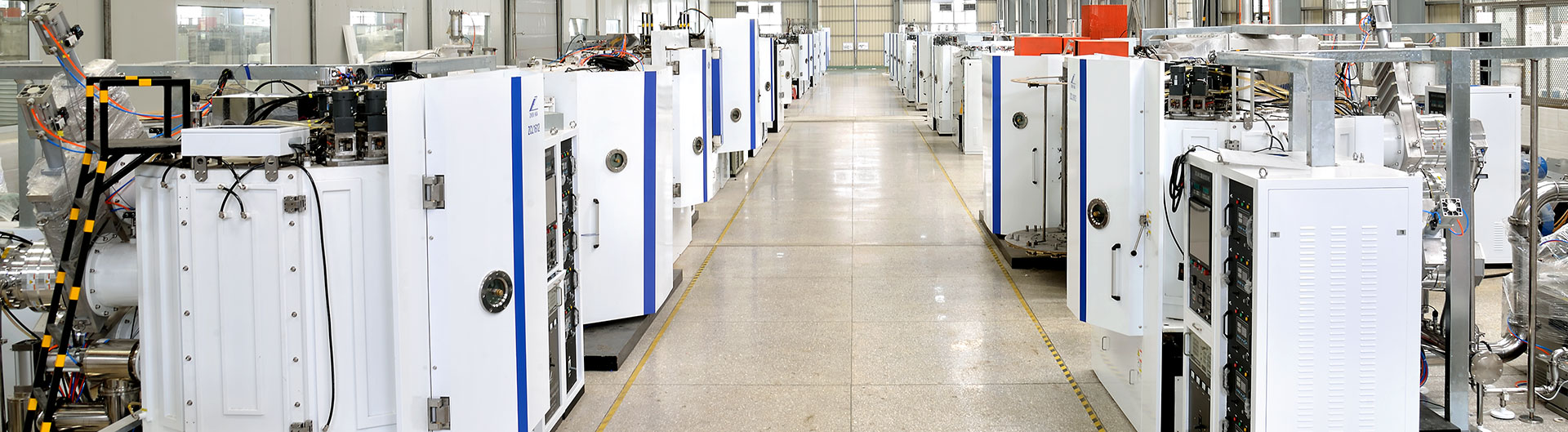
In the field of advanced materials engineering, the deep integration of vacuum coating technology and nanotechnology is driving a revolutionary progress in surface functionalization and high-performance material design. By leveraging advanced processes such as Physical Vapor Deposition (PVD), Chemical Vapor Deposition (CVD), and Atomic Layer Deposition (ALD) in high-vacuum environments, we can achieve precise control over material composition, structure, and morphology at the nanoscale. This interdisciplinary synergy not only surpasses the performance limits of traditional coatings but also lays a solid foundation for the manufacturing of next-generation nanodevices.
Precise Control of Nanoscale Thin Film Deposition
Vacuum coating processes, including magnetron sputtering, electron beam evaporation, and pulsed laser deposition (PLD), have become core techniques for fabricating nanomultilayers, superlattice structures, and quantum dot arrays due to their exceptional film uniformity, low defect density, and superior adhesion. By adjusting deposition parameters (such as substrate temperature, working pressure, and plasma power), precise control of film thickness from sub-nanometer to hundreds of nanometers can be achieved, meeting stringent requirements for optical filters, hard protective coatings, and Micro-Electro-Mechanical Systems (MEMS) devices.
Atomic Layer Deposition: Revolutionizing Nanoscale Encapsulation and 3D Structures
ALD technology, through self-limiting surface chemical reactions, enables atomic-level precision thin film coverage on complex three-dimensional structures. This characteristic makes it crucial for modifying nanoporous materials, coating high-aspect-ratio structures, and engineering electrode/electrolyte interfaces in energy storage devices (e.g., all-solid-state batteries). For instance, in lithium-ion batteries, ALD-deposited nanolayers of alumina or hafnia can significantly enhance the thermal stability and cycle life of cathode materials.
Directed Construction of Functional Nanostructures
Combined with template-assisted deposition and nanolithography techniques, vacuum coating can further facilitate the directed growth of nanowires, nanotubes, and nanopore arrays. Such structures show great potential in surface plasmon resonance (SPR) sensors, catalytic converters, and high-performance transistors. For example, using reactive sputtering to deposit titanium dioxide nanotube arrays within anodic aluminum oxide (AAO) templates can dramatically improve photocatalytic degradation efficiency.
Future-Oriented Application Prospects
With continuous innovation in nanotechnology and vacuum coating, emerging fields such as smart responsive coatings, flexible electronic devices, and quantum computing components are poised for groundbreaking advances. Through the synergistic optimization of cross-scale integration and interface engineering, we are progressively bridging the gap from “microstructural design” to “macroscopic performance customization,” offering transformative solutions for industries including aerospace, biomedical, and sustainable energy.
—This article was published by vacuum coating manufacturer Zhenhua Vacuum
Post time: Oct-31-2025