
1. Introduction: Advanced Displays Demand Advanced Surface Engineering
With the rapid development of Mini LED, Micro LED, and ultra-high-definition display technologies, LED displays are evolving toward higher brightness, higher contrast, wider color gamut, and longer service life. In this process, vacuum coating technology, as a core surface engineering solution, plays a critical role in improving the optical performance, reliability, and environmental durability of LED displays.
2. Key Challenges in LED Display Applications
In practical applications, LED displays face several technical challenges:
Optical losses caused by excessive surface reflection
Insufficient resistance to humidity, UV radiation, and oxidation
Color degradation and chromatic drift over long-term operation
Surface contamination and micro-damage affecting display uniformity
These issues are closely related to surface properties, where vacuum coating provides effective solutions.
3. Key Applications of Vacuum Coating in LED Displays
3.1 Anti-Reflection (AR) Coatings: Improving Brightness and Contrast
By depositing multi-layer optical coatings on display glass or encapsulation surfaces, surface reflectance can be reduced to below 1%, significantly enhancing:
Effective luminance
Contrast ratio
Readability under strong ambient light
Typical processes include magnetron sputtering of dielectric stacks such as SiO₂ / TiO₂.
3.2 Protective Coatings: Enhancing Environmental Reliability
To protect LED chips and encapsulation structures, coatings such as:
Dense inorganic barrier layers
Diamond-like carbon (DLC) protective films
are applied to improve:
Moisture and oxygen resistance
Chemical corrosion resistance
Surface hardness and wear resistance
These coatings greatly extend the service life of LED display modules, especially in outdoor applications.
3.3 Spectral Control Coatings: Optimizing Color Performance
Through precise control of film thickness and refractive index, spectral engineering enables selective transmission and reflection of specific wavelengths, contributing to:
Higher color purity
Improved white balance consistency
Reduced color shift during long-term operation
Such coatings require extremely high uniformity and process repeatability.
3.4 Functional Surface Coatings: Enhancing User Experience
Functional coatings applied to the outer surface of displays include:
Anti-fingerprint (AF) coatings
Anti-glare (AG) coatings
Hydrophobic and easy-to-clean coatings
These layers further enhance usability and perceived quality in both consumer and commercial display applications.
4. Key Equipment and Process Control Requirements
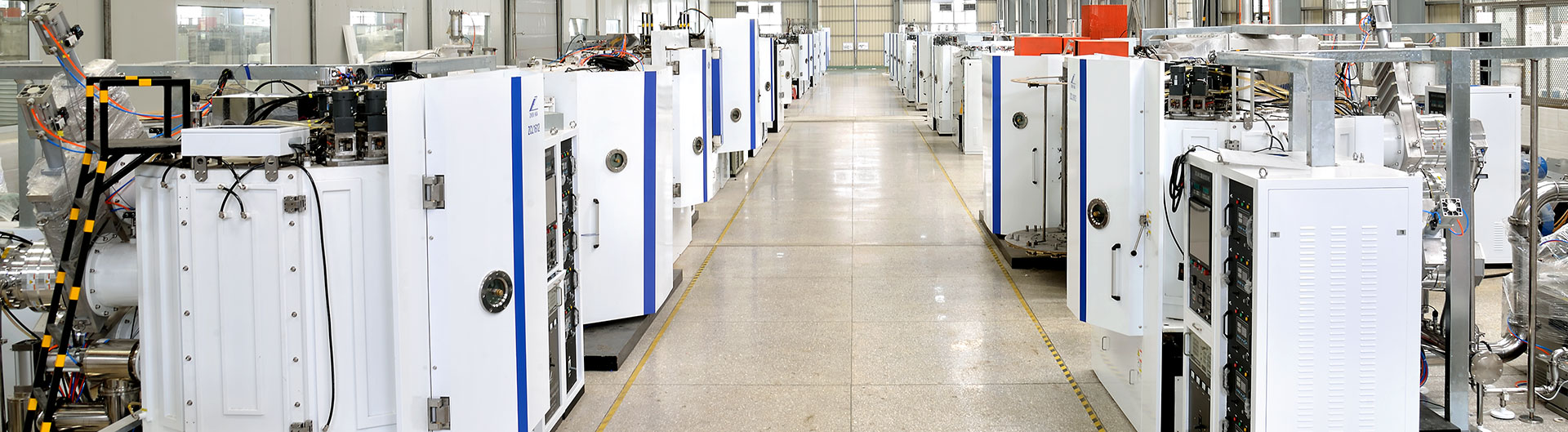
To meet the demand for large-area, high-uniformity LED display coatings, coating systems must feature:
Highly stable magnetron sputtering systems
In-situ film thickness monitoring
Precise substrate temperature control and plasma uniformity
Automation and high process repeatability for mass production
These requirements place stringent demands on equipment design, vacuum systems, and process control software.
5. Conclusion: Vacuum Coating as a Core Enabling Technology for Advanced LED Displays
As display technologies continue to advance toward higher performance and reliability, vacuum coating has become an indispensable manufacturing technology rather than an auxiliary process. By continuously optimizing coating materials, process windows, and equipment capabilities, vacuum coating technology will keep empowering the next generation of high-end LED displays.
–This article was published by vacuum coating equipment manufacturer Zhenhua Vacuum
Post time: Dec-16-2025