
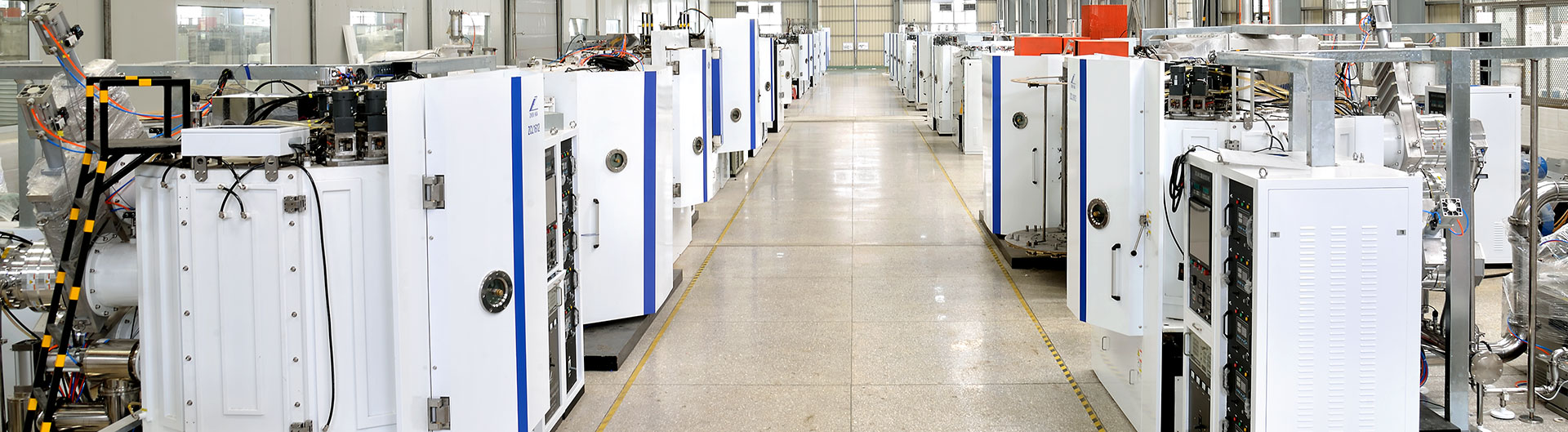
In vacuum deposition technologies such as Physical Vapor Deposition (PVD) and Chemical Vapor Deposition (CVD), the vacuum chamber is far more than a mechanical enclosure — its structural design directly affects critical film properties, including thickness uniformity, adhesion strength, particle contamination control, and deposition rate. The rationality of chamber design is one of the core determinants of equipment performance and coating yield.
No.1. Chamber Geometry Dictates Gas Flow and Plasma Distribution
In processes like Magnetron Sputtering and Electron Beam Evaporation, the internal gas flow field and plasma distribution within the chamber have a direct impact on the trajectory and energy state of the depositing species. An optimized chamber should enable uniform gas inlet and efficient exhaust, eliminating dead zones that can lead to localized high-pressure regions or gas stagnation — both of which adversely affect coating uniformity.
Furthermore, the geometric configuration of the chamber (e.g., cylindrical or rectangular) and the spatial relationship between the target and substrates affect plasma density distribution, thereby influencing film density and adhesion strength. For systems designed for batch coating of multiple substrates, a radially symmetric chamber combined with planetary rotation is highly effective in enhancing deposition uniformity.
No.2 Thermal Management Affects Film Stability
High-energy particle bombardment, plasma discharges, and target heating are intrinsic to vacuum deposition processes. Without effective thermal control, these heat sources can lead to abnormal stress within the film structure or cause overheating of the substrate, ultimately degrading film performance and adhesion.
Modern vacuum chambers are typically equipped with water-cooled walls, thermal shielding, or insulation layers to maintain thermal stability and consistent process conditions. For thermally sensitive substrates — such as plastics, PC, or PET — the chamber design must also minimize radiative heat paths to prevent deformation or coating failure due to localized thermal hotspots.
No.3 Chamber Cleanliness Directly Influences Coating Quality
Particle contamination control is a critical aspect of high-end vacuum coating equipment design. Internal chamber surfaces with dead corners, welding spatter, or poor surface finish tend to accumulate contaminants, becoming sources of defects like pinholes, particle inclusions, or delamination.
To address this, modern vacuum chambers are typically constructed with electropolished or mechanically polished surfaces, rounded corners, and minimized weld protrusions. High-spec systems may also integrate in-situ plasma cleaning or thermal baking systems to enable rapid chamber conditioning between batches.
No.4 Chamber Dimensions Are Tied to Throughput and Productivity
With increasing demand for large-area substrates — such as HUD displays or CMS mirror components — and multi-chamber inline systems, vacuum chamber design is evolving toward larger dimensions, high vacuum stability, and multi-station configuration. A well-balanced chamber volume and optimized pump port layout can significantly improve vacuum pumping speed and stability, thereby enhancing batch throughput and film uniformity.
A vacuum chamber is far more than just a “container” — it plays a pivotal role in vacuum integrity, deposition dynamics, thermal regulation, cleanliness control, and equipment productivity. Tailored chamber designs must be precisely engineered and validated across multiple iterations to meet the specific requirements of different coating processes and product applications.
For vacuum coating equipment manufacturers, the level of expertise in chamber design is a direct reflection of their process capability and equipment quality.
Post time: Jul-16-2025