
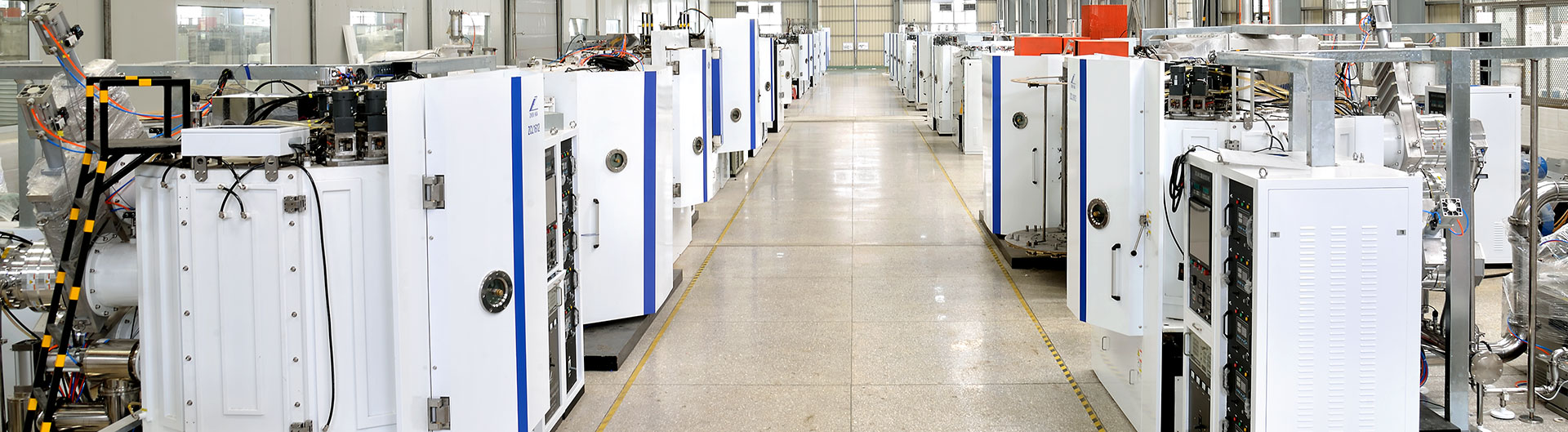
In modern manufacturing, thin film deposition technologies are widely utilized across various industries including electronics, optics, automotive, and aerospace. Selecting the appropriate vacuum coating method is crucial to ensure product quality, enhance production efficiency, and control costs. As an advanced surface engineering technique, vacuum deposition encompasses a range of coating processes, each with distinct advantages and application scopes.
So, how do you determine which coating method best fits your needs? This guide outlines the most commonly used vacuum coating techniques and the key factors to consider when selecting a deposition process.
Common Vacuum Coating Methods
1. Physical Vapor Deposition (PVD)
PVD refers to a group of vacuum coating techniques where material is physically vaporized and then condensed as a thin film on the substrate surface. Popular PVD methods include:
Magnetron Sputtering,Thermal Evaporation, Electron Beam (E-beam) Evaporation
PVD offers high film quality, excellent adhesion, uniformity, and film density. It is suitable for a wide range of metals, ceramics, and alloys.
Typical Applications:
PVD is ideal for electronic components, decorative coatings, and hard coatings, especially when high adhesion strength and durability are required.
2. Chemical Vapor Deposition (CVD)
CVD is a process in which volatile precursor gases chemically react near or on the substrate surface to form a solid thin film. It allows precise control over film thickness, composition, and uniformity.
Typical Applications:
CVD is widely used in the semiconductor industry, solar photovoltaics, and precision optical coatings, where high-purity, high-uniformity films are essential.
3. Plasma-Enhanced Chemical Vapor Deposition (PECVD)
PECVD is a variant of CVD that utilizes plasma excitation to enhance the chemical reactions at lower deposition temperatures, enabling coating on thermally sensitive substrates.
Typical Applications:
PECVD is used in thin-film solar cells, OLED displays, and microelectronics, particularly for electronic-grade functional films.
4. Evaporation Coating
Evaporation coating involves heating solid source materials under vacuum until they sublime or evaporate, then condensing onto the substrate to form a thin film. Common methods include thermal evaporation and electron beam evaporation.
This technique is relatively simple, cost-effective, and well-suited for applications where extremely tight control over film properties is not required.
Typical Applications:
Evaporation is widely used for reflective coatings, decorative finishes, and protective layers, especially in low-cost, large-area deposition scenarios.
5. Sputtering Deposition
Sputtering involves bombarding a target material with high-energy ions, causing atoms to be ejected and deposited onto the substrate. It provides high-density films, with good step coverage on complex substrate geometries.
Typical Applications:
Sputtering is extensively used in semiconductors, optical films, magnetic media, and hard coatings, especially where high film uniformity and adhesion are essential.
Key Factors in Selecting a Vacuum Coating Method
1. Substrate Material and Geometry
The composition and shape of the substrate (e.g., metal, glass, ceramic, plastic) significantly influence process selection. For complex 3D geometries, CVD and sputtering offer superior conformality and uniformity. For flat or simple substrates, evaporation and PVD may suffice.
2. Desired Film Properties
Target performance characteristics of the coating are a major factor. For example:
For high hardness and wear resistance, magnetron sputtering (PVD) is ideal.
For low-temperature processing and high-purity films, PECVD is preferred.
For aesthetic or decorative coatings, evaporation is a more cost-effective choice.
3. Cost and Production Efficiency
Each method varies in terms of capital investment and operational cost:
Evaporation is lower-cost and suitable for high-throughput production, but with less precise film control.
PVD and CVD offer superior film quality but require higher equipment cost and technical complexity.
Decision-makers must balance cost vs. performance according to product requirements.
4. Film Thickness and Uniformity Requirements
If your application demands precise film thickness control and uniformity, PVD and CVD processes are better suited. On the other hand, evaporation and basic sputtering may be acceptable for coatings with less critical thickness tolerance.
5. Environmental and Safety Considerations
Some deposition processes—especially CVD and PECVD—involve reactive or hazardous gases. Proper safety controls and ventilation systems are essential. In contrast, PVD is generally cleaner and more environmentally friendly, making it a safer choice for many operations.
Selecting the right vacuum coating method is essential to achieving desired film performance, optimizing production efficiency, and managing costs. By understanding the advantages, limitations, and application scopes of each process, you can make informed decisions tailored to your specific product needs.
Whether your goal is to enhance surface adhesion, improve wear resistance, optimize optical performance, or reduce manufacturing costs, choosing the right coating technology will directly impact your product’s quality and market competitiveness.
—This article was published by vacuum coating equipment manufacturer Zhenhua Vacuum
Post time: Nov-12-2025