
Over the past decade, millimeter-wave (mmWave) radar has evolved from a niche sensor in a few high-end vehicles to a critical perceptual infrastructure in intelligent vehicles. From adaptive cruise control (ACC) and automatic emergency braking (AEB) to increasingly prevalent high-speed navigation on autopilot (NOA) and urban driving assistance, mmWave radar plays a pivotal role in vehicle environment perception.
As the demand for advanced driver-assistance systems grows, radar systems themselves are undergoing continuous evolution. Early two-dimensional radars have gradually been replaced by 4D imaging radars capable of simultaneously providing range, velocity, azimuth, and elevation information, imposing stricter requirements on detection distance, angular resolution, and target identification capabilities. Beyond improvements in chip processing power and algorithm sophistication, antenna system design has emerged as a key factor enabling these performance enhancements. For instance, Continental’s high-resolution imaging radar ARS540 achieves nearly 300-meter detection range through high-density antenna arrays, simultaneously tracking hundreds of targets. Domestically, next-generation 4D mmWave radar products leverage large-scale array antennas and optimized waveguide structures to enhance long-range target recognition, enabling earlier detection of vehicles, guardrails, and stationary obstacles. Behind these advancements, a clear trend has emerged: high-performance mmWave radars are increasingly adopting waveguide antenna architectures.
In mmWave radar systems, the antenna is responsible for both emission and reception of electromagnetic waves, directly influencing detection range, angular resolution, and signal fidelity. Early mmWave radar designs predominantly employed PCB microstrip antennas due to their simplicity, low cost, and ease of large-scale production. However, as radar frequencies rise to 77 GHz and beyond, the limitations of PCB antennas become apparent. The dielectric properties of PCB materials introduce propagation losses at mmWave frequencies, reducing signal energy, while constraints in radiation efficiency and beamforming capabilities limit system performance.
Waveguide antennas, in contrast, guide electromagnetic waves through metallic structures, substantially reducing propagation losses and achieving higher radiation efficiency. Consequently, for systems demanding extended detection range and fine angular resolution, waveguide antennas have emerged as a preferred solution. Yet the widespread adoption of waveguides introduces new manufacturing challenges.
Unlike PCB antennas, waveguide antennas are precision metallic electromagnetic structures. Wave propagation within the waveguide is highly sensitive to cavity dimensional accuracy and internal conductivity. Deviations in waveguide dimensions or surface roughness can degrade gain, deflect beam direction, and increase signal loss, ultimately affecting radar detection distance and target recognition. Traditional fabrication relies on CNC machining or metal milling, which ensures precise electromagnetic performance but faces significant limitations in cost and scalability. Millimeter-wave structures, often only a few millimeters in size with tolerances of tens of microns, demand sophisticated machinery and fine process control. Mechanical machining suits small-scale production but becomes prohibitive for mass-market automotive radars or consumer sensors.
To reconcile high electromagnetic performance with manufacturability, the industry has explored metallized waveguide antennas. The fundamental concept is to decouple structural formation from electrical conduction. Rather than machining the entire metallic block, the approach employs “structure formation + surface metallization.”
Initially, the waveguide cavity is formed using injection molding, compression molding, or additive manufacturing with engineering plastics or high-performance polymers, offering flexibility and suitability for high-volume production. After structural fabrication, surface pre-treatment—cleaning, roughening, or chemical activation—is applied to enhance metal adhesion. Subsequent deposition of a continuous conductive layer, via PVD, electroplating, or electroless plating, typically with copper, nickel, or silver, converts the structure into a low-loss conductive waveguide. Key areas such as radiating apertures or interface regions may receive localized metallization or fine machining to optimize electromagnetic performance.
This “structure + metallization” approach retains the high performance of traditional waveguides while enabling flexible, efficient production. Injection-molded components allow rapid mass fabrication, reducing costs; plastic substrates reduce weight, supporting automotive lightweighting, and 3D printing facilitates complex geometries, enhancing the design of large-scale antenna arrays. The method successfully balances electromagnetic efficiency, manufacturability, and cost control, making metallized waveguide antennas increasingly prevalent in mmWave radar products.
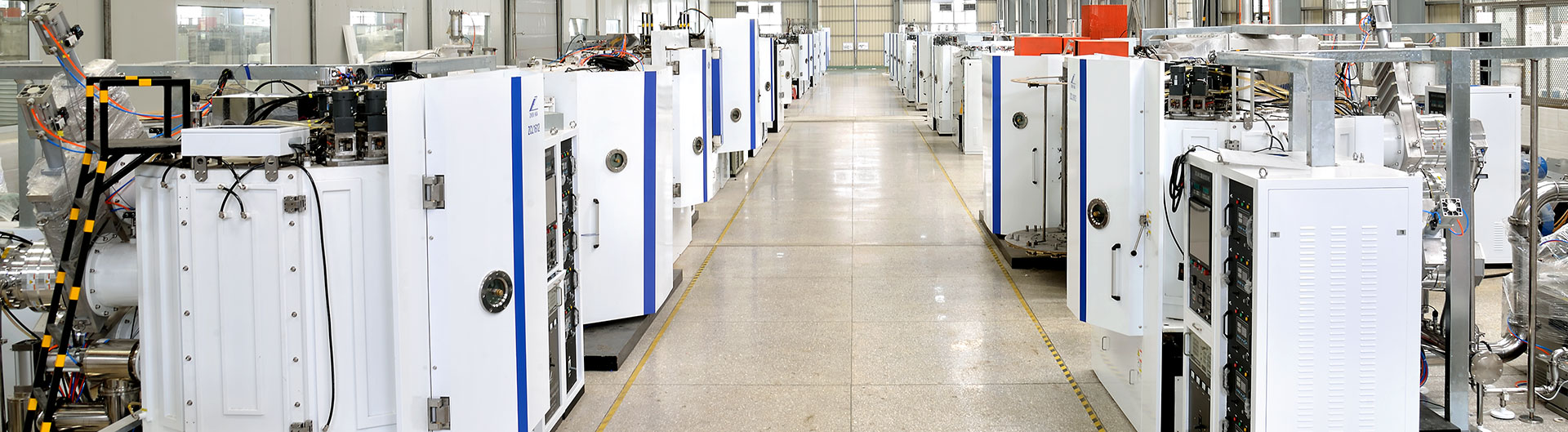
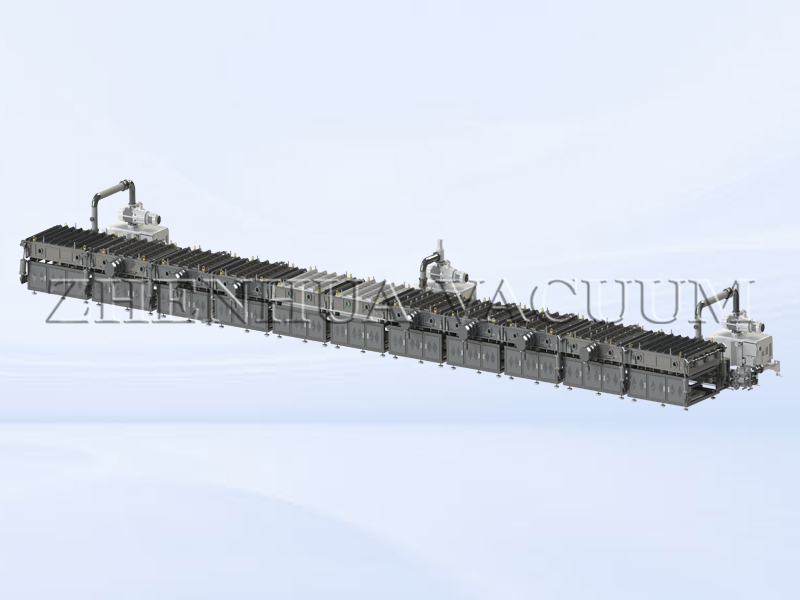
Zhihua Vacuum provides comprehensive solutions for intelligent manufacturing of metallized mmWave radar waveguide antennas. Their horizontal continuous coating production line, based on vacuum sputtering, achieves dual- or multi-layer metallic deposition in a single vacuum cycle with precise control and consistency. Compared to traditional silver electrode printing, magnetron-sputtered copper electrodes enhance conductivity, reliability, and anti-sulfuration performance while lowering cost. Automated handling and compatibility with various ceramic sizes ensure high throughput for mass production. With over 30 years in vacuum coating technologies, including PVD, PECVD, and ALD, Zhihua Vacuum offers customized, confidential process integration from R&D through mass production.
As autonomous driving and intelligent sensing technologies advance, mmWave radar performance demands continue to rise. The evolution from PCB microstrip antennas to waveguide antennas, and now to metallized waveguide structures, reflects the critical role of antenna manufacturing technology. By separating structural formation from conductive functionality, metallized waveguide antennas achieve both high electromagnetic performance and production efficiency, offering flexibility for complex array radar designs. As material science and fabrication techniques advance, this approach is poised to play an increasingly vital role in future mmWave radar systems.
-This article was published by vacuum coating equipment manufacturer Zhenhua Vacuum
Post time: Mar-27-2026