
In the past, the core function of a car’s rearview mirror was simple: to help drivers observe road conditions behind the vehicle and enhance driving safety. It was primarily a reflective component, with the focus on clear visibility, glare reduction, and durability.
However, with the development of smart cockpits and driver-assistance technologies, the role of the rearview mirror is evolving.
In an increasing number of smart cockpit solutions, the interior rearview mirror is no longer just a traditional reflective component; it is now integrating more display, sensing, and interactive functions. Features such as streaming displays, electronic anti-glare systems, hidden cameras, infrared sensing windows, and in-cabin status recognition are transforming the rearview mirror from a simple “mirror” into a vital smart sensing window within the vehicle.
This also means that the focus of rearview mirror manufacturing is shifting from simple reflective imaging to the control of multi-band, multifunctional optical performance. Coating technology is at the heart of this transformation. Traditional single-metal reflective coatings (aluminum/silver) are being upgraded to multi-layer dielectric coatings to achieve selective control over visible light reflection and the infrared spectrum; simultaneously, composite structures such as anti-reflective coatings, beam-splitting coatings, and ITO conductive coatings must be integrated to balance display clarity, sensor transmittance, and electrical functions like touch control and heating.
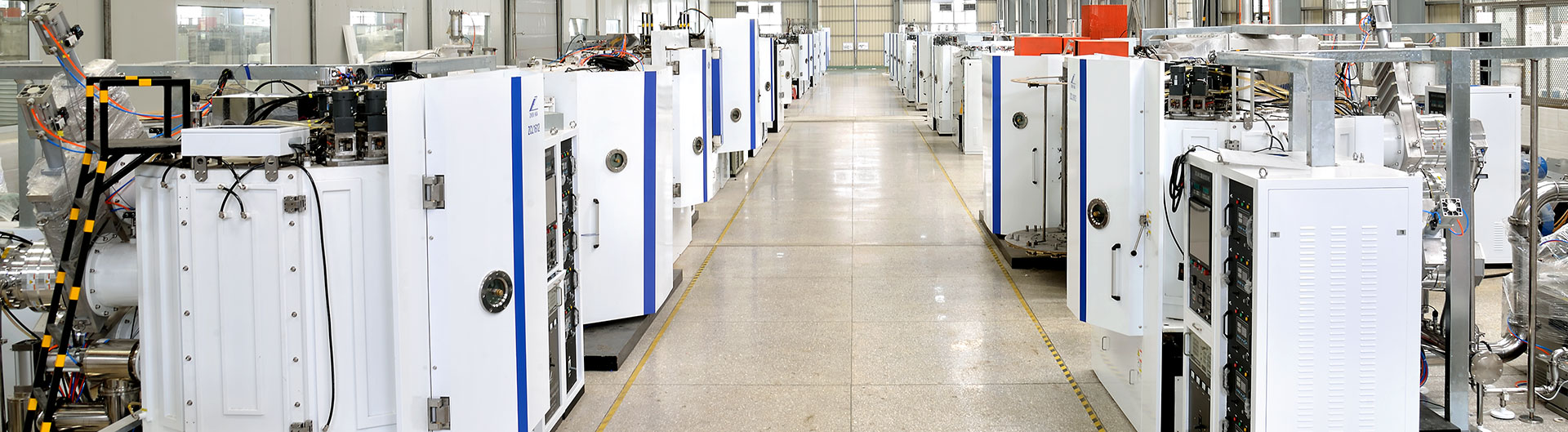
Currently, the most mainstream approach to achieving this multi-band, multifunctional optical control is the vacuum coating process.
No.1 Vacuum Coating: Building the Optical Pathway for Smart Rearview Mirrors
Smart rearview mirrors must simultaneously accommodate multiple functions—including mirror reflection, image display, hidden sensing, and infrared transmission—which places higher demands on the spectral control capabilities of the coating layers.
Vacuum coating involves depositing atoms or molecules from a target material onto a substrate surface via physical or chemical methods under high-vacuum conditions to form dense, nanoscale film layers. Compared to traditional wet coating, this process produces more uniform films with stronger adhesion and more precise spectral control, and is better suited for the large-scale fabrication of multi-layer composite systems.
Through this process, nanoscale functional coatings can be deposited onto the surfaces of glass or cover plates to achieve selective reflection, transmission, and control of different wavelength bands, such as visible and infrared light. Coatings such as low-reflection, anti-reflective, semi-transparent/semi-reflective, infrared-matching, and anti-soiling protective coatings can respectively enhance display clarity, sensing stability, aesthetic integration, and long-term reliability.
No.2 Zhenhua Vacuum’s Large-Format Optical Coating Production Line, Designed to Meet Mass Production Demands for Smart Rearview Mirror Optical Components
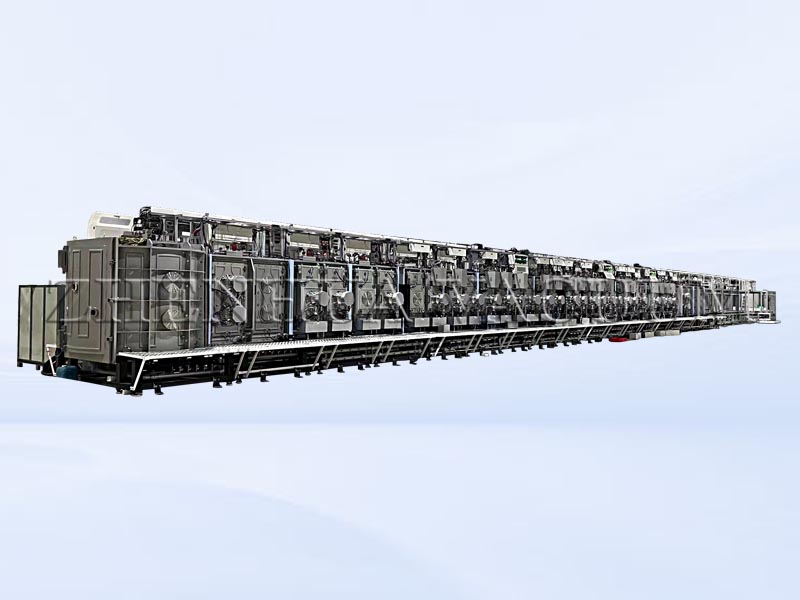
Based on vacuum coating technology, Zhenhua Vacuum has launched a large-format optical coating production line to provide equipment support for the mass production of large-size optical components such as smart automotive rearview mirrors, CMS cover plates, and in-vehicle display glass.
This production line is capable of mass-producing ultra-large optical glass measuring 1600 mm × 630 mm and supports the deposition of up to 14 layers of precision optical coatings. It enables the fabrication of various functional coatings—including low-reflection, anti-reflective, semi-transparent/semi-reflective, infrared-matching, and anti-fingerprint coatings—to meet the complex requirements of smart rearview mirrors in terms of display clarity, sensing stability, aesthetic integration, and automotive-grade reliability.
In mass production, the equipment achieves a continuous coating cycle time of 50 seconds and can be integrated with automated modules such as robots, helping to enhance production efficiency and batch consistency. For automotive-grade optical components, the equipment must not only complete the deposition of complex coating systems but also maintain a stable process window during long-term production, reduce batch-to-batch variation, and improve yield and delivery efficiency.
Conclusion: The Evolution of Smart Rearview Mirrors Reflects Advances in Optical Manufacturing
From traditional reflective mirrors to smart sensing windows, the value of automotive rearview mirrors is being redefined. They are no longer merely auxiliary components for drivers to observe rear traffic conditions but are gradually becoming a key gateway in smart cockpits that connects display, sensing, and safety functions.
In this process, optical coating plays a critical supporting role. Whether it involves mirror reflection, image display, or the implementation of functions such as hidden cameras and infrared sensing windows, all rely on stable, precise, and controllable coating designs and mass production processes.
In response to the ever-evolving manufacturing demands for smart automotive optical components, Zhenhua Vacuum will continue to deepen its expertise in large-area optical coating equipment and process applications, providing stable and efficient equipment support for the high-quality mass production of core components such as smart rearview mirrors, in-vehicle displays, and HUD glass.
— Published by a professional vacuum coating equipment manufacturer Zhenhua Vacuum
Post time: Jun-29-2026