
1. Demand Evolution: High-Level Intelligent Driving Places New Requirements on Antenna Structures
As intelligent driving evolves toward advanced NOA, forward-looking long-range millimeter-wave radar is facing increasing pressure for systematic performance upgrades. Improvements in detection range, angular resolution, and signal stability are placing higher demands on the RF transmission efficiency of underlying antenna structures.
Market growth is further accelerating this trend. According to statistics from Zoss Automotive Research, the installation volume of 4D millimeter-wave radar reached 2.737 million units in 2024. This figure is expected to climb to 11.06 million units in 2025 and exceed 50 million units by 2030. Meanwhile, the penetration rate of 4D millimeter-wave radar is projected to increase from 26.0% in 2025 to 54.5% in 2030. As the installation share of forward-looking 4D radar and 4D corner radar continues to rise, automotive millimeter-wave radar is moving from a basic sensing configuration toward a system upgrade characterized by higher precision, higher resolution, and higher stability.
At the 77 GHz frequency band, conventional PCB microstrip patch antennas face physical limitations such as high dielectric loss and restricted radiation efficiency, making it difficult to fully meet the requirements of 300-meter-level ultra-long-range detection and 4D imaging. Against this background, low-loss, high-gain waveguide antennas are gradually becoming an important option for high-performance automotive radar.
Currently, waveguide antennas are mainly divided into metal waveguides and metallized plastic waveguides. Metal waveguides involve high machining costs and heavy weight, creating bottlenecks for large-scale mass production. Metallized plastic waveguides, which combine injection-molded 3D cavities with PVD conductive film deposition, offer engineering advantages in lightweight design and manufacturing consistency, and are becoming an important direction of industry development.
However, engineering advantages do not necessarily mean mass-production maturity. From design drawings to large-scale automotive-grade production, metallized plastic waveguides still need to overcome multiple barriers in materials, processes, and equipment.
2. From Design Advantages to Mass-Production Stability: Metallized Plastic Waveguides Still Face Yield Challenges
At the laboratory stage, plastic waveguide antennas can achieve strong RF performance through structural design and process optimization. However, once they enter batch production, yield stability often becomes the core issue affecting project implementation.
For complex three-dimensional waveguide structures, injection molding accuracy, material stability, surface condition, cleaning and pretreatment, fixture positioning, and the PVD metallization process all affect the final result. Any fluctuation in one of these steps may lead to film discontinuity, insufficient local conductivity, reduced adhesion, or slight structural deformation, ultimately affecting RF indicators such as S-parameters, insertion loss, and gain.
During the mass-production introduction stage of some complex structural products, the first-pass yield of metallization may still fluctuate significantly. If yield remains at a relatively low level for an extended period, it not only means the scrapping of injection-molded parts, but also continuous increases in target material consumption, equipment operating time, labor costs, and inspection costs. For antenna manufacturers and hardware OEMs, the real challenge is not simply whether the product can be coated, but whether stable, repeatable, and mass-producible film quality can be achieved under continuous production conditions.
This also means that the industrial competition for metallized plastic waveguide antennas will ultimately extend from the design side to the manufacturing side. Companies that can establish a stable process window for complex-structure metallization, thermal deformation control, and batch consistency will be better positioned to gain an advantage in the mass-production chain of automotive millimeter-wave radar.
3. The Core Cause of Yield Fluctuation: Complex 3D Structures Place Higher Demands on PVD Processes
Unlike flat substrates, plastic waveguide antennas for automotive millimeter-wave radar usually feature deep grooves, narrow slots, blind holes, sidewalls, and multi-layer three-dimensional cavity structures. These structures impose higher requirements on the PVD metallization process, mainly in two aspects.
3.1 High Coverage Difficulty in Complex Structures: Insufficient Film Thickness Can Occur in Deep Grooves and Sidewalls
PVD deposition has a certain degree of directionality. When dealing with complex three-dimensional waveguide structures, if target source layout, ion assistance, fixture motion, and process parameter control are insufficient, thicker deposition may occur around openings or edge areas, while the bottom of deep grooves, inner walls, and sidewalls may suffer from thin coating or even insufficient coverage.
For 77 GHz to 79 GHz millimeter-wave signals, the continuity and electrical conductivity of the metal film directly affect RF transmission efficiency. If local film thickness is insufficient inside complex structures, electromagnetic wave energy loss may increase, affecting the antenna’s insertion loss, gain, and signal stability. Therefore, plastic waveguide metallization is not a simple decorative surface coating process, but a functional metallization process aimed at RF performance.
3.2 Engineering Plastics Are Thermally Sensitive: Heat Accumulation During PVD May Cause Dimensional Deviation
Metallized plastic waveguide antennas commonly use modified engineering plastics such as PPS. Although these materials offer good heat resistance and dimensional stability, they are still affected by particle bombardment, plasma environments, and continuous deposition heat during the PVD process.
Due to the limited thermal conductivity of engineering plastics, if equipment temperature control, cooling design, and production takt are not properly managed, local heat can easily accumulate, resulting in thermal stress and slight deformation. For millimeter-wave radar antennas, dimensional changes in the cavity structure can affect resonance characteristics and RF consistency. Even minor deformation may cause final test results to deviate from design requirements.
Therefore, PVD equipment for metallized plastic waveguide antennas must solve two key challenges at the same time: complex-structure coverage and plastic thermal deformation control. Only when film quality and substrate dimensional stability are both maintained can consistent downstream RF performance be achieved.
4. Zhenhua Vacuum Continuous PVD Solution: A System-Level Approach for Automotive Radar Antenna Metallization
To meet the mass-production requirements of automotive millimeter-wave radar plastic waveguide antennas, Zhenhua Vacuum has launched a high-yield continuous PVD mass-production solution focusing on complex three-dimensional structure metallization. The solution integrates equipment structure, cooling control, deposition method, fixture design, and process window optimization to improve film coverage uniformity, conductive continuity, adhesion stability, and dimensional stability of plastic substrates.
4.1 High-Ionization Deposition and Optimized Target Layout Improve Coverage Capability in Complex Structures
To address the coverage challenges of deep grooves, blind holes, and sidewalls, Zhenhua Vacuum has optimized the ion-assisted system, magnetron sputtering system, and target source layout. By increasing the activity of metal particles and improving the distribution of incident angles, the solution enhances film coverage inside complex three-dimensional structures.
Compared with conventional flat-substrate coating equipment, this solution places greater emphasis on film continuity at the bottom of deep grooves, sidewall areas, and structural corners. It can reduce the risks of local undercoating, missed coating, and insufficient conductivity, thereby improving the overall consistency of the metallized film within complex waveguide structures.
4.2 Multi-Stage Cooling Control Reduces Dimensional Risks Caused by Heat Accumulation
To address the temperature sensitivity of engineering plastics during PVD processing, Zhenhua Vacuum has introduced a multi-stage cooling design into its continuous coating system. Through phased and uniform cooling control, heat generated during deposition can be released in time, reducing the impact of local heat accumulation on the dimensional stability of plastic substrates.
This design helps reduce the risks of micro-deformation, warpage, and structural deviation, enabling the plastic waveguide cavity to maintain better dimensional consistency during metallization and providing a stable structural foundation for subsequent RF testing.
4.3 Independent Chamber Design Improves Continuous Production Stability
Compared with traditional single-chamber batch coating systems, which are prone to heat accumulation, process fluctuation, and takt-time limitations during long-duration coating, Zhenhua Vacuum adopts a continuous production architecture in which different process stages are completed in independent chambers.
The independent chamber design helps achieve process isolation, takt control, and parameter stability, reducing mutual interference between different process stages. Workpieces can be continuously transferred among functional chambers, while pretreatment, deposition, cooling, and other process steps can be flexibly configured according to product structure and film requirements. This provides a more stable equipment foundation for the large-scale production of plastic waveguide antennas.
5. From Equipment to Process Validation: Promoting Mass Production of Plastic Waveguide Antenna Metallization
The metallization of automotive millimeter-wave radar plastic waveguide antennas is not a competition based on a single equipment parameter, but a competition of coordinated capabilities across materials, structures, processes, and equipment. A PVD solution truly suitable for mass production must meet the following requirements: the film must have good continuity and electrical conductivity; complex internal structures must achieve stable coverage; the plastic substrate must maintain dimensional stability during deposition; batch production must be repeatable and consistent; and the process results must be compatible with subsequent RF testing and automotive-grade validation.
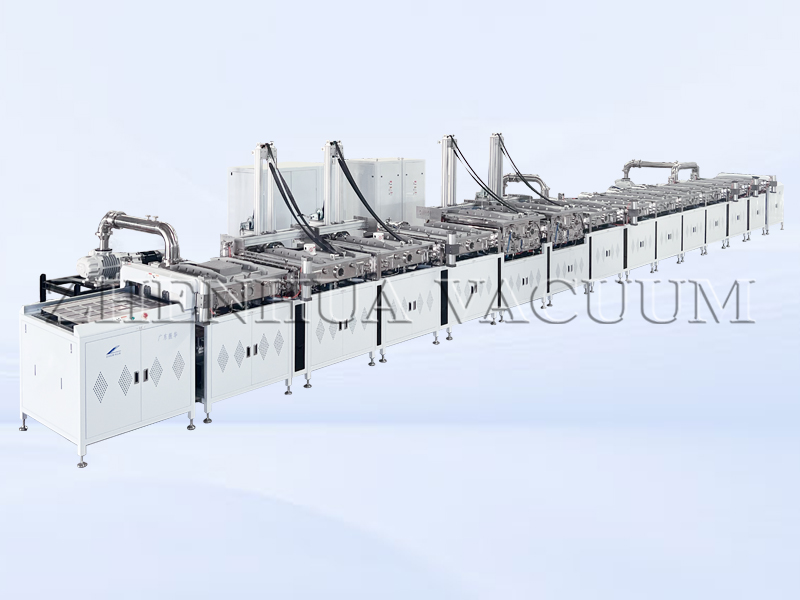
Zhenhua Vacuum’s continuous PVD mass-production solution has been developed around these key indicators. The solution can provide customized process sampling and parameter optimization according to customers’ sample structures, material systems, film requirements, and capacity targets. It helps customers verify film thickness, coverage capability, adhesion, electrical conductivity, and batch stability, providing a stable metallization foundation for subsequent RF performance validation, including S-parameters, insertion loss, and gain.
Conclusion
The upgrading of automotive millimeter-wave radar sensing systems appears on the surface to be a competition of chips, algorithms, and system architecture. At a deeper level, however, it is the coordinated evolution of materials, processes, and high-end manufacturing equipment.
For metallized plastic waveguide antennas, the design advantages of low loss, high gain, and lightweight structure must ultimately be realized through stable, repeatable, and scalable manufacturing capability. PVD metallization equipment is not merely a production tool for surface coating; it is a key factor determining film quality, batch consistency, and mass-production yield.
-This article is published by Zhenhua Vacuum, a manufacturer of PVD metallization equipment for plastic waveguide antennas.
Post time: May-19-2026