
Intensifying competition in the automotive industry is transferring cost pressures from vehicle manufacturing to the parts supply chain. Automotive lighting reflector coating involves multiple processes and corresponding material, labor, and time investments, including primer spraying, aluminizing, topcoat spraying, drying, and transfer. Reducing spraying and intermediate handling while meeting film performance requirements provides a starting point for automotive lighting companies to simplify production processes and optimize manufacturing costs.
Multiple Spraying and Coating Processes Require Quality Assurance for Process Optimization
In traditional coating structures with primer and topcoat, the primer typically provides a smoother surface for metal deposition and helps form good interlayer bonding; the topcoat, located on the outside of the metal film, provides protection. The two paint layers serve different stages, and eliminating spraying requires implementing these functions separately.
Step-by-step production also involves spraying, drying or curing, coating, and workpiece transfer. The increased flow between processes raises requirements for production organization and on-site management, and each stage also needs to control surface cleanliness. For automotive lighting manufacturers producing in batches, process simplification needs to be pursued simultaneously with stable film quality.
Specifically, eliminating undercoating requires a substrate that is compatible with the direct coating process. By selecting suitable materials, controlling injection molding surface quality, and verifying film formation in conjunction with appropriate cleaning and pretreatment conditions, a foundation can be laid for direct coating. Eliminating topcoating requires a corresponding protective film to meet the surface protection requirements of the metal layer.
RTD evaporation and PECVD composite, completing the reflective and protective films in one step
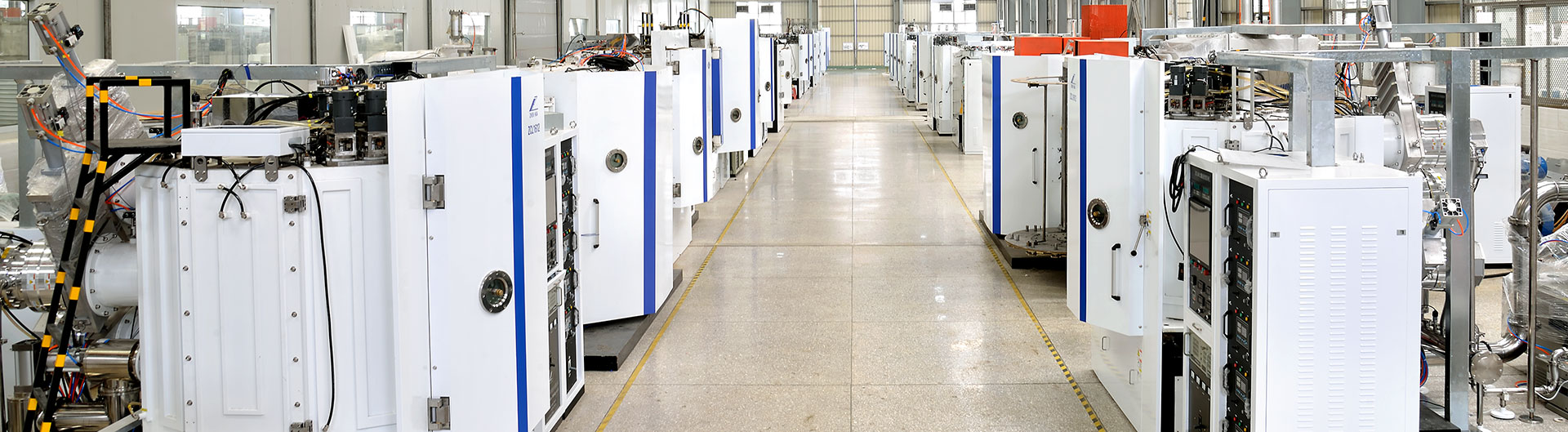
To address the process optimization needs of automotive lighting coating, Zhenhua Vacuum has launched the ZBM1819 automotive lighting protective film equipment, which combines RTD evaporation and PECVD technology to complete the preparation of the metal reflective and protective films within the same vacuum cycle, providing equipment and process support for undercoating-free and topcoating-free automotive lighting coating solutions.
The equipment first forms an aluminum reflective layer through RTD evaporation, and then uses the PECVD process to prepare the protective film, completing the reflective and protective functions in the same process. For substrates and products that have undergone compatibility verification, the corresponding base coat and top coat painting processes can be eliminated, reducing related spraying and subsequent processing steps.
Continuous preparation of the metal film and protective film also reduces intermediate transfer between the two film-forming processes, lowering the risk of surface contamination from reprocessing. By integrating the coating preparation process, automotive lighting manufacturers can reduce workpiece turnover and simplify the production process.
Film performance verification provides a basis for the application of paint-free processes. The application of paint-free processes requires specific performance verification as a foundation. Test results for relevant samples include:
Adhesion: No peeling after direct application of 3M tape; peeling area less than 5% after grid crossing;
Silicone oil performance: Changes in line thickness with water-based markers;
Corrosion resistance: No corrosion after 10 minutes of 1% NaOH titration;
Immersion test: No peeling after 24 hours in 50℃ warm water.
Conclusion: To cope with cost competition, automotive lighting companies need to translate process improvements into production efficiency. The no-base-spray and no-top-spray solution provides a path to optimize the manufacturing process by reducing spraying and related turnover. Zhenhua Vacuum combines composite coating technology with the production needs of automotive lighting, helping companies meet film performance requirements while simultaneously achieving production efficiency and cost control.
Post time: Oct-30-2026