
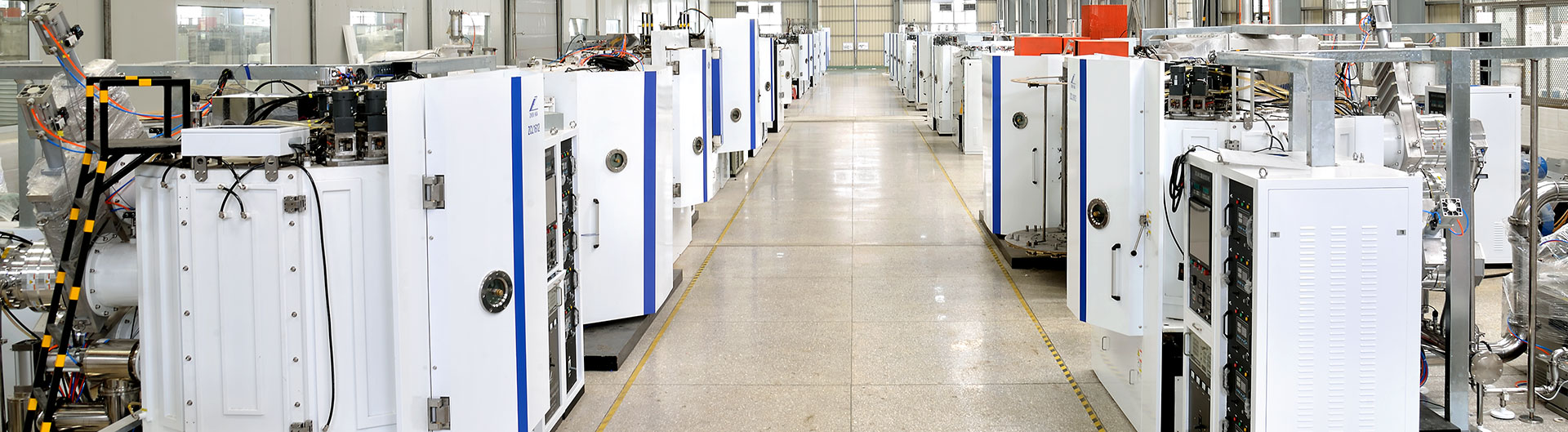
As automotive intelligence continues to deepen, in-vehicle display systems are constantly upgrading to become core interactive components of smart cockpits. In particular, the rapid popularization of HUD and AR-HUD is gradually rewriting the way driving information is obtained and accelerating the innovation of the upstream optical component manufacturing chain.
I. Optical Coating Layers Become “Invisible,” Yet Technical Barriers Are Rising
HUD (Head-Up Display) is highly sensitive to display clarity, color reproduction, and reflection angle metrics, imposing extremely stringent requirements on the optical coating layers on the surface of glass covers. Take an HUD glass panel as an example: its surface typically requires the deposition of a complex film system including metal reflective films (such as aluminum films), multi-layer dielectric films (anti-reflective/reflective), and anti-fingerprint AF films. Improper control of the thickness of any single layer can lead to issues such as ghosting, color distortion, or blurred imaging.
More complexly, these functional film layers often do not exist independently but are in a multi-layer coupled state; on the other hand, it is necessary to ensure the overall film system structure is stable, thickness is controllable, yield is predictable, and process rhythm remains stable and output efficiency is controllable during mass production. In this context, the bottlenecks of coating equipment in terms of film layer uniformity, process repeatability, and production line efficiency are gradually being exposed.
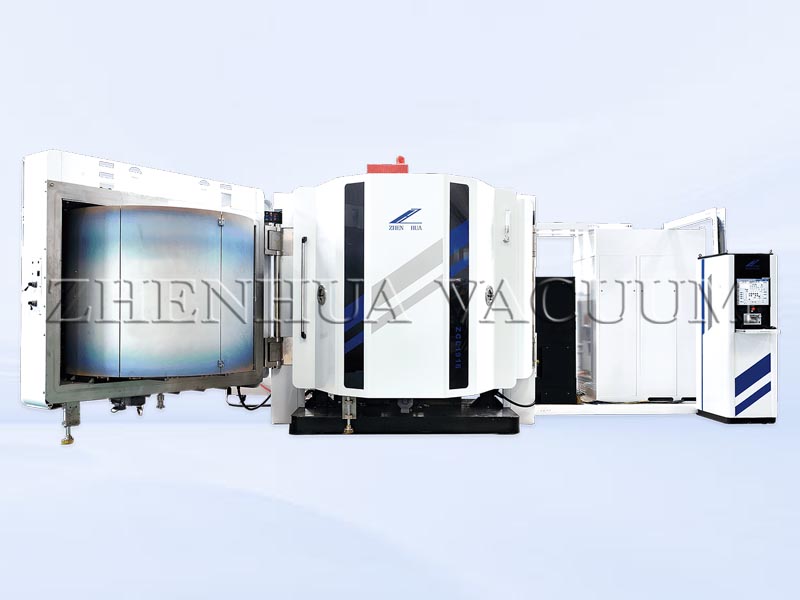
In this context, Zhenhua Vacuum’s GFM1916 magnetron sputtering optical coating equipment offers a more integrated and controllable solution for HUD.
II. Design Focuses on Practicality, Balancing “High Precision + High Efficiency”
1. Double the load capacity of the workpiece rack, significantly increasing production capacity
The GFM1916 adopts a unique cylindrical workpiece rack structure, achieving a single batch loading capacity more than twice that of conventional electron beam evaporation equipment while maintaining excellent uniform deposition performance. It accommodates glass components of various shapes and sizes, significantly increasing output per unit time.
2. High process integration, enabling the deposition of multi-layer film systems in a single batch
By integrating a magnetron sputtering PVD system + auxiliary CVD module + high-energy ion source auxiliary system, the GFM1916 supports the deposition of complex film layer combinations, including aluminum films, dielectric films, and AF films, in a single batch. This not only shortens the process path but also effectively reduces cumulative errors, improving the overall consistency of the film system.
3. Dual assurance from crystal control and closed-loop systems, with strong film thickness controllability
Equipped with a crystal control monitoring system for precise control of film thickness, the process has high stability and good repeatability. Equipped with the SPEEDFLO closed-loop and fully automatic control system, it effectively increases the deposition rate of SiO₂, achieving visible light reflectance of over 90%, meeting the stringent standards for HUD applications.
III. For next-generation in-vehicle displays, display technology determines the upper limit of quality
In-vehicle HUD glass is no longer just a single-function glass but a multi-layer optical component that integrates “information window + sensory experience.” As a core variable in the manufacturing process, the equipment is increasingly becoming the decisive factor in determining display quality and manufacturing yield. The GFM1916 magnetron sputtering system aligns comprehensively with automotive-grade optical glass standards in terms of structural design, process adaptation, and film system control. It not only helps customers optimize existing production lines but also provides a more robust equipment foundation for HUD applications targeting the L2+/L3 era.
At the turning point where smart cockpits transition from “showcasing technology” to “mass production,” equipment performance has never been more critical. The GFM1916 is designed for next-generation HUD optical processes, ensuring precise deposition of every “invisible” layer.
—This article was published by vacuum coating equipment manufacturer Zhenhua Vacuum
Post time: Jul-31-2025