
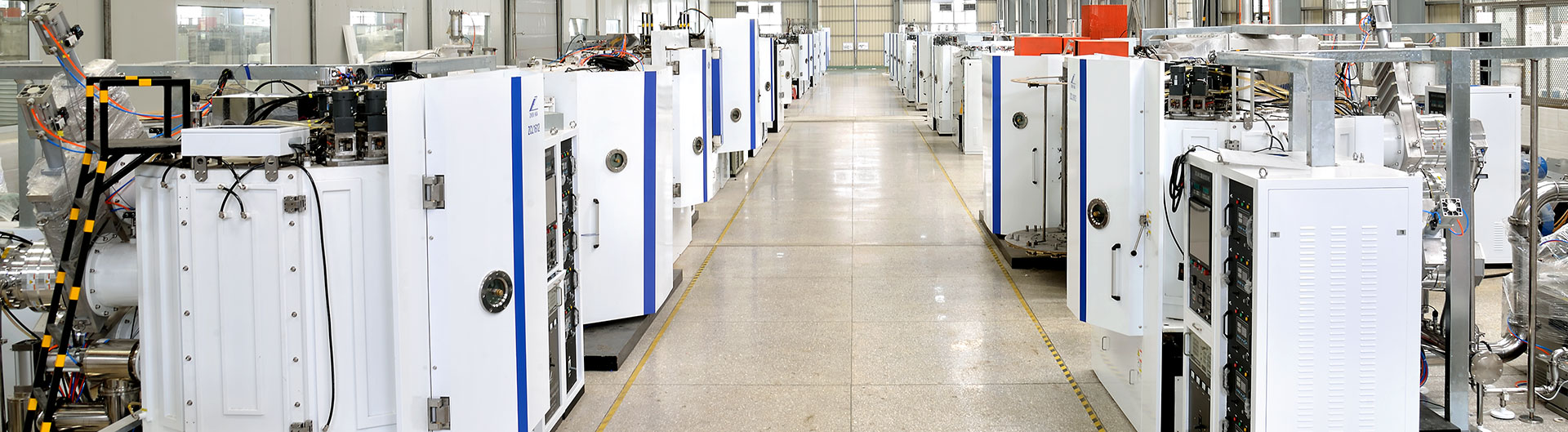
In modern manufacturing, vacuum coating equipment has become an indispensable core asset for industries such as electronics, optics, automotive, semiconductors, and solar energy. With continuous technological advancements, different types of vacuum coating equipment exhibit diverse trends in process principles, application fields, and performance requirements. So, what are the common types of vacuum coating equipment, and which scenarios are they suitable for? This article provides a detailed analysis of the classification and application scope of vacuum coating equipment, along with a brief explanation of their principles, to help you make a more scientific choice in selecting coating systems.
No.1 Basic Principles of Vacuum Coating
Vacuum coating refers to the process of transforming materials into vapor or plasma states through physical or chemical methods in a high-vacuum environment and depositing them onto substrate surfaces to form thin films. Its core advantages include dense film layers, strong adhesion, high purity, and compatibility with various material surface treatments.
Vacuum coating is mainly divided into two categories: Physical Vapor Deposition (PVD) and Chemical Vapor Deposition (CVD), with specific equipment further classified based on process methods.
No.2 Main Classifications of Vacuum Coating Equipment
Thermal Evaporation System
Principle: Uses resistive heating to sublime the evaporation material into a gaseous phase, which then condenses on the substrate surface to form a film.
Application Scope: Decorative coatings, optical films, metallic reflective films, etc., particularly suitable for substrates such as plastics and glass.
Features: Simple structure, low cost, suitable for mass production in applications where high film thickness precision is not critical.
E-beam Evaporation System
Principle: High-energy electron beams bombard the target material, causing localized melting and evaporation, which then deposits onto the substrate surface.
Application Scope: Coating of high-melting-point materials (e.g., Ti, W, SiO₂), widely used in precision optics, multilayer film systems, and functional thin films.
Features: High evaporation efficiency, high material utilization, and excellent film purity.
Magnetron Sputtering System
Principle: Ions in the plasma bombard the target material, causing atoms to be “sputtered” onto the substrate at an atomic level.
Application Scope: Hard coatings (e.g., TiN, CrN), semiconductor films, touch panels, solar thin films, etc.
Features: Uniform film layers, strong adhesion, high controllability, suitable for large-area and complex-shaped workpieces.
CVD System
Principle: Reactive gases undergo chemical reactions at high temperatures, generating deposition products on the substrate surface.
Application Scope: Preparation of functional films for semiconductor devices, silicon carbide (SiC), silicon nitride (Si₃N₄), etc.
Features: Achieves high uniformity, high density, and complex-structured coatings, suitable for high-precision applications.
Plasma-Enhanced CVD (PECVD) System
Principle: Introduces RF plasma to excite reactive gases, forming thin films at lower temperatures.
Application Scope: OLEDs, solar cells, MEMS, optical fiber coatings, etc.
Features: Low-temperature process, excellent step coverage, suitable for thermally sensitive materials.
No.3 How to Select the Right Vacuum Coating Equipment?
When selecting vacuum coating equipment, the following factors should be considered comprehensively:
Substrate Type and Shape: e.g., metal, glass, plastic, or complex geometric structures.
Film Functional Requirements: Whether high hardness, high reflectivity, conductivity, or optical performance is needed.
Production Scale and Budget: Large-scale automated production vs. small-batch precision coating.
Process Compatibility: Whether integration with existing production lines or future scalability is required.
Different types of vacuum coating equipment have distinct emphases in process principles, applicable materials, and target industries. By gaining an in-depth understanding of the technical characteristics and application scopes of each system, companies can enhance production efficiency and market competitiveness while ensuring quality. With the continuous development of high-end manufacturing, vacuum coating equipment will continue to evolve toward higher precision, intelligence, and multifunctionality, becoming a key enabler for industrial upgrading.
—This article was published by vacuum coating equipment manufacturer Zhenhua Vacuum
Post time: Jul-19-2025