
In recent years, artificial intelligence, autonomous driving, and high-performance computing chips have dominated the semiconductor landscape. As chip performance continues to rise, conventional two-dimensional (2D) packaging can no longer meet the increasing demands for interconnect density and thermal management. The industry is rapidly moving toward the three-dimensional (3D) integration era.
To accommodate higher computing density and interconnection within limited space, the role of the packaging substrate has become more critical than ever. Through-Silicon Via (TSV) technology once symbolized 3D packaging, yet its high cost, limited throughput, and material constraints have hindered widespread adoption. Now, a new contender is emerging—Through-Glass Via (TGV) interconnect technology.
The core principle of TGV is to fabricate micron-scale vias through an insulating glass substrate, followed by metal filling to establish vertical conductive paths between chips or substrates. While the concept seems straightforward, the process involves multiple precision steps where every stage directly impacts interconnect reliability. Among these, the seed layer deposition—often overlooked—serves as the hidden foundation that determines the overall success of metallization.
1. TGV Process Flow: The Seed Layer—Conductive “Bridge” of Metallization
A typical TGV process consists of:
Glass substrate preparation → Precision via drilling → Seed layer deposition → Electroplating fill → Surface planarization.
The seed layer is essentially a very thin conductive film deposited along the inner walls of non-conductive glass vias. If the TGV structure is viewed as a vertical “bridge” for electrical interconnection, then the seed layer acts as the first steel cable anchoring that bridge. Without it, subsequent electroplating cannot initiate, and uniform metallization inside the via becomes impossible.
However, the deposition quality of this layer depends heavily on the geometric morphology of the via itself. Different via shapes lead to distinct challenges in achieving uniform seed layer coverage.
2. Via Morphology: The Ultimate Challenge for Uniform Seed Layer Coverage
TGV via profiles vary depending on the drilling and etching process. Common geometries include butterfly-shaped, blind, vertical, and V-shaped vias, each posing unique deposition difficulties:
Butterfly via: The constricted mid-section causes a shadowing effect, preventing metal atoms from reaching the central region. This results in uncoated “dead zones” where electroplating continuity is lost.
Blind via: With a closed bottom, gas flow is restricted and ion energy attenuates, leading to thin and poorly adherent films that may delaminate under subsequent process stress.
Vertical via: Characterized by a high aspect ratio and straight sidewalls, metal atoms travel linearly and often fail to coat the via bottom adequately, producing incomplete conductive paths or plating voids.
V-shaped via: The tapered profile improves deposition angle uniformity to some extent, but excessive taper can cause film thickness non-uniformity and stress concentration, degrading signal integrity.
In all cases, the core challenge is to achieve continuous, uniform, and well-adhered metal coverage on high-aspect-ratio glass surfaces with inherently low surface energy. Any discontinuity or poor adhesion in the seed layer leads to voids, cracks, or delamination during electroplating, resulting in increased interconnect resistance, signal delay, or complete device failure.
Addressing these challenges requires high-precision, high-stability vacuum coating equipment capable of achieving deep-via metallization. This is where ZHENHUA Vacuum’s TGV coating solution comes into play.
3. ZHENHUA Vacuum’s TGV Via Metallization Solution
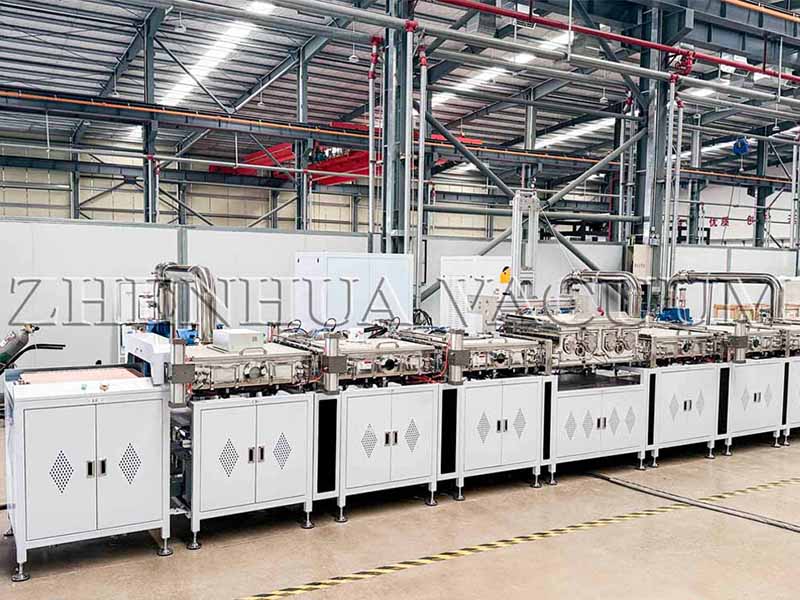
Equipment Advantages:
Deep-Via Coating Optimization
Proprietary deep-hole coating technology enables uniform seed layer deposition even for vias with diameters as small as 30 μm, achieving aspect ratios up to 10:1 and effectively resolving metallization issues in complex 3D via structures.
Customizable for Various Substrate Sizes
Compatible with glass substrates of 600 × 600 mm, 510 × 515 mm, and larger formats to meet diverse production requirements.
Process Flexibility Across Multiple Materials
Supports deposition of Cu, Ti, W, Ni, Pt and other conductive or functional thin films, satisfying different electrical and corrosion-resistance demands.
Stable Performance & Easy Maintenance
Equipped with an intelligent control system for automatic parameter tuning and real-time film thickness monitoring. Modular design ensures simplified maintenance and reduced downtime.
Application Scope:
Suitable for TGV/TSV/TMV advanced packaging, enabling high-quality seed layer coating in vias with aspect ratios up to 10:1.
Conclusion: Mastering the Seed Layer—A Step Toward True 3D Integration
The value of TGV technology lies not only in providing a new vertical interconnection channel but in enabling a genuine three-dimensional interconnect architecture.
At the heart of this transition, seed layer metallization remains the most crucial yet often overlooked process.
Only when this invisible “conductive foundation” achieves uniformity, density, and strong adhesion can the subsequent electroplating and interconnect performance be ensured. Achieving high-quality metal deposition within micron-scale glass vias has thus become a defining benchmark of advanced packaging capability.
Through continuous process innovation and equipment evolution, ZHENHUA Vacuum delivers reliable, high-yield TGV deep-via coating solutions, empowering packaging manufacturers to move confidently from pilot runs to mass production, accelerating the full realization of 3D integration.
In an era driven by ever-increasing compute power and integration density, this is more than an equipment advancement—it represents a decisive step toward the maturity of next-generation 3D packaging technology.
—This article was published by vacuum coating equipment manufacturer Zhenhua Vacuum
Post time: Oct-13-2025