
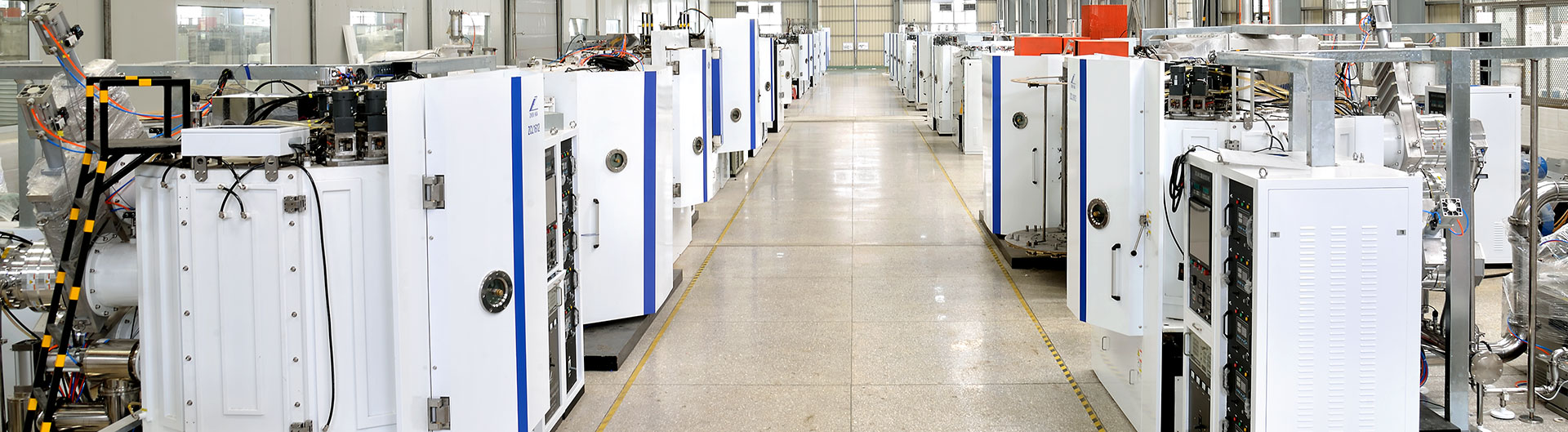
In fields such as optical glass, display panels, and automotive components, the demand for large-area surface treatment is rapidly increasing. Compared with traditional spray coating, Vacuum Coating Technology not only delivers higher film density and uniformity, but also enables diverse functional layers. So, can vacuum coating be applied to large areas? The answer is yes.
I. Challenges of Large-Area Deposition
Scaling up deposition is not just about enlarging the substrate size. The main technical challenges include:
Film Uniformity: The larger the substrate, the more significant the particle distribution differences, leading to thickness variations.
Deposition Rate: Large-area substrates require higher sputtering or evaporation efficiency to maintain productivity.
Stress & Adhesion: As surface area increases, internal stress concentration makes films more prone to cracking or delamination.
Thermal Management: Large substrates are prone to localized overheating, compromising film quality.
II. Principles of Large-Area Vacuum Coating
Today, Magnetron Sputtering is the mainstream process for large-area coating, supported by precise motion and process control to ensure consistency.
Cathode Array Design
Multiple sputtering targets arranged in parallel expand the deposition coverage and improve thickness uniformity.
Substrate Handling & Motion Control
Techniques such as reciprocating motion or rotating fixtures compensate for local deposition variations.
In large-scale glass coating lines, roll-to-roll or flat-plate in-line transport modes are widely used.
High Vacuum & Process Gas Control
Stable vacuum levels and accurate gas flow regulation ensure reproducibility in reactive sputtering for large substrates.
Thermal Control & Cooling Systems
Backplate water cooling and zonal temperature control maintain thermal balance during deposition.
III. Application Scenarios and Industrial Value
Display Panels: Large LCD and OLED cover glass requires ITO transparent conductive films and anti-reflective coatings.
Automotive Industry: HUD windshields, smart mirrors, and center console touch panels rely on large-area sputtering lines.
Photovoltaics: Solar glass with anti-reflection coatings enhances light absorption and conversion efficiency.
Appliance & Architectural Glass: Functional coatings for refrigerator doors and architectural façades depend on large-area deposition.
Conclusion
Vacuum coating is not only capable of large-area deposition, it has already become the mainstream solution in display, automotive, photovoltaic, and architectural glass industries. The core enabling factors are target array design, substrate motion control, and stable vacuum environments. With continuous advancements in magnetron sputtering technology, large-area coatings will become faster, more uniform, and more cost-effective—unlocking broader opportunities for high-end manufacturing.
—This article was published by vacuum coating equipment manufacturer Zhenhua Vacuum
Post time: Sep-13-2025