
As automotive lighting and intelligent vehicle systems continue to evolve, optical components are facing increasingly demanding requirements for reflectance, optical efficiency, environmental durability, and coating uniformity. From headlamp reflectors and lighting modules to ambient-light components, illuminated emblems, and sensing-related optical components, the performance of the reflective coating directly affects the efficiency and visual quality of the overall optical system.
Vacuum coating technology provides an effective solution by depositing high-reflectivity metallic or dielectric-based coating systems onto suitable substrates. Through precise control of the coating material, film thickness, multilayer structure, and deposition parameters, optical components can achieve high reflectance while maintaining the required appearance, adhesion, and environmental resistance.
1. What Is a High-Reflectivity Coating?
A high-reflectivity coating is a functional optical film system designed to maximize the reflection of light within a specified wavelength range. Compared with conventional decorative metallic coatings, its primary objective is not simply to create a bright metallic appearance, but to achieve controlled optical reflectance and efficient light utilization.
For automotive optical components, aluminum is one of the commonly used reflective materials because of its high reflectance across a broad spectral range and its compatibility with vacuum evaporation processes. Depending on the optical design and application requirements, other metallic materials and multilayer dielectric structures may also be considered.
The final optical performance is determined not only by the coating material but also by film thickness, surface roughness, substrate quality, coating structure, wavelength, angle of incidence, and deposition uniformity.
Therefore, a high-reflectivity coating should be regarded as an engineered optical system rather than simply a metallic layer deposited onto a component.
2. Why High-Reflectivity Coatings Are Important in Automotive Optical Systems
In an automotive optical system, light generated by an LED or other light source must be efficiently directed toward the intended optical path. Any unnecessary absorption or scattering within the reflective component can reduce the optical efficiency of the system.
A high-reflectivity coating can reduce optical losses by reflecting a greater proportion of the incident light. For components such as headlamp reflectors, the coating works together with the reflector geometry to redirect light into the designed beam pattern.
This means that the coating performance cannot be evaluated independently from the optical design. Reflectance, surface geometry, substrate quality, and coating uniformity must work together to achieve the required optical output.
For modern automotive lighting, this is particularly important because optical systems are becoming more compact while requiring higher luminous efficiency and more precise light distribution.
3. High-Reflectivity Coatings for Headlamp Reflectors
Headlamp reflectors are one of the most representative applications of high-reflectivity vacuum coatings.
Reflectors are commonly manufactured from engineering plastics such as PC, ABS, or other optical-grade polymer materials, depending on the component design and operating environment. After molding and surface preparation, a reflective coating can be deposited onto the optical surface to provide the required reflectance.
In a typical process, the substrate surface is first cleaned and prepared to obtain a smooth and stable coating interface. A suitable base layer may then be applied where required, followed by vacuum deposition of the reflective metal layer. Depending on the product specification, a protective layer can subsequently be added to improve resistance to humidity, corrosion, chemicals, temperature cycling, and other environmental conditions.
For high-performance optical components, the objective is not simply to achieve high reflectance at one measurement point. The coating must maintain consistent optical performance across the entire reflector surface, including curved areas and geometrically complex regions.
4. The Importance of Surface Quality and Coating Uniformity
High-reflectivity optical coatings are particularly sensitive to substrate surface quality.
Surface defects such as scratches, pits, particles, molding marks, or excessive roughness can affect the optical behavior of the finished component. Even when the nominal reflectance of the metal film is high, surface defects may cause scattering and reduce the effective optical performance.
Coating uniformity is equally important. Differences in film thickness across the component can lead to variations in reflectance, color, and optical efficiency. For large or complex three-dimensional reflectors, the distance and orientation between different areas of the workpiece and the evaporation source are not identical, making uniform deposition more challenging.
Therefore, fixture design, workpiece rotation, source geometry, evaporation rate, vacuum conditions, and process stability all need to be optimized to achieve consistent coating performance.
5. Vacuum Evaporation and Other Deposition Technologies
Vacuum evaporation is widely used for depositing reflective aluminum films on automotive optical components. The process can provide high deposition efficiency and is well suited to large-area reflective surfaces.
In electron-beam evaporation, the coating material is heated and vaporized under high vacuum, and the resulting vapor flux condenses onto the substrate surface. By controlling the evaporation rate and deposition conditions, the required film thickness and optical performance can be achieved.
For applications requiring more complex optical functions, magnetron sputtering can provide greater flexibility in material selection and multilayer film design. Sputtering can be used to deposit metallic, alloy, or dielectric layers with precise control over the coating structure.
The appropriate technology therefore depends on the component geometry, substrate material, optical specification, durability requirements, and production capacity.
6. Protective Coatings Are Essential for Long-Term Performance
A high-reflectivity metal film alone may not provide sufficient environmental durability for automotive applications.
The reflective surface can be exposed to moisture, condensation, temperature fluctuations, chemical contamination, and other environmental factors. For this reason, a protective coating or multilayer protective system may be required to isolate the reflective layer from the external environment.
For automotive optical components, the complete coating architecture may therefore consist of a substrate, surface preparation or base layer, reflective metal layer, and protective layer.
Plasma-enhanced deposition technologies such as PECVD can be integrated into the coating process to deposit protective films with controlled thickness and properties. Depending on the product specification, the protective layer may be designed to improve resistance to humidity, chemicals, abrasion, corrosion, and environmental aging.
The final coating system should be validated through appropriate reliability testing rather than evaluating the initial reflectance alone.
7. High-Reflectivity Coatings for Other Automotive Optical Components
The application range of high-reflectivity coatings extends beyond conventional headlamp reflectors.
They can also be used in LED lighting modules, interior ambient-light components, illuminated emblems, radar-related decorative components, optical housings, and other automotive optical or decorative parts.
For illuminated emblems, for example, the coating may need to provide a controlled balance between reflection and transmission. In the unlit state, the surface should maintain a metallic appearance, while in the illuminated state, sufficient light must pass through the coating to produce the required lighting effect.
This type of application requires a different optical design from a conventional high-reflectivity reflector. Film thickness, material selection, optical transmittance, reflectance, and the internal light-guide structure must be considered together.
8. Equipment Requirements for High-Reflectivity Automotive Optical Coatings
As automotive optical components become more complex, coating equipment must provide sufficient process flexibility and stability.
A suitable vacuum coating system should provide a stable high-vacuum environment, controlled deposition rate, appropriate substrate handling, uniform workpiece rotation, and precise process monitoring. For complex optical components, the equipment must also accommodate the required fixture configuration and source-to-substrate geometry.
For applications involving multiple coating functions, a multifunctional system integrating electron-beam evaporation, resistance evaporation, magnetron sputtering, and plasma-assisted coating technologies can provide greater flexibility.
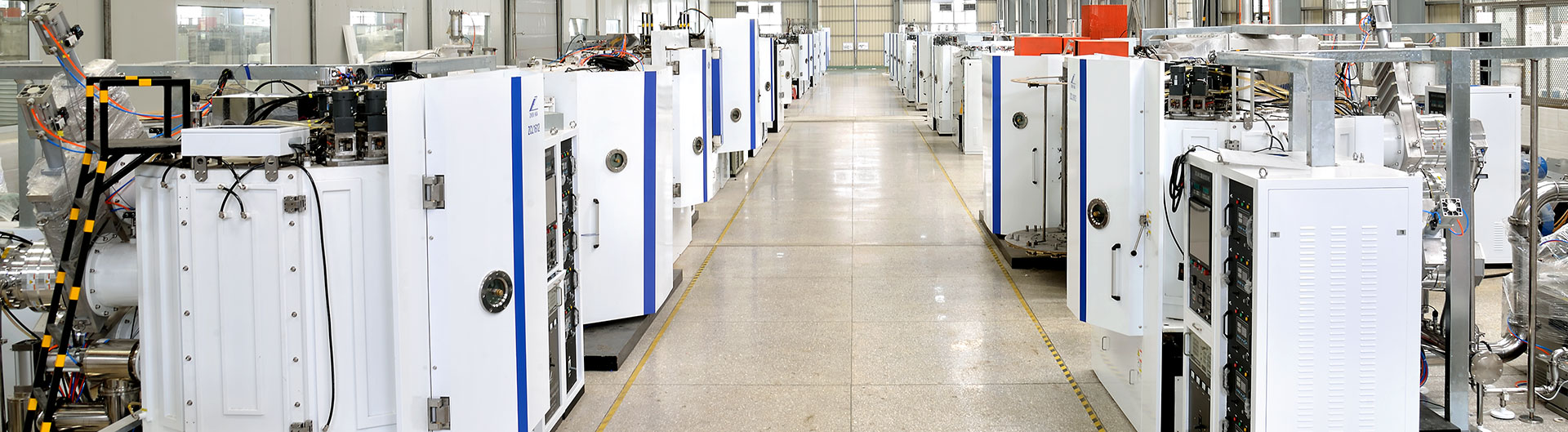
For example, the Zhenhua ZCL1417 automotive coating system integrates magnetron sputtering, CVD, and resistance evaporation, allowing different coating processes to be configured according to the requirements of automotive optical and decorative components. The system can be used for applications including headlamp reflectors, ambient-light components, illuminated emblems, radar emblems, and interior trim.
For products requiring both metallic and protective layers, completing multiple coating processes within the same vacuum cycle can help reduce secondary contamination and improve overall process consistency.
High-reflectivity coatings are an important functional component of modern automotive optical systems. Their role is not limited to creating a bright metallic appearance; they directly influence optical efficiency, light distribution, appearance, durability, and overall system performance.
Achieving a high-performance reflective coating requires coordinated control of the substrate surface, coating material, film thickness, deposition technology, coating uniformity, and protective structure. For complex automotive optical components, equipment configuration and fixture design are equally important to ensure stable and repeatable deposition.
As automotive lighting and optical systems continue to move toward higher efficiency, compact structures, and more precise optical control, vacuum coating technology will continue to play an important role in developing high-reflectivity and multifunctional optical coating systems for next-generation automotive components.
-This article was published by vacuum coating equipment manufacturer Zhenhua Vacuum
Post time: Sep-12-2026