
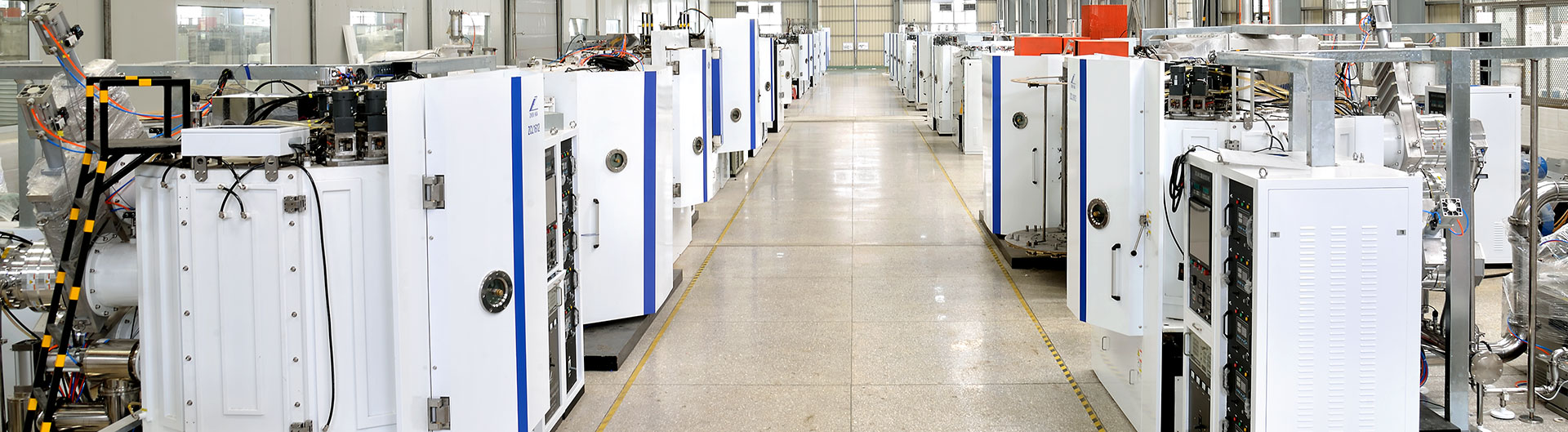
As electronic components evolve toward miniaturization and high-frequency performance, varistors remain a vital component for overvoltage protection. Whether in smart devices, automotive electronics, or industrial control and power systems, varistors serve as frontline defenders against voltage surges. To ensure they respond faster, endure longer, and operate reliably, performance depends not only on the ceramic core but also—critically—on the quality of surface treatment. In particular, vacuum coating has become a key enabler of high-reliability varistor manufacturing.
1. What Does a Varistor Actually Do?
In simple terms, a varistor is a voltage-dependent resistor. Its resistance drops sharply once the applied voltage exceeds a certain threshold, thereby diverting and dissipating surge energy to protect downstream circuits. This self-adaptive behavior makes varistors ideal for surge protection, lightning protection, and transient voltage suppression.
Thanks to their fast response time, compact size, and low cost, varistors are widely used in telecommunication devices, consumer electronics, automotive ECUs, and renewable energy systems.
2. Why Is Surface Treatment So Important?
While the core performance of a varistor originates from zinc oxide-based ceramic materials, long-term reliability often hinges on the quality of its electrode layer. In real-world applications, varistors face repeated voltage surges and harsh electrical environments. The electrode film must not only exhibit excellent conductivity but also offer strong adhesion, thermal stability, corrosion resistance, and optimal compatibility with the ceramic substrate.
In other words, even the best ceramic material can underperform if the surface metallization layer fails. As such, electrode deposition and surface treatment have become critical in next-generation varistor manufacturing.
3. Traditional Electrode Technologies and Their Limitations
Currently, varistor electrode fabrication primarily relies on silver paste sintering, electroplating, and screen printing. However, these conventional methods face growing challenges:
Inconsistent adhesion: On inert ceramic substrates, peeling, delamination, or cracking may occur.
Poor film uniformity: Impacts electrical consistency and limits overall yield.
Environmental concerns: Electroplating involves heavy metals and chemical waste, complicating compliance with environmental standards.
Limited scalability: Difficult to meet the demands of miniaturized components and fine-line geometries.
These limitations are driving the industry toward precision, clean, and scalable electrode technologies.
4. Vacuum Coating: A New Approach for Varistor Manufacturing
To address these pain points, magnetron sputtering—a type of vacuum coating technology—has emerged as a preferred method for electrode deposition on varistors.
Under high vacuum, high-energy ions bombard a metal target, causing atoms to be ejected and deposited onto the substrate. This process yields a dense, uniform, and highly adherent film layer with several key advantages:
Strong adhesion and compact structure, ensuring durability under repeated surge conditions.
Excellent film thickness uniformity and process repeatability, ideal for high-volume, high-consistency production.
Dry and clean process, with no chemical effluents, compliant with RoHS and REACH directives.
Compatibility with complex shapes, suitable for chip-type and irregular electronic components.
Today, vacuum coating has been widely adopted in the production of high-end varistors, MLCCs, thin-film resistors, and other precision electronic components.
ZhenHua Vacuum Ceramic Capacitors Magnetron Sputtering System In-Line
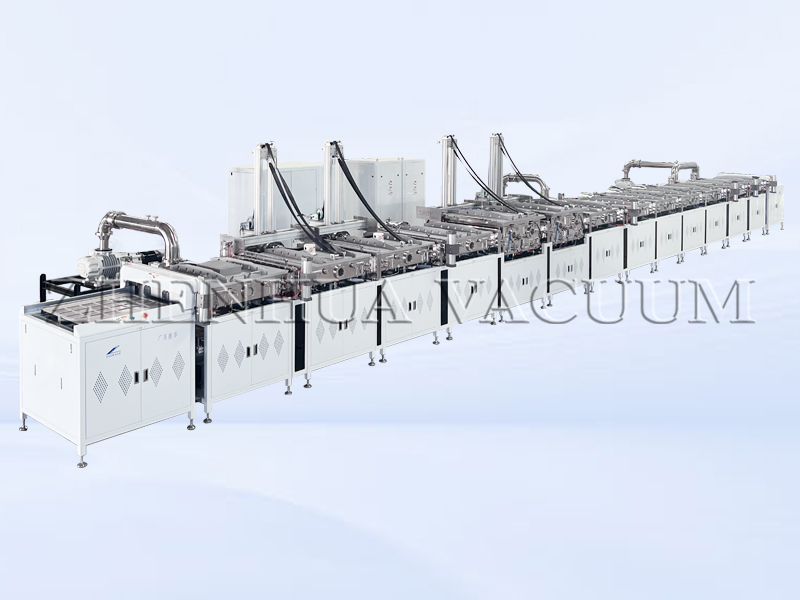
Equipment Advantages:
-Fully automated control via industrial PC, including recipe management, real-time monitoring, and remote diagnostics.
-Integrated handling system for automated workpiece transport and continuous operation.
-Optimized target structure with high material utilization and excellent sputtering uniformity.
-Advanced ionization and surface activation system to enhance film adhesion and coating uniformity.
Applications: Chip capacitors, thin-film resistors, and other surface-mounted electronic components.
Conclusion: Surface Treatment Defines Future Reliability
For varistors, reliability starts at the surface. As standards rise and miniaturization intensifies, selecting a high-performance, environmentally friendly surface treatment is becoming a strategic imperative for electronic component manufacturers.
Vacuum coating is more than just a technical upgrade—it’s a shift in manufacturing philosophy.
ZhenHua Vacuum will continue to innovate vacuum coating equipment and process solutions tailored to the electronics industry, helping customers gain competitive advantages in both performance and cost.
—This article was published by vacuum coating equipment manufacturer Zhenhua Vacuum
Post time: Jun-30-2025